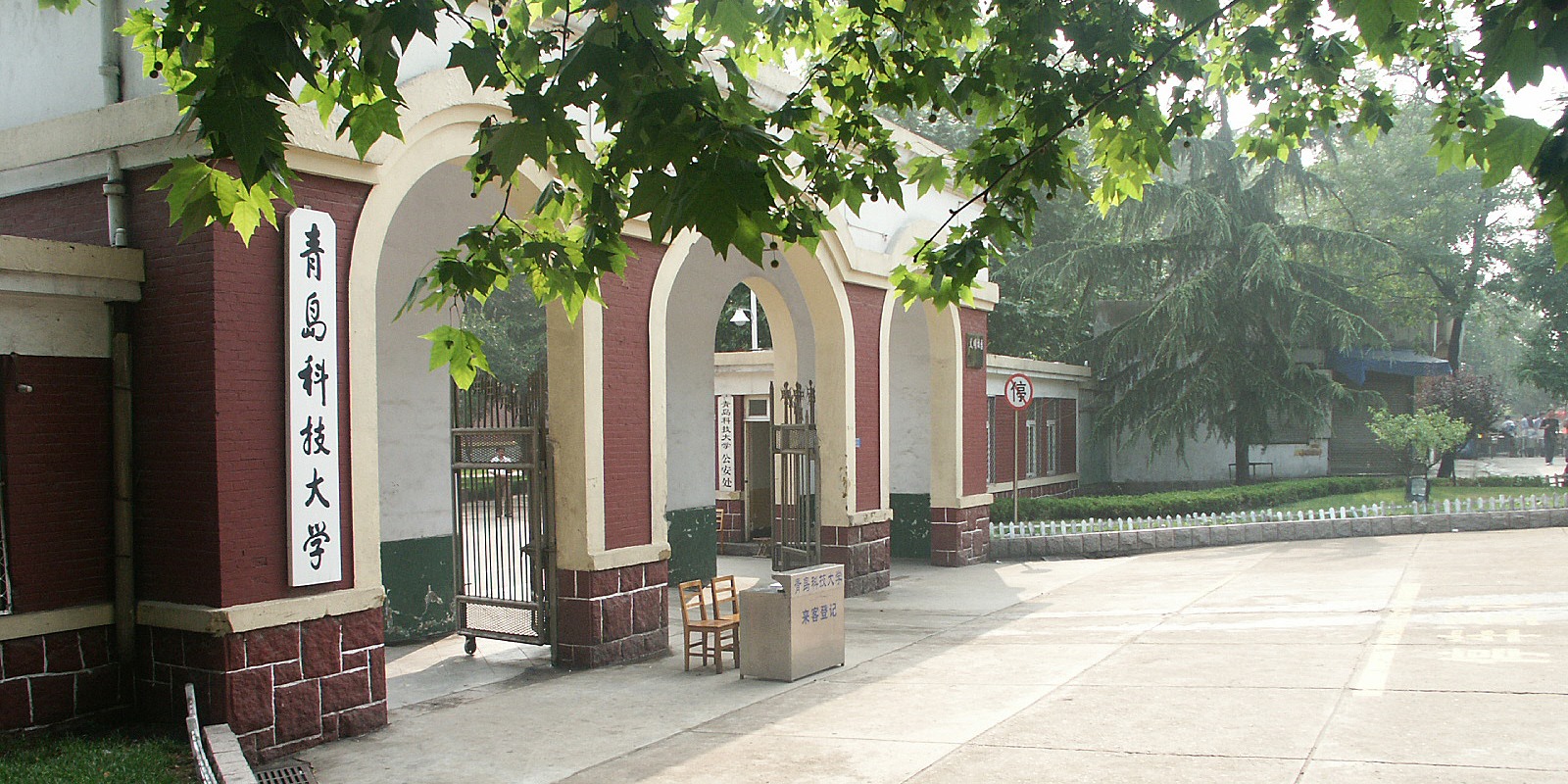
The university that helped put China’s rover on Mars grew out of a rubber school. Qingdao University of Science and Technology (QUST) contributed key autonomous-navigation technology to the Tianwen-1 mission that landed on Mars in 2021, and three years earlier its own satellite, Qingkeda No. 1, had been launched into orbit as the first satellite named after a Shandong university.
Its lineage is written in rubber. Founded in 1950 in Shenyang as a light-industry vocational school, it moved to Qingdao in 1956 and became the Qingdao Rubber Industry School, was upgraded to the Shandong Institute of Chemical Technology in 1958, renamed the Qingdao Chemical Technology College in 1984, and became Qingdao University of Science and Technology in 2002. Each name change tracked the industry it served.
The academic profile now runs far beyond tires. Seven disciplines sit in the ESI global top 1 percent, with chemistry and engineering in the top 1 per mille, and the university ranks in the world’s top 100, 42nd among Chinese universities. Eight doctoral programs and five post-doctoral stations sit under 84 undergraduate majors, and chemical engineering and technology holds 18th place nationally in ShanghaiRanking.
Teaching and talent follow the same curve. More than 31,000 undergraduates and 7,200 graduate students are taught by a faculty of 3,000-plus that includes two resident academicians and six foreign academicians; 24 of the 84 programs are national first-class, 17 have passed engineering education accreditation, and the province’s first AI training platform for industry-education integration was launched here.
Research is where QUST outgrows the label of an industrial school. Fourteen national science and technology awards, a national key laboratory for high-performance optical polymers and a national engineering research center for tire equipment anchor the lab floor, and its technology has helped create nine listed companies. The university’s technology-transfer contracts rank 23rd among Chinese universities and its patent sales 37th, the record behind the “Qingkeda model” of industry-university cooperation that state media have covered at length.
International doors opened early and wide. QUST has agreements with 150 universities in 25 countries, runs two Sino-foreign institutions and six joint programs, and its Sino-German College of Technology, built with Germany’s University of Paderborn, is part of a Sino-German government cooperation program. Its Thai-Sino Rubber Institute is the first offshore undergraduate engineering institution run by a Shandong university.
The university’s orbit keeps widening: a satellite of its own, navigation for a Mars landing, nine listed companies, and a rubber industry still staffed by its graduates. In 1950 it taught rubber processing; in 2026 it helps navigate Mars, and the distance between those two jobs is the measure of what QUST has become.
Data Source: QUST Official Website (as of 2026)