The most traveled name from Jiujiang University may be its Confucius Institute in Cambodia: a partnership with the Royal Academy of Cambodia that has trained some 130,000 students, earned a model Confucius Institute rating and been named an advanced institute three times. For a university merged in 2002, the reach is striking, and it says something about how far this school in northern Jiangxi has come.
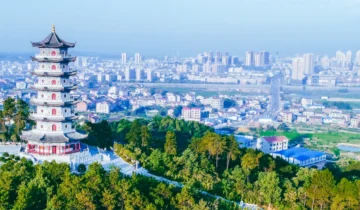
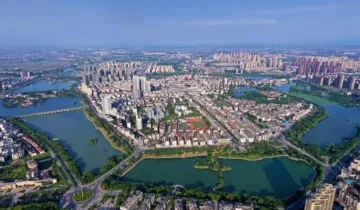
Formed in 2002 from four colleges, a finance school, a normal college, a medical college and an education institute, the university’s history reaches back to a nursing school founded in 1901, making medicine the oldest thread in its makeup. It won master’s degree rights in 2024. The setting is rare among Chinese universities: Jiujiang sits where the Lushan mountains meet the Yangtze River and Poyang Lake, the largest freshwater lake in China, and the thousand-year White Deer Grotto Academy lies nearby.
More than 33,000 undergraduates study across 69 programs in nine fields, with four national first-class programs in accounting, microelectronics, medical laboratory technology and tourism management, and two national characteristic programs in international trade and biological science. Three master’s programs, in bio-medicine, resources and environment, and international business, are just starting, with 137 postgraduates enrolled. The faculty of 1,891 is unusually well qualified, 91 percent holding doctorates or master’s degrees.
Research follows the setting: the school hosts a national key laboratory center in Jiujiang, four provincial key laboratories, and a network of national and provincial science stations serving local agriculture, alongside a humanities tradition built on the region’s greats, from the poet Tao Yuanming to the historian Chen Yinke, and the province’s first intangible heritage research base. Its dance drama about the lake, Da Hu Zhi Ling, was selected for the China Federation of Literary and Art Circles’ key creation list, and a dance work made the finals of the national Lotus Award, a first for Jiangxi.
Abroad, ties reach universities in more than 30 countries, with four approved Sino-foreign programs including two with Russian partners, and 384 international students study clinical medicine and Chinese language on campus. The Cambodia Confucius Institute remains the flagship, part of a Chinese language teaching mission that has made the university a base for overseas Chinese education under the state overseas Chinese affairs office.
Where the Lushan mountains meet the Yangtze and Poyang Lake, Jiujiang University has turned a nurses’ school of 1901 into a university with a model Confucius Institute in Cambodia, and it is still growing: the school has set its next goal, upgrading its name from a college to a full university.
Data Source: JJU Official Website (as of 2026)