Seventy-eight years separate the two facts that define Huizhou University: it opened in 1946 as a provincial normal school, and in 2024 it became a master’s degree-granting university. Between those dates lies the quiet climb of a school that grew with its region, from a teacher-training college for the Dongjiang River basin to an applied university whose engineering discipline now ranks in the ESI global top 1 percent.
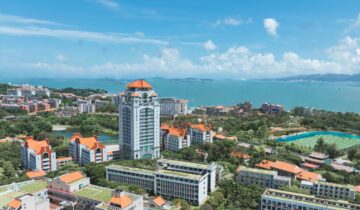
The university sits in Huizhou, a manufacturing city on the eastern edge of the Pearl River Delta, roughly an hour from Guangzhou by rail. Its 2,422-mu campus, about 160 hectares, hosts about 21,000 full-time students taught by nearly 1,000 full-time faculty, more than half of them with doctorates, one of the highest doctoral ratios among Guangdong’s applied universities.
The academic profile pairs engineering strength with a teaching tradition. Fifty-seven undergraduate programs run across twenty colleges, with eighteen national and provincial first-class programs, six majors certified through teacher-education accreditation and four through engineering-education accreditation. Five national teaching achievement awards and a stream of provincial prizes mark the classroom side, and the engineering discipline’s ESI top-1-percent ranking in recent years gave the school a research credential to match.
Industry links follow the city’s electronics economy. Four provincial industry colleges train students with local firms, 150-plus enterprise partnerships and 800-plus contracted projects tie the campus to the region, and a science-commissioner program sends faculty teams to work inside companies and farms. The university has helped solve over a thousand technical problems for regional businesses in five years.
Research anchors include more than fifty municipal-and-above platforms, two academician workstations and a growing portfolio of patents, with about 540 granted in five years and over 200 transferred to industry. Students win national and international competition prizes at a rate that placed the university among the top forty new undergraduate universities in China.
The climb from 1946 to 2024 was steady rather than sudden: a normal school that supplied teachers to the Dongjiang basin now sends engineers to its factories too, and the numbers have kept climbing, twenty-one thousand students today and a master’s degree in 2024. The habit of teaching well carried into every new field.
Data Source: HZU Official Website