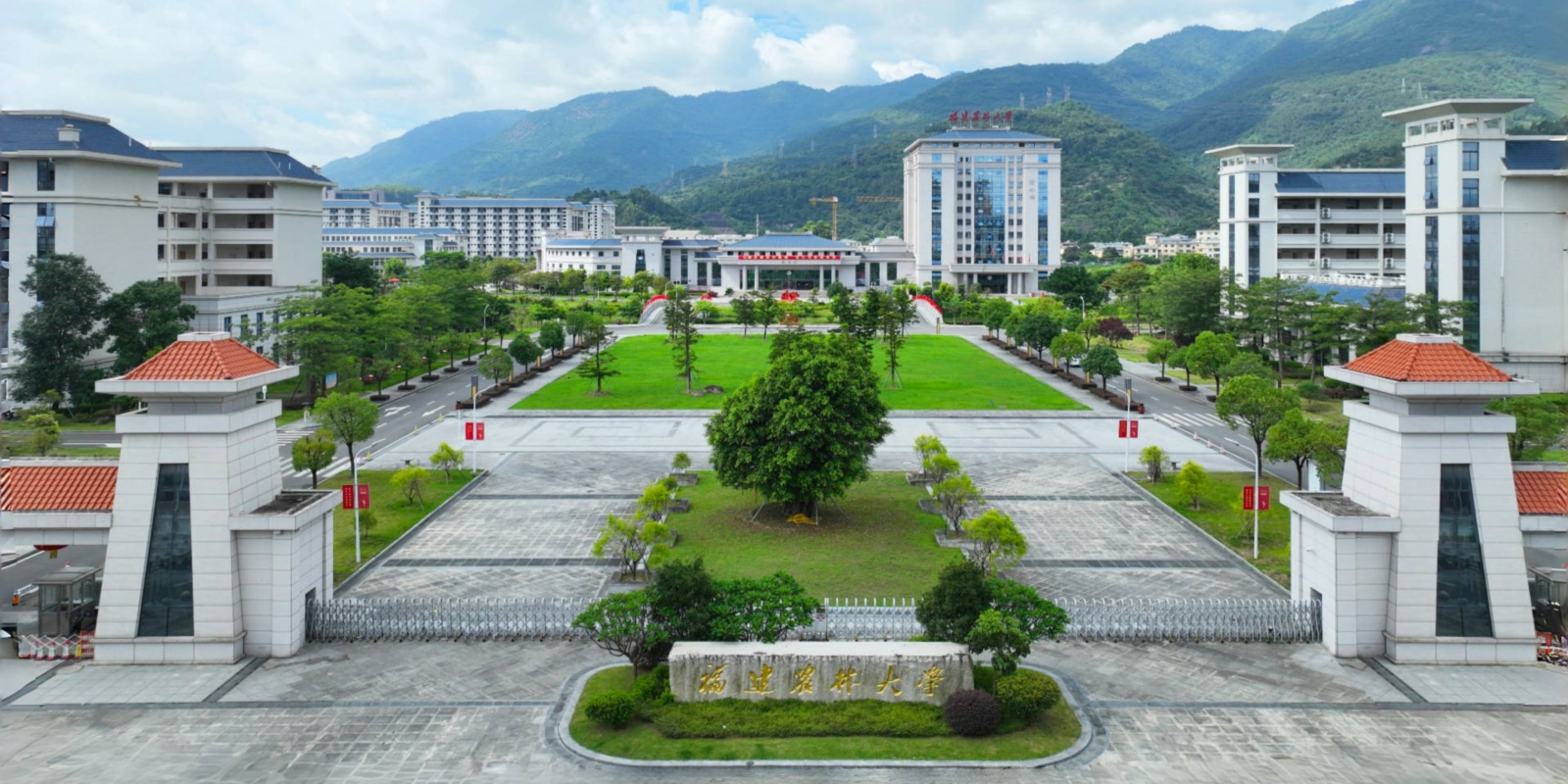
Fujian Agriculture and Forestry University holds an unusual asset: a teaching forest of some 3,600 hectares beside its 400-hectare campus in Fuzhou. That land is part of the curriculum at a school that has trained Fujian’s agricultural workforce for nine decades.
Its history runs through two lineages: the agriculture program of Fukien Christian University, founded in 1936, and the Provincial College of Agriculture, founded in 1940 as one of the first independent agricultural colleges in southern China. Both merged into Fujian Agricultural College in 1952, and in 1958 the forestry section split off as Fujian Forestry College. In 1994 the agricultural college was renamed Fujian Agricultural University, and in 2000 the two merged again to form the present institution.
Today 24 colleges enroll about 39,000 students across four campuses in Fuzhou, Quanzhou and Nanping, with 28,000-plus undergraduates and 11,000-plus postgraduates. It grants doctorates in 12 first-level disciplines and 4 professional categories, and master’s degrees in 28 first-level and 22 professional categories. Eleven disciplines sit in the ESI global top 1 percent, with plant and animal science and agricultural science in the top 0.1 percent, the best standing among non-“Double First-Class” agricultural universities nationwide.
Its faculty includes three academicians of the Chinese Academy of Sciences, one member of the Canadian Academy of Engineering, and 103 national-level experts among 744 high-level talents at provincial level or above. Eight national innovation platforms and 48 ministry-level ones support the research, including two national key laboratories for agricultural biosecurity and marine-aquaculture breeding. The university has won 35 national science and technology awards, published 23 papers in Science, Nature and Cell as first or corresponding author, and decoded the genomes of crops including sugarcane, pineapple, orchid and papaya.
The university is the birthplace of juncao technology, a grass-based method for growing edible mushrooms that has spread to more than 100 countries, with training bases in 23 of them and 23,000-plus technicians trained. Its Confucius Institute built with Durban University of Technology in South Africa has taught over 10,000 students and was named a global model Confucius Institute. The university cooperates with 100-plus institutions in 30-plus countries and regions, hosts 160-plus international students from 40 countries, and runs a Sino-foreign joint college and five Sino-foreign programs. It was among the first mainland universities to recruit students from Taiwan, runs eight 4+0 Fujian-Taiwan programs with leading universities there, and teaches Taiwanese students from bachelor’s to doctoral level; with Taiwan experts it has co-drafted two national standards for Taiwan-style oolong tea.
More than 300,000 graduates have gone into agriculture and forestry since 1936, and the teaching forest still marks what this school is about: the crop, the soil and the trees themselves.
Data Source: FAFU Official Website (as of 2026)