North China University of Science and Technology is two universities in one, and both halves grew from the same source: a coal mine. The engineering line traces back to a mining department founded in 1895 as a response to the rise of the Kailuan coalfields, whose staff and program moved to Tangshan in 1959. The medical line began in 1926 as a nurses school run by the Kailuan mining administration. Coal built Tangshan, and Tangshan built this university.
The two bloodlines ran parallel for decades: a mining and metallurgy institute founded in 1958, and a coal medical college formed in 1963, each passing through several names. In 2010 they merged into Hebei United University, renamed North China University of Science and Technology in 2015. A century of mining, medicine and manufacturing thus came together under one roof.
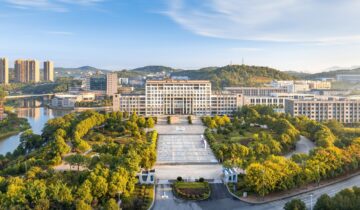
Today 102 undergraduate programs sit beside three doctoral programs, 28 first-level master’s programs and 21 professional master’s categories, with metallurgical engineering and public health and preventive medicine the province’s focus disciplines. Five fields, from clinical medicine to materials science, rank in the ESI global top 1 percent. More than 45,000 full-time students study on a smart campus of 4,500 mu, about 300 hectares, opened in 2016.
Research is anchored by Yanzhao Steel Laboratory, the first provincial laboratory in Hebei, alongside 31 provincial and ministerial platforms. The past decade brought a national technological invention second prize, a national science and technology progress second prize and 240 provincial and ministerial awards, while the genomics team has published 50-plus papers in Nature, Science and other top journals. One academician of the Chinese Academy of Engineering leads a faculty of 3,260-plus.
Its double character still shows in its graduates: it is a cradle of general managers and chief engineers for metallurgy, mining and heavy chemicals, and a cradle of senior medical talent and occupational-disease specialists, with six affiliated hospitals serving the region. Internationally, its signature is the first Chinese-medicine Confucius Institute in Central and Eastern Europe, built with the University of Pécs in Hungary, and it runs joint programs with universities in Germany and Russia among 70-plus partners in 15 countries.
A school that began with a coal seam and a nurses school now turns out the engineers and physicians who keep heavy industry and public health moving. The mine is long gone from the campus map, but its double legacy is not.
Data Source: NCUST Official Website (as of 2025)