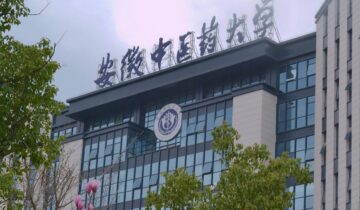
Xinyu University’s signature subject is the one its city is built around: new energy. Its new energy science and engineering program ranks first among all universities in Jiangxi, the school runs a national lithium materials research center, and its research partners include the lithium company Ganfeng and the steel giant Xinyu Steel, both among the leading enterprises of the region. In a city that reinvented itself around batteries, the university has reinvented its curriculum around the same promise.
The school began in 1985 as a vocational college, became a junior college in 1992, and was elevated to undergraduate status as Xinyu University in 2010, passing the education ministry’s teaching evaluation in 2017 and again in 2025. Its campus covers 2,000 mu, about 134 hectares, and its 17,000 full-time students include 160 international students.
Thirty-nine undergraduate programs, more than half of them in science, engineering and medicine, are organized across 12 colleges, with four provincial first-class programs and a provincial top-four-star rating for its flagship new energy program. The faculty of 900, 88.5 percent of them with doctorates or master’s degrees, sends graduates into the province’s power companies at a rate that keeps the school among the top in Jiangxi for State Grid hiring.
Research tracks the battery chain: the national lithium materials center is joined by a provincial key laboratory for power storage batteries and materials, a provincial silicon materials laboratory and a national power battery innovation joint laboratory, a partnership that ended a long drought of national research bodies in Xinyu. Faculty have won a provincial science and technology grand prize, filed 167 invention patents and published 263 high-level papers in recent years.
Application is the point: a team of doctoral service engineers has helped generate 2.3 billion yuan in revenue for local companies, and partnerships with Xinyu Steel, Ganfeng Lithium and dozens of other enterprises keep the curriculum wired to real production lines. Graduates’ employment rate has stayed above the provincial average, and four of the school’s 12 colleges report that more than 40 percent of their graduates go on to graduate school.
Long past its origins as a vocational college, Xinyu University now feeds the battery supply chain, from lithium research to State Grid recruitment lists, and it has set its next goal, a master’s degree program of its own, to match the industry it serves.
Data Source: XYC Official Website (as of 2026)