The Beijing Central Axis, stretching 7.8 kilometers through the heart of China’s capital, represents one of the most remarkable achievements in human urban planning. Inscribed on the UNESCO World Heritage List in July 2024 during the 46th UNESCO session in New Delhi, this monumental north-south axis from Yongdingmen in the south to the Bell and Drum Towers in the north embodies the ideal of capital city planning that guided Chinese dynasties for over seven centuries.
🏛️ The Grand Axis: 7.8 Kilometers of Imperial Design
Running like a majestic spine through the ancient capital, the Beijing Central Axis was first established during the Yuan Dynasty (1271–1368) and reached its fully developed form during the Ming (1368–1644) and Qing (1644–1912) dynasties. Its precise alignment and careful orchestration of architectural elements create a powerful sense of order, hierarchy, and harmony — principles central to traditional Chinese cosmology and statecraft.
The axis is defined by 15 component sites that together form an integrated urban ensemble of extraordinary cultural significance. From south to north, these include: Yongdingmen (the southern gate), the Temple of Heaven, the Temple of Agriculture, Zhengyangmen (the Front Gate), the Outer Golden Water Bridges, Tiananmen Gate, Tiananmen Square, Duanmen (the Upright Gate), the Forbidden City, Jingshan Park (Coal Hill), Wanning Bridge, and the Bell and Drum Towers.
📜 A 700-Year Tradition of Urban Planning
What makes the Beijing Central Axis truly exceptional is its continuous development and use over more than 700 years. The planning principles embodied in this axis — symmetry, axiality, and the hierarchical ordering of space — were derived from the Kaogong Ji (The Artificers’ Record), an ancient Chinese text on urban planning dating from the Zhou Dynasty (c. 5th century BCE). The axis represents the most complete and best-preserved example of this planning tradition anywhere in the world.
The layout reflects the cosmological principles of traditional Chinese philosophy, where the emperor, as the “Son of Heaven,” resided at the center of the universe. The Forbidden City, occupying the heart of the axis, was positioned precisely on the meridian line, with all major buildings facing south — the direction of imperial authority and cosmic harmony. The urban form thus embodied the philosophical ideal of a well-ordered state under heaven.
🌍 UNESCO Recognition: Outstanding Universal Value
At the 46th session of the World Heritage Committee held in New Delhi, India, in July 2024, the Beijing Central Axis was inscribed as a UNESCO World Heritage site under criteria (iii) and (iv). The committee recognized its Outstanding Universal Value as a supreme example of Chinese capital city planning, demonstrating the continuity of Chinese civilization and the interaction between human creativity and the natural environment.
The successful inscription was the culmination of 12 years of preparation, following its addition to China’s tentative World Heritage list in 2012. The nomination process involved extensive conservation work, urban management improvements, and community engagement across the entire axis corridor.
🗺️ The 15 Component Sites in Detail
The 15 inscribed component sites together tell the story of Beijing’s evolution from imperial capital to modern metropolis:
-
Bell and Drum Towers: The northern terminus of the axis, used for timekeeping from the Yuan Dynasty onward
-
Wanning Bridge: A Yuan Dynasty stone bridge that is the oldest surviving bridge on the axis
-
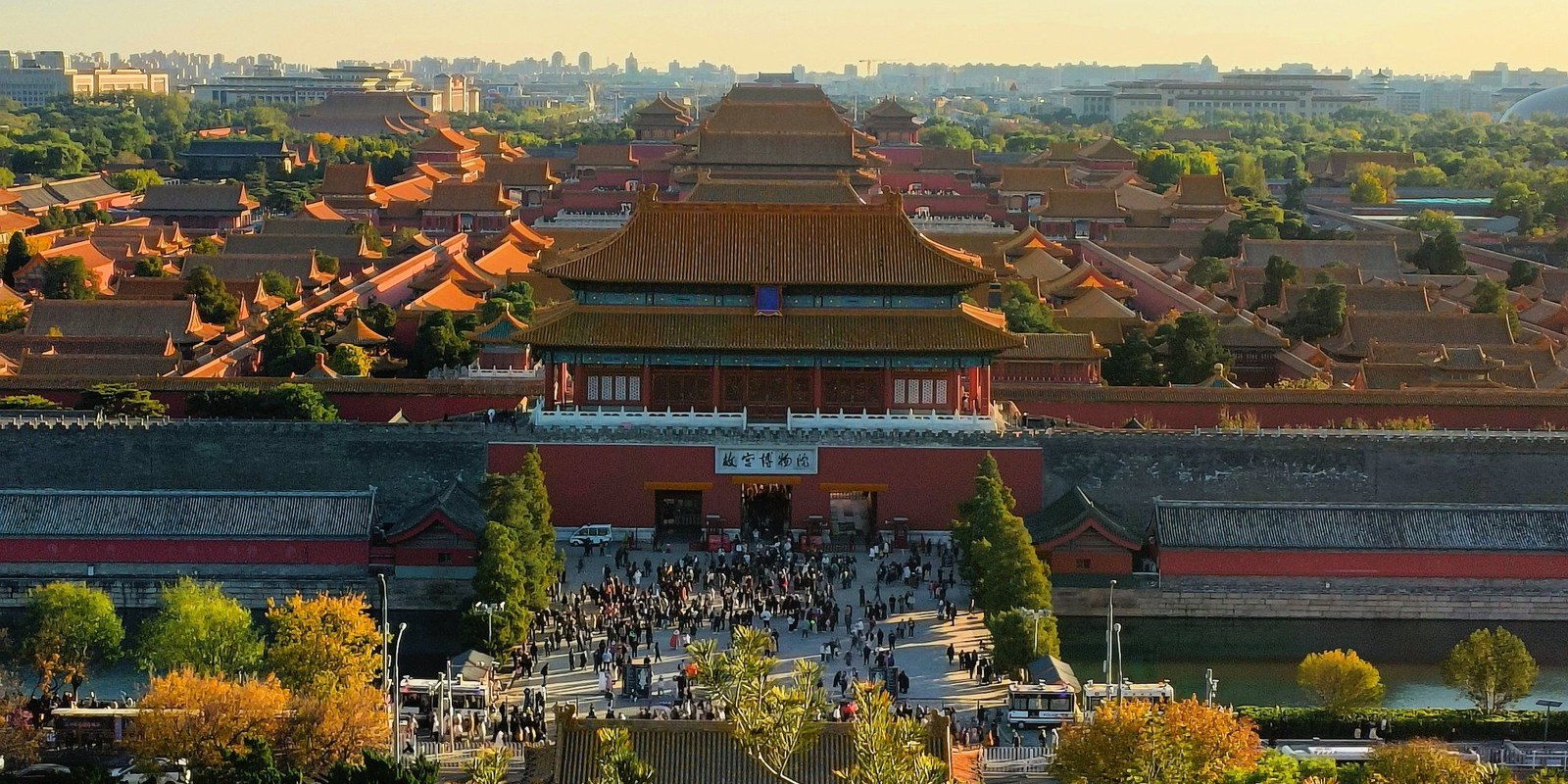
Jingshan Park: An artificial hill created from earth excavated during the construction of the Forbidden City’s moats, offering the iconic panoramic view of the axis
-
Forbidden City: The imperial palace complex of the Ming and Qing dynasties, a UNESCO World Heritage site in its own right (listed in 1987)
-
Duanmen: The “Upright Gate,” serving as the formal southern entrance to the imperial palace complex
-
Tiananmen Gate: The “Gate of Heavenly Peace,” the national symbol of China
-
Outer Golden Water Bridges: Seven elegant marble bridges spanning the Golden Water River south of Tiananmen
-
Tiananmen Square: One of the world’s largest public squares, a symbol of modern China
-
Zhengyangmen: The southern gate of the inner city, also known as Qianmen
-
Temple of Agriculture: Where Ming and Qing emperors performed ceremonial plowing rituals
-
Temple of Heaven: The supreme imperial sacrificial complex, also a UNESCO World Heritage site (listed in 1998)
-
Yongdingmen: The southern terminus of the axis, rebuilt in 2005 following its demolition in the 1950s
🔍 Architectural and Cultural Significance
The Beijing Central Axis is not merely a physical alignment of buildings but a profound expression of Chinese civilization’s core values. The axis embodies the Confucian ideal of social order and harmony, the Daoist principle of balance between yin and yang, and the Legalist emphasis on centralized authority. It represents the Chinese concept of “zhong” (中) — the “center” or “middle” — which is fundamental to Chinese thought about space, power, and identity.
The axis also demonstrates remarkable continuity of use. Unlike many ancient urban axes that were abandoned or transformed beyond recognition, Beijing’s central axis remained the primary organizing principle of the city from the Yuan Dynasty through the imperial period, the Republican era, and into the People’s Republic. Today, it continues to function as both a ceremonial route for national celebrations and a vibrant urban space enjoyed by millions of residents and visitors.
📌 Visitor Information
The Beijing Central Axis can be experienced by walking its length from Yongdingmen to the Bell and Drum Towers, a journey of approximately 7.8 kilometers that takes most of a day to complete properly. Key viewpoints include the summit of Jingshan Park, which offers the most famous panoramic view of the axis looking south over the Forbidden City, and the top of the Drum Tower, which provides an excellent northward perspective.
The best time to walk the axis is spring (April–May) and autumn (September–November) when Beijing enjoys its most pleasant weather. The entire axis is accessible by public transportation, with multiple subway lines intersecting key points along the route. Plan to spend a full day to appreciate the sites along the way, with the Temple of Heaven and Forbidden City requiring the most time for thorough exploration.
💎 Summary
The Beijing Central Axis is one of the world’s great urban achievements — a masterwork of city planning that gave coherent form to an imperial capital for over 700 years. Its inscription as a UNESCO World Heritage site in 2024 recognizes not only its architectural and historical significance but also its living role as the symbolic heart of Beijing and the embodiment of Chinese civilization’s enduring spirit of order, harmony, and grandeur.