Quanzhou, known in medieval times as Zayton (刺桐), was once one of the greatest port cities on earth. Inscribed on the UNESCO World Heritage List in July 2021 during the 44th UNESCO session in Fuzhou, China, the site known as “Quanzhou: Emporium of the World in Song-Yuan China” tells the extraordinary story of a city that served as the primary maritime gateway for trade between China and the world during the 10th to 14th centuries.
🌊 The Great Port of the Maritime Silk Road
Long before the great European voyages of discovery, Quanzhou was the bustling epicenter of global maritime trade. During the Song Dynasty (960–1279) and the subsequent Yuan Dynasty (1271–1368), this Fujianese port city welcomed merchants, sailors, and travelers from across Asia, the Middle East, and East Africa. It was a place where languages, religions, and cultures mingled freely, creating a cosmopolitan society unprecedented in the pre-modern world.
The site comprises 22 component sites spread across the city and its surrounding region, together forming a comprehensive picture of the maritime trade system that connected China to the world. These sites include administrative offices, dockyards, bridges, pagodas, temples of multiple faiths, kilns, and tombs — each telling a unique story of Quanzhou’s golden age.
⛵ Zayton: The City That Marco Polo Called Home
When the great Venetian traveler Marco Polo arrived in Quanzhou in the late 13th century, he called it “Zayton” and described it as one of the two greatest ports in the world for commerce, equaled only by Alexandria in Egypt. He wrote of enormous vessels laden with pepper, ginger, porcelain, and silk — goods that would find their way to the tables and wardrobes of Europe’s elite.
A few decades later, the Moroccan scholar and explorer Ibn Battuta visited Quanzhou and was equally awestruck. He described the city’s vast harbor filled with hundreds of ships, its thriving communities of Muslim, Hindu, and Christian merchants, and the extraordinary wealth generated by international trade. “Zayton is a great city,” he wrote, “in which the people are merchants and possess the largest vessels.”
🕌 A City of Many Faiths: Religious Diversity in Medieval Quanzhou
One of the most remarkable aspects of Quanzhou’s heritage is its extraordinary religious diversity. The 22 component sites include places of worship from virtually every major faith present in medieval Asia:
-
Qingjing Mosque: Founded in 1009 CE, this is one of the oldest surviving mosques in China, built in a distinctive Arabic architectural style. Its stone gate, prayer hall, and minaret remain remarkably well-preserved, a testament to the thriving Muslim merchant community that once called Quanzhou home.
-
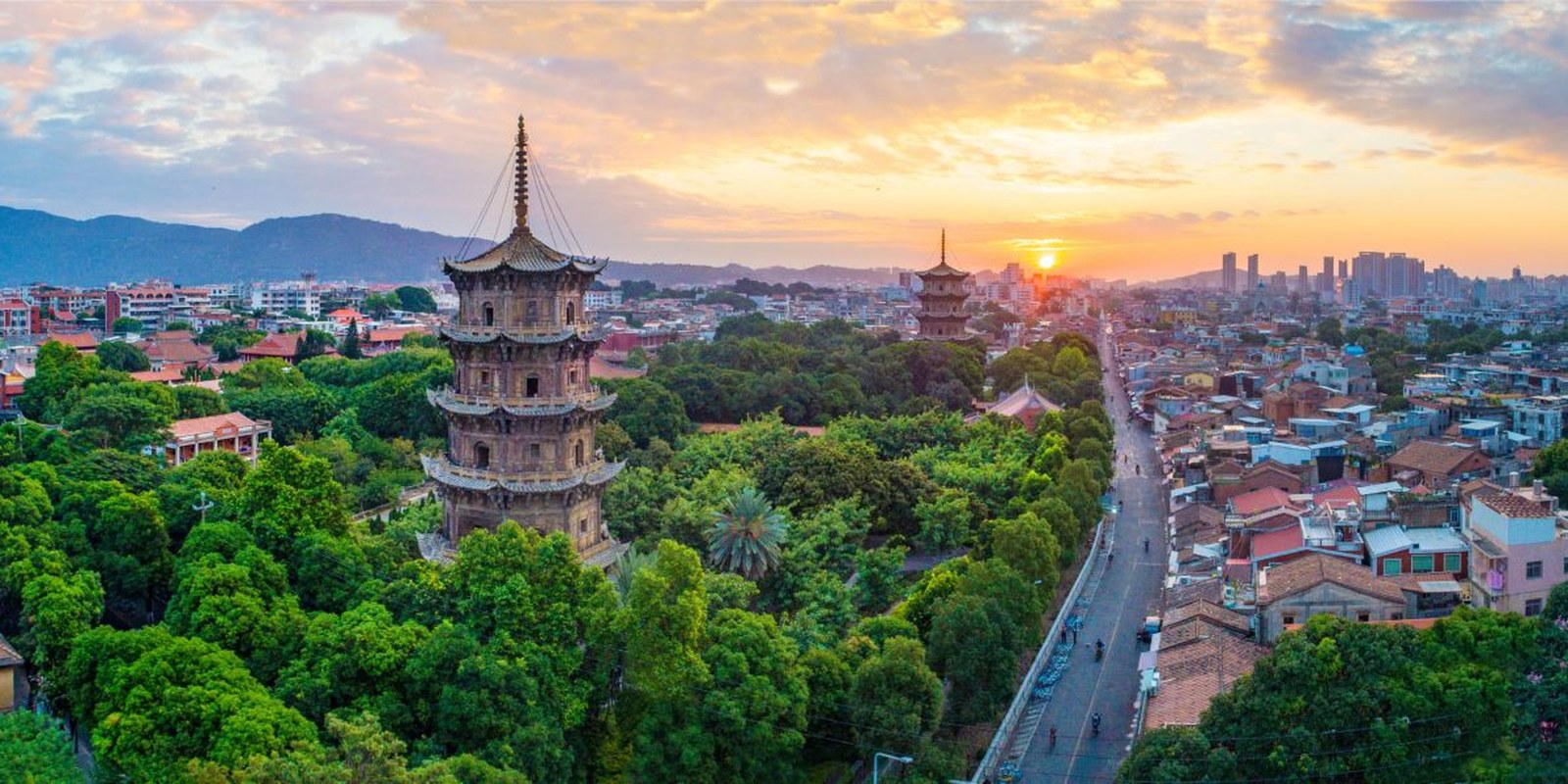
Kaiyuan Temple: Founded in 686 CE during the Tang Dynasty, this is the largest and most important Buddhist temple in Fujian Province. Its twin stone pagodas, the East Pagoda (Zhenguo) and West Pagoda (Renshou), rise over 40 meters high and are masterpieces of Chinese stone carving, adorned with exquisite Buddhist iconography.
-
Maritime God Temple (Tianhou Temple): Dedicated to Mazu, the Chinese goddess of the sea and patron deity of sailors and fishermen, this temple reflects the intimate relationship between Quanzhou’s people and the ocean that sustained their prosperity.
-
Tomb of the Two Saints: According to Islamic tradition, this tomb on Ling Mountain contains the remains of two companions of the Prophet Muhammad who came to China in the 7th century to spread Islam.
🏗️ Engineering Marvels of Quanzhou’s Golden Age
The prosperity of Quanzhou funded ambitious infrastructure projects that remain impressive even by modern standards:
Luoyang Bridge, built between 1053 and 1059 CE, is one of the great engineering achievements of pre-modern China. Stretching over 1,200 meters across the Luoyang River, it was the longest stone bridge in the world at the time of its construction. Its innovative use of oyster farming to solidify the foundations — a technique known as “planting oysters to fix the bridge” — demonstrates the brilliant integration of natural and human engineering.
Stone Dock (Shihu Dock), a well-preserved Song Dynasty dock and shipyard, provides tangible evidence of the sophisticated maritime infrastructure that supported Quanzhou’s trade network. The dock could accommodate the massive sea-going vessels that carried Chinese porcelain, silk, and tea to ports across the Indian Ocean.
🏺 The Kilns That Supplied the World
Quanzhou’s trade was built on its thriving manufacturing industry. The Ci’ao Kiln and Dehua Kilns (including the famous Wei’er Kiln) produced vast quantities of high-quality ceramics that were exported across Asia and Africa. Dehua porcelain, known in the West as “Blanc de Chine,” was particularly prized for its pure white color and translucent quality. Archaeological excavations at these kiln sites have revealed extensive workshops, kiln structures, and millions of ceramic fragments, providing an unparalleled record of medieval industrial production.
🌍 UNESCO Recognition: A Maritime Cultural Landscape
Inscribed in July 2021 during the 44th session of the World Heritage Committee in Fuzhou, China, the site was recognized under criteria (iv) and (vi). UNESCO describes Quanzhou as “a remarkable demonstration of the maritime role of China in the economic and cultural exchange between the East and the West” and notes that it “provides exceptional testimony to the maritime trade and cultural exchanges between China and the outside world from the 10th to the 14th centuries.”
📍 Visiting Quanzhou Today
Located in Fujian Province, on China’s southeastern coast, Quanzhou is easily accessible by high-speed rail from Xiamen (about 1 hour) or Fuzhou (about 1.5 hours). The city’s UNESCO heritage sites are concentrated in the old city center, making them easily walkable. Key sites to visit include the Kaiyuan Temple with its magnificent twin pagodas, the Qingjing Mosque, the Maritime Museum (which houses an extraordinary collection of shipwreck artifacts and stone carvings), and the Luoyang Bridge just outside the city.
The best time to visit is autumn (October–December) when the weather is mild and dry. Spring can be rainy, while summer is hot and humid. Allow at least two full days to explore the major heritage sites, with a third day recommended for visiting the outlying Luoyang Bridge and kiln sites.
💎 Summary
Quanzhou — the legendary “Zayton” of Marco Polo and Ibn Battuta — stands as one of the world’s great maritime heritage sites. Its 22 inscribed components together tell a story of global connection and cultural exchange that foreshadowed the modern era of globalization. As a UNESCO World Heritage site, Quanzhou invites us to imagine a time when the world came to China’s shores, and China reached out to embrace the world.