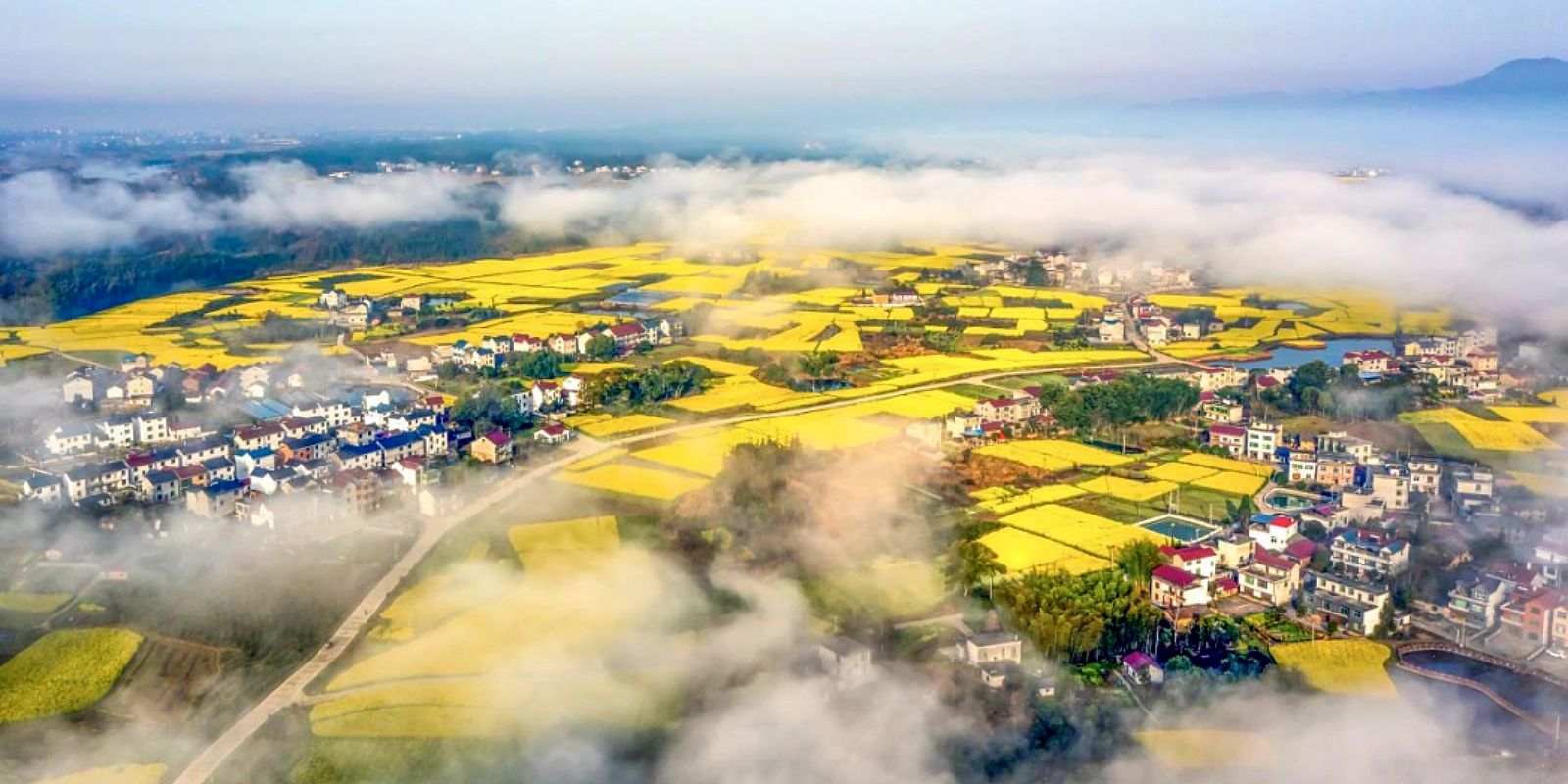
Above the surface of Lushan West Sea, islands scatter like jade across 300 square kilometers of crystal water. Beneath them lies what was once a county founded in 199 AD, when the Eastern Han emperor established a seat of power called “Wuning” — meaning “Martial Pacification” — on the western frontier of what is now Jiangxi Province. Eighteen centuries later, Wuning County covers 3,507 square kilometers in northwestern Jiangxi under Jiujiang City, making it the fourth-largest county in the province by land area. Its population of over 400,000 is spread across 18 townships, 1 subdistrict, and 1 industrial development zone. The county has woven three distinct identities into one: it is a national ecological civilization pilot area, the recognized “Hometown of Chinese Decoration” whose migrant entrepreneurs run thousands of interior design firms nationwide, and a tourism gateway anchored by the waters of Lushan West Sea.
🔧 Featured Industries
- Interior Decoration Industry: Wuning is officially designated “China’s Decoration Hometown” by the China Building Decoration Association. Over 100,000 Wuning natives work in the decoration industry, having founded more than 2,000 decoration companies across over 1,000 cities nationwide. Brands such as Xingyi, Huaxun, Mingjiang, and Sanxing were born from Wuning entrepreneurs and have become nationally recognized names in interior design and renovation.
- Tungsten Mining and Processing: Wuning is one of Jiangxi’s most mineral-rich counties, with over 30 types of minerals identified. The Dahu Tang tungsten deposit in Shimengiao Town is one of the county’s most significant mining assets, and the county government has prioritized advancing the Dahu Tang tungsten project as a key economic driver. Other minerals include antimony, coal, manganese, iron, vanadium-bearing stone coal (with approximately 600 million tons of reserves), marble (an estimated 7 million cubic meters of recoverable reserves, including the prized “Golden Jade” variety), granite, quartz, and porcelain clay.
- Green Agriculture: Wuning’s vast territory, forest coverage of over 70 percent, and high-quality water from the Xiushui River watershed support specialty agricultural products. The county has developed ecological fruit orchards, selenium-rich crop cultivation, and organic tea farming across its mountainous townships.
🗺 Tourist Attractions
- Lushan West Sea: A vast reservoir lake formed by the Zhelin Hydropower Station, the largest artificial lake in Jiangxi. It covers an area of 308 square kilometers surrounded by lush mountains. The Sunshine 29 Resort — Huayuan Valley, a lake-island resort featuring seasonal flower blooms accessible only by boat, sits within Wuning’s portion of the lake. The Xihai Yan Marina and Xihai Wetland Park provide additional access points for boat tours and lakeside recreation.
- Changshui Scenic Area: A National 4A Tourist Attraction and the site of Changshui Village, known as “China’s First Forest Reform Village.” The area is covered by 93.7 percent forest, with over 200,000 yew trees, sometimes called the “giant panda of the plant kingdom.” Attractions include the Millennium Yew Grove, Yuexi Valley, and Yueshanju Mountain Resort. The high concentration of negative oxygen ions makes it a popular health and wellness tourism destination.
- Mituo Temple: A historic Buddhist temple located in Wuning, offering mountain views and a serene atmosphere for visitors.
- Taiping Mountain: A scenic mountain area in Wuning known for its winter snow scenery and hiking trails.
- Hot Springs: Wuning has developed hot spring tourism resources, with several spa facilities operating in the county, popular during the cooler months.
🎭 Culture
- Tea-Picking Opera: A traditional folk opera form unique to Wuning, combining singing, dancing, and storytelling in the local dialect. Listed as a provincial intangible cultural heritage, it reflects the daily lives and emotions of the region’s tea-growing communities.
- Drum Songs: A folk drum-singing tradition performed during festivals and communal gatherings, featuring rhythmic drumming accompanied by vocal narration of local legends and historical stories.
- Community Fire Festivals: A traditional celebration involving fire performances, lantern processions, and communal feasts, preserving ancient folk beliefs about warding off evil and welcoming prosperity.
- Madam Fu Festival: A local folk festival honoring a virtuous woman named Madam Fu, combining ritual offerings, operatic performances, and community gatherings that have been passed down for generations.
- Historical Legacy: Wuning has attracted poets and scholars throughout history, including Tao Yuanming, Su Shi, Huang Tingjian, and Zhou Dunyi, who visited, served as officials, or lived in seclusion here. The county’s Lianxi Academy bears the imprint of Zhou Dunyi’s Neo-Confucian teachings.
🚗 Getting There
- Road: Wuning sits within a 2-hour economic circle of three provincial capitals: Nanchang, Wuhan, and Changsha. The Daguang Expressway (G45) runs north-south through the county, while the Yongwu Expressway crosses east-west. High-speed road connections reach Shanghai, Hangzhou, Hefei, Nanjing, and Fuzhou within 3 to 5 hours.
- Rail: The nearest major railway stations are in Jiujiang and Nanchang, both accessible within approximately 1.5 hours by road. High-speed rail connections are available from Jiujiang Railway Station.
- Air: Nanchang Changbei International Airport is approximately 100 kilometers from Wuning’s county seat, with a driving time of about 1.5 hours. Wuhan Tianhe Airport and Changsha Huanghua Airport are also within reasonable driving distance.
🍜 Local Cuisine
- Wuning Steamed Fish Head: Fresh fish from Lushan West Sea, typically steamed with chopped chilies, ginger, and scallions, showcasing the clean flavor of the reservoir’s high-quality water.
- Xiushui River Fish Soup: A nourishing soup made from fish caught in the Xiushui River, slow-cooked with tofu and local herbs resulting in a milky-white broth.
- Bamboo Shoot Stir-fry: Fresh bamboo shoots harvested from Wuning’s forested mountains, stir-fried with preserved pork or simply blanched to highlight their natural sweetness.
- Yuan Tea: A local specialty tea grown in Wuning’s mountainous areas, known for its smooth taste and fragrant aroma, produced using traditional hand-processing techniques.