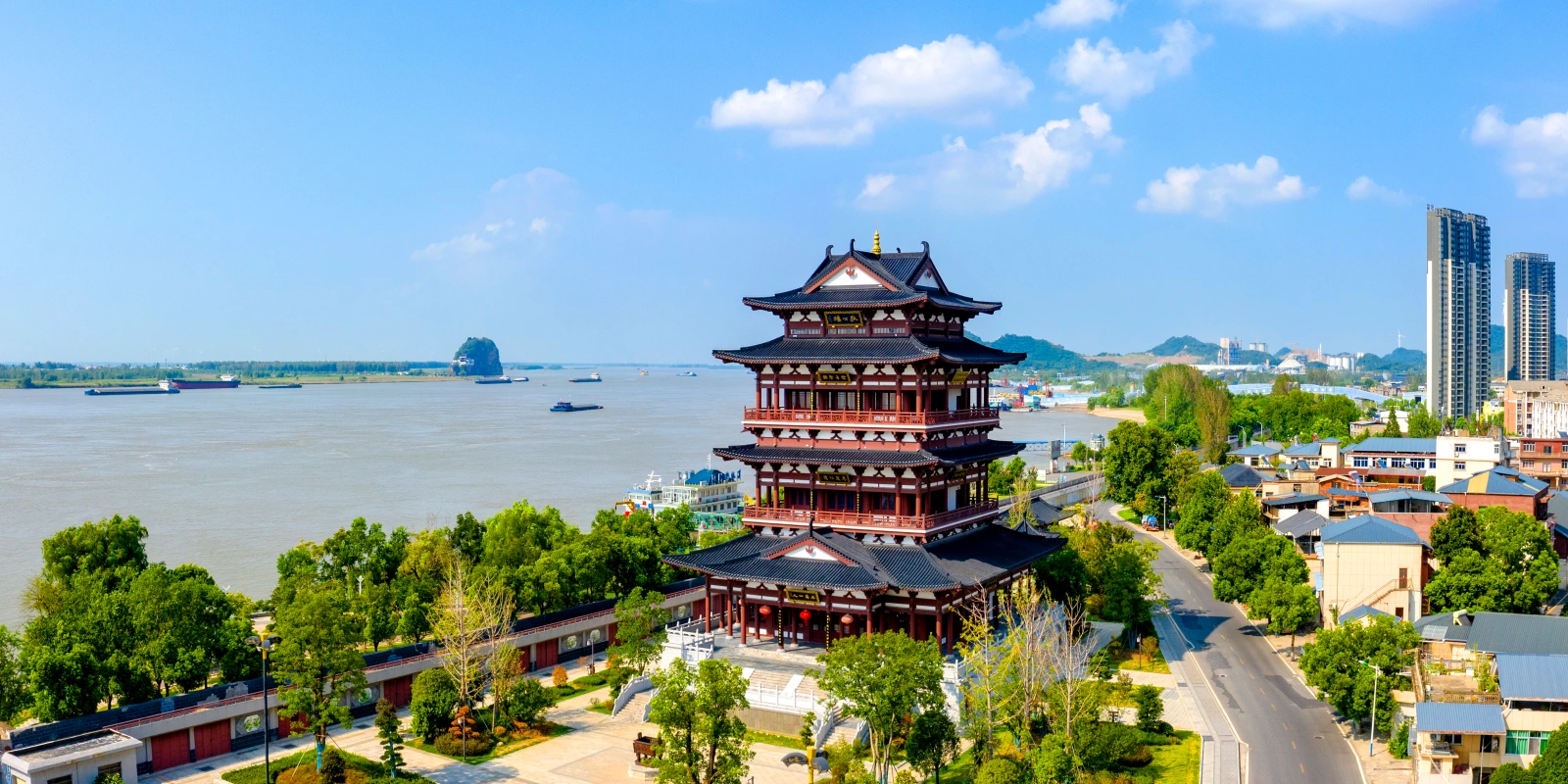
A thousand years ago, the great poet Tao Yuanming served as magistrate of Pengze County. After just 80 days in office, he resigned rather than bow to a visiting inspector, returning to his farm to write poetry — a story that has embodied the Chinese ideal of integrity and pastoral freedom ever since. But Pengze’s story stretches far deeper. Tang dynasty prime minister Di Renjie once governed here with the philosophy “take the people’s heart as your heart.” And in the mountains nearby, the only wild population of South China sika deer — a subspecies found nowhere else on Earth — still roams a 367,000-hectare protected reserve. Pengze covers 1,544 square kilometers along the Yangtze River in northeastern Jiangxi under Jiujiang City, with a population of 380,000. Pengze’s name refers to the Yangtze’s seasonal swelling, whose floods have nourished this land for millennia.
💡 Featured Industries
- Chemicals and New Materials: Pengze hosts a significant chemical industrial cluster along the Yangtze River, producing fine chemicals, synthetic materials, and petrochemical derivatives. The riverside location provides convenient bulk transport access, making the county one of Jiujiang’s key industrial bases for heavy chemical manufacturing.
- Port and Logistics Economy: With its Yangtze River shoreline, Pengze has developed a growing port economy. The county’s deep-water berths and multimodal transport network — combining water, rail (Tongling-Jiujiang Railway), and highway (Pengze-Hukou Expressway) — make it an important logistics node along the middle Yangtze.
- Ecological Agriculture and Specialty Products: Pengze is known for high-quality agricultural products including its famouscrucian carp froman carp) from local waters, high-grade tea, and organic vegetables. The county’s fertile Yangtze floodplain and clean mountain water produce prized agricultural goods sold across Jiangxi and beyond.
- Sika Deer Conservation and Eco-Tourism: The county is home to China’s only nature reserve for the South China sika deer subspecies (Cervus nippon kopschi), covering 367,000 hectares. Beyond conservation, the reserve and surrounding areas support eco-tourism, wildlife research, and related service industries.
- Renewable Energy: Pengze has developed wind and solar energy projects, leveraging its topography along the Yangtze River for wind power generation and its abundant sunshine for photovoltaic installations.
🗺 Tourist Attractions
- Longgong Cave (Dragon Palace Cave): A 4A-level national scenic spot described as “China’s finest karst cave wonder.” This massive limestone cave system features spectacular stalactites, stalagmites, underground rivers, and palace-like chambers illuminated with colored lighting. The cave extends for kilometers underground and is one of the largest karst cave systems in Jiangxi.
- South China Sika Deer Nature Reserve: The only nature reserve in China protecting the South China sika deer subspecies — one of the most endangered deer species in the world. The reserve is home to the last wild population of this subspecies, along with diverse other wildlife and pristine forest ecosystems.
- Digong Cultural Park: A scenic area dedicated to the memory of Di Renjie, the legendary Tang dynasty prime minister renowned for his incorruptible governance and wise judgments (and later immortalized in the Judge Dee mystery novels). The park includes Digong Tower, Wuliu Academy (named after Tao Yuanming’s five willow trees), and walking paths along the Yangtze River.
- Shangshiling Scenic Area: A beautiful mountain landscape with hiking trails, forest scenery, and rural village charm. The area offers panoramic views over the surrounding countryside and is a popular destination for weekend hiking and family outings.
- Linglong Flower Valley: A seasonal flower park featuring expansive blooms across the valley floor, with themed gardens, walking paths, and photography spots. The valley is especially spectacular during spring and autumn when flowers are in full bloom.
🎭 Culture
- Tao Yuanming and the Spirit of Pengze: Tao Yuanming (365-427 AD), China’s first and greatest pastoral poet, served as Pengze’s magistrate for just 80 days before famously resigning with the words “I will not bow for five bushels of rice.” His poems about returning to nature and farming life — including “Returning to Live in the Country” and “Peach Blossom Spring” — were inspired partly by Pengze’s landscapes. Wuliu Academy (Five Willows Academy) in the county is named after his famous poem “Biography of Master Five Willows.”
- Di Renjie’s Governance: The celebrated Tang dynasty prime minister Di Renjie (630-700 AD) served as an official in Pengze, where he established his philosophy of “taking the people’s heart as the heart” — a principle of empathetic governance that later defined his legendary career at the imperial court. His legacy is preserved at Digong Cultural Park in the county.
- Taobowu’s Artistic Heritage: Tao Bowu (1900-1986), a renowned modern Chinese painter and calligrapher from Pengze, left numerous artworks depicting the county’s natural scenery. His paintings capture the quiet beauty of Pengze’s rivers, mountains, and rural life, and his work remains an important part of the county’s cultural identity.
- Intangible Cultural Heritage: Pengze preserves traditions including folk paper-cutting, traditional boat-building techniques along the Yangtze, and local opera performances. The county’s riverside communities maintain customs linked to fishing, dragon boat racing during the Dragon Boat Festival, and Yangtze River worship ceremonies.
- Millennium Ancient County: Pengze’s history as an administrative county dates back over 1,000 years. The county’s old town area preserves traces of its historical layout, with traditional Jiangxi-style architecture, ancient wells, and narrow lanes that reflect the county’s deep heritage.
🚗 Getting There
- Road: Pengze is served by the Pengze-Hukou Expressway, connecting eastward to the broader highway network. National and provincial roads link the county to neighboring cities and counties.
- Rail: The Tongling-Jiujiang Railway passes through Pengze, providing passenger and freight rail service. The county is well-connected to the national rail network for both north-south and east-west routes.
- Water: Pengze’s Yangtze River shoreline provides direct water transport access. Vessels can travel upstream to Wuhan and Chongqing and downstream to Nanjing, Shanghai, and the East China Sea.
- Air: The nearest major airports are Jiujiang Lushan Airport and Nanchang Changbei International Airport, both within 1.5-2 hours by road from the county seat.
🍜 Local Cuisine
- Eight Treasure Assorted Soup: Despite its name suggesting “eight treasures,” this soup contains far more ingredients. Made by taking small portions of leftover banquet dishes, finely chopping them, and stir-frying before adding broth, the soup represents the local philosophy of resourcefulness and the art of combining diverse flavors into a harmonious whole.
- Steamed Rice Cake: A traditional Pengze snack made from rice flour formed into patties and steamed. The ba can be filled with savory ingredients like pickled vegetables and meat, or served plain as a neutral base for other dishes. It is a beloved breakfast item and festival food.
- Pickled Vegetable Steamed Pork: Slices of pork belly steamed with house-made pickled vegetables until tender. The pickles’ saltiness and tang penetrate the rich pork, creating a deeply satisfying dish that pairs perfectly with steamed rice.
- Stir-Fried Rice Noodles: Pengze-style fried rice noodles, made with locally produced rice noodles stir-fried at high heat with shredded pork, vegetables, egg, and soy sauce. The noodles are springy and slightly charred from the wok hei, making this a staple comfort food across the county.
- Pengze Yangtze River Fish: Fresh fish caught from the Yangtze River, prepared simply with steaming or braising to preserve the natural flavor. Pengze crucian carp from local waters is particularly prized for its sweet, tender flesh.