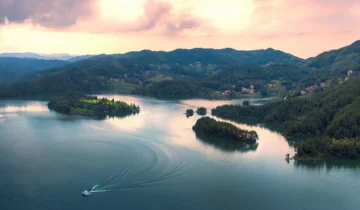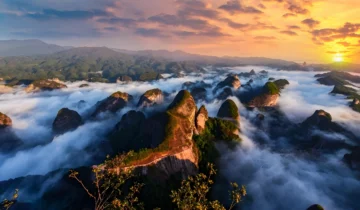
Xinning County, Hunan Province
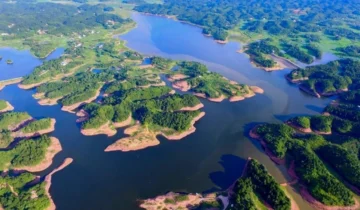
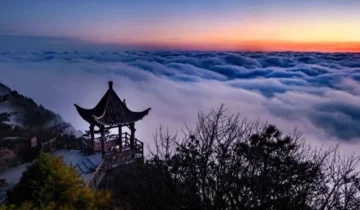
The Fuyi River threads through Langshan’s red sandstone World Heritage peaks. Navel oranges, blood sauce duck, firewood-smoked pork, and Shunhuang Mountain’s 22°C summer — Xinning in southwestern Hunan.
The Fuyi River threads through Langshan’s red sandstone World Heritage peaks. Navel oranges, blood sauce duck, firewood-smoked pork, and Shunhuang Mountain’s 22°C summer — Xinning in southwestern Hunan.
The Hunan-Guizhou border county that was once the Yelang Kingdom — Dong Grand Song, Dongdong Tui Nuo opera, Longxi Ancient Town, yellow cattle, and the nine resources that define the land.
A boat made of unplaned pine planks, built to break apart. Ten set out; three surviving was profit. Xinhua — Meishan, Ziquejie’s gravity-fed terraces, Chiyou’s mountain, and a people who have been breaking through walls for a thousand years.
Three Kingdoms prime minister. Qing dynasty general. Two PLA founding great generals. The school where Mao studied. A 12-meter gold-leaf Guanyin. Xiangxiang, ancient Longcheng on the Lian River.
Lin Zexu met a failed-exam farmer on a boat and gave him Xinjiang. The farmer was Zuo Zongtang. The county that raised him also fired Yuezhou celadon for the Southern Dynasty court — Xiangyin, where the Xiang meets Dongting.
The land that produced a Shang bronze boar, founded the Huxiang School, and sent Qi Baishi and Peng Dehuai into Chinese history. Xiangtan County — lotus fields, soybean sauce, and the suona that still plays through the nose.
Behind the best-preserved stone city wall in China, a Ming princely kitchen’s broth still simmers after 600 years. Wugang, Hunan — where luwei culture, bronze goose banquets, Taoist cloud peaks, and Huangpu Academy history converge in a single county-level city.
Home to the Four-Ram Square Zun (National Museum of China), the Tanheli Western Zhou city site, the Ningxiang Huazhu pig (one of China’s four national heritage breeds), Huitang hot springs, and the birthplace of Liu Shaoqi, He Shuheng, Xie Juezai, Zhou Guangzhao, and Jiang Wan. Famous local saying: “Ningxiang people know how to raise pigs and how to study.”
Birthplace of China’s latiao snack industry, the upstream source of the Miluo River, and the fourth-largest general-producing county in the country.
One of only five Miao autonomous counties in China, with a Panhu dragon boat tradition that predates Qu Yuan. World Longevity Township (56 centenarians, 81.18-year life expectancy), China’s foremost crystal sugar orange producer (first export train to Dubai, 2023), birthplace of Teng Daiyuan (first PRC railway minister), Mayang folk painting (UNESCO publication), and huadeng lantern opera.
A county built on Dongting Lake silt since 1895: Chinas largest rice-crayfish farming zone (35.56B brand value), the Kemian noodle company, Nanxian Dihuagu folk dance (national intangible heritage, 2011), the Changjiao Massacre memorial (1943, 30,000 civilians), and Luowen graffiti village.
Where Qu Yuan drowned in 278 BC and the Dragon Boat Festival was born (UNESCO Intangible Heritage, 2009). Also: China’s largest non-ferrous metal recycling center (68 copper/aluminum companies), Ren Bishi’s birthplace, the Longle Story Parade, Quzi Temple, and the “Little Nanjing” of Xinshi Ancient Town.
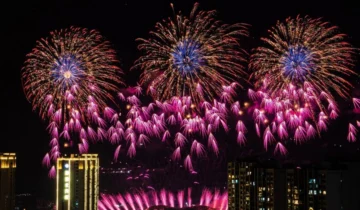
World capital of fireworks (500+ billion yuan industry) and home to Lens Technology, which makes glass panels for half the world’s smartphones. Also: the Sky Theater’s 142 choreographed shows, Dawei Mountain (66% forest cover), Jinshou Hall (first provincial Soviet government, 1930), and a maglev line under construction.
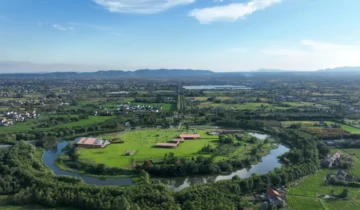
Home to Chengtoushan, China’s earliest walled city (ca. 4000 BC), where the oldest known irrigated rice paddies were found. Also: “Southern Turpan” grapes, the largest mirabilite mine in southern China, firefly scholar Che Yin, Tang poet Li Qunyu, and the Liyang Plain site cluster on the UNESCO tentative list.
The home of Wei Yuan, China’s “first person to open his eyes to the world” (author of Haiguo Tuzhi, 1842). Also: China’s largest selenium-rich area, 53% of national honeysuckle output, space-bred seeds, Flower Yao embroidery and mountain songs, Tantou New Year prints (collected by Lu Xun and the British Museum), and four national intangible cultural heritages.