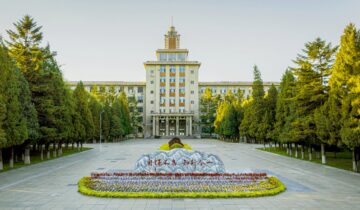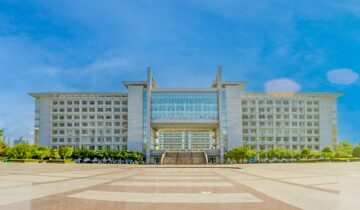
A school that opened in 1906 as a women’s teacher-training academy now runs China’s first college of artificial intelligence art. That long arc belongs to Tianjin Academy of Fine Arts, founded by the noted educator Fu Zengxiang as Beiyang Women’s Normal School, reorganized as an independent fine arts academy in the 1950s, and today one of China’s eight independent fine arts academies.
The academy occupies two campuses in central Tianjin, covering about 13 hectares, with 22 undergraduate programs spread across 11 schools and roughly 4,800 students, about a quarter of them postgraduates. Its programs span traditional Chinese painting, sculpture, industrial design, animation and digital media, anchored by 12 national first-class undergraduate programs and two national characteristic programs.
On the academic side it offers master’s degrees in art studies and design, with professional master’s programs in fine arts and calligraphy as well as design, and its fine arts discipline has been selected for Tianjin’s top-tier discipline cultivation plan. In a step unusual for an art school, it founded the country’s first college of artificial intelligence art, bringing AI education into general coursework across the academy.
The faculty of about 580 includes 120 doctoral-degree holders among its 430 full-time teachers, and their work has been recognized with lifetime achievement awards in Chinese art, from the China Art Award and the Chinese Calligraphy Lanting Award to the West Lake Seal Society’s lifetime achievement award, and gold, silver and bronze prizes at the National Art Exhibition. The academy’s public projects reach beyond campus: it designed the overall visual identity and main torch tower for the 13th National Games in Tianjin and contributed public artworks to the Beijing 2022 Winter Olympics.
International engagement runs wide: 56 universities in 21 countries and regions are partners, supporting 15 joint programs with art academies in France, the United States, Britain and Italy, including dual master’s degrees and exchange schemes. The academy also publishes North Art, an academic journal, and Painting and Calligraphy in China, a professional newspaper with domestic and international distribution.
From a classroom for women teachers in 1906 to an AI art school in the 2020s, the academy has spent more than a century answering the same question in different keys: what an art school should teach next.
Data Source: TAFA Official Website (as of 2025)