The West Lake Cultural Landscape of Hangzhou, inscribed as a UNESCO World Heritage site in 2011 in the historic city of Hangzhou, Zhejiang Province (30°14’N, 120°08’E), is not merely a lake — it is a masterwork of Chinese landscape aesthetics that has inspired poets, painters, and garden designers for over a thousand years. Covering 43.3 square kilometers of water, gardens, pagodas, and causeways, West Lake represents the Chinese ideal of “perfect harmony between heaven, earth, and humanity” — a place where nature has been shaped by human hands into a living poem of unparalleled beauty.
🏞️ A Lake Shaped by Poetry and Power
The story of West Lake (西湖) is inseparable from the history of Hangzhou itself, which Marco Polo described as “the finest and most splendid city in the world” during its heyday as the capital of the Southern Song dynasty (1127–1279). The lake’s transformation from a shallow tidal lagoon into the world’s most celebrated urban lake was the work of generations of poets, officials, and artists. The two great causeways that cross the lake — Su Causeway, built by the Northern Song poet-governor Su Dongpo in 1089, and Bai Causeway, named after the Tang dynasty poet Bai Juyi — were originally constructed as flood control projects but became integral elements of the lake’s aesthetic composition. These men were not merely administrators; they were poets who understood that water and stone, when arranged with sensitivity, could reflect the deepest truths of Chinese philosophy.
🌙 The Ten Scenes of West Lake
The Ten Scenes of West Lake (西湖十景) are the most celebrated embodiment of Chinese landscape aesthetics. Each scene captures a specific atmospheric moment — “Autumn Moon over the Calm Lake,” “Snow on the Broken Bridge,” “Evening Bell at Nanping Hill,” “Viewing Fish at Flower Harbor,” “Leifeng Pagoda in Evening Glow.” These names are not merely descriptive; they are invitations to contemplation, encapsulating entire philosophies of beauty in just four Chinese characters. The designations were first established during the Southern Song dynasty and have been celebrated in paintings, poems, and guidebooks ever since. Each scene represents the ideal fusion of a particular time, place, weather condition, and emotional state — the essence of traditional Chinese aesthetics condensed into landscape form.
🏯 Pagodas and Pavilions: Architecture Embracing Water
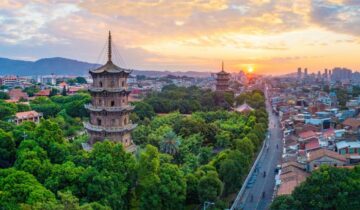
The architecture of West Lake is deliberately placed to complement rather than dominate the landscape. The Leifeng Pagoda (雷峰塔), rebuilt in 2002 after its original structure collapsed in 1924, stands on Sunset Hill at the southern edge of the lake, its silhouette framing the view from countless ideal perspectives. The Baochu Pagoda (保俶塔), slender and elegant, rises from the northern shore like a brush stroke against the sky. Together, they create a visual balance — one solid and imposing, the other graceful and delicate — that exemplifies the Chinese principle of complementary opposites. The pavilions, bridges, and temples scattered around the lake are designed according to the same principle: each structure is positioned so that it appears as a natural part of the landscape, as if it had grown there.
🌉 The Broken Bridge and the Legend of White Snake
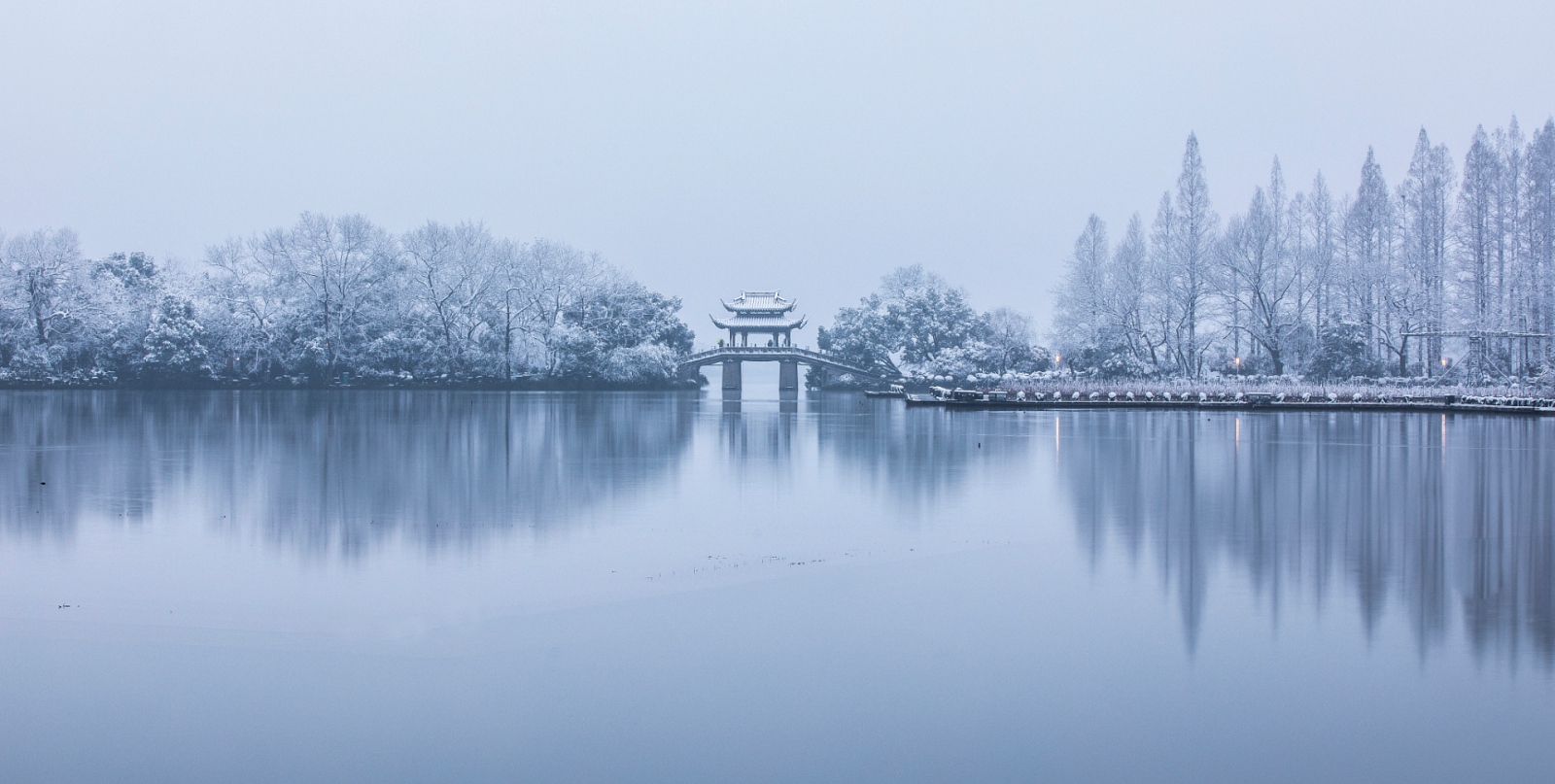
Among the Ten Scenes, “Snow on the Broken Bridge” (断桥残雪) holds a special place in Chinese cultural memory. The Bridge itself — which is not actually broken but appears to be when snow melts unevenly on its warm side — is the setting of one of China’s most beloved folk tales, the Legend of the White Snake (白蛇传). It was on this bridge that the snake spirit Bai Suzhen first met the scholar Xu Xian, setting in motion a story of love, betrayal, and transcendence that has been retold in operas, films, and television series for centuries. The bridge, the lake, and the legend are so deeply intertwined in the Chinese imagination that it is impossible to separate them — a powerful reminder that West Lake’s beauty is as much cultural as it is natural.
🌸 Gardens, Tea, and the Literati Tradition
West Lake’s influence extends far beyond its shores. The lake and its surrounding hills provided the template for the classical Chinese garden — a miniature version of the ideal landscape — that would be replicated in private gardens across China and, later, Japan and Europe. The hills around the lake, particularly Longjing (Dragon Well), produce China’s most famous green tea — Longjing tea (龙井茶), whose subtle, chestnut-like flavor has been prized since the Qing dynasty. For centuries, China’s literati — the scholar-officials who were both administrators and artists — built their retreats on the hills overlooking the lake, gathering to compose poetry, paint landscapes, and drink tea in the company of like-minded souls. It was here that the ideal of the cultivated life — balancing public service with artistic refinement — found its most perfect expression.
🧭 Experiencing West Lake Today
Admission to the West Lake scenic area is free, making it one of the most accessible World Heritage sites in China. The classic way to experience the lake is to walk or cycle the 10-kilometer perimeter, crossing the Su and Bai causeways, stopping at the pavilions and gardens, and watching the light change over the water. A boat ride to the islands in the center of the lake — Lesser Yingzhou, Mid-Lake Pavilion, and the Island of Three Pools Mirroring the Moon — offers a different perspective, bringing the visitor into the heart of the lake’s design. Spring (March to May) brings peach blossoms and willow catkins; summer, lotus flowers; autumn, the famous moon; and winter, the rare but magical snow scenes that have inspired poets for a millennium.