Perched 3,056 meters above sea level in the rugged mountains of northern Shanxi Province (38°59’N, 113°33’E), Mount Wutai — inscribed as a UNESCO World Heritage site in 2009 — is one of the most sacred places in the Buddhist world. Known as the “Five-Terrace Mountain” for its five flat peaks, Wutai is the earthly abode of the Bodhisattva Manjusri (Wenshu in Chinese), the embodiment of transcendent wisdom. For nearly two millennia, pilgrims have made the arduous journey to this remote mountain range, building temples, carving caves, and creating a cultural landscape that is at once profoundly spiritual and architecturally extraordinary.
🪷 The Sacred Mountain of Manjusri
Mount Wutai occupies a unique position in the Buddhist cosmos. According to the Avatamsaka Sutra, this mountain was revealed by the Buddha himself as the dwelling place of Manjusri Bodhisattva (文殊菩萨), who appears to the faithful as a radiant figure riding a lion, brandishing a sword that cuts through ignorance. As the first of the four sacred Buddhist mountains of China — the others being Mount Emei, Mount Putuo, and Mount Jiuhua — Wutai has been a pilgrimage destination since the Eastern Han dynasty (67 CE). The mountain’s five peaks — each representing a different aspect of Manjusri’s wisdom — are arranged in a configuration that mirrors the cosmic mandala, making the entire mountain range a vast, natural temple.
🏯 The Oldest Wooden Building in East Asia
In a quiet valley on the eastern side of Mount Wutai stands the Nanchan Temple (南禅寺), whose Great Buddha Hall, built in 782 CE during the Tang dynasty, is the oldest surviving wooden building in East Asia. The hall’s bracket-laden roof, its massive wooden columns, and its austere, dignified proportions represent Chinese architecture at its purest — a tradition that deeply influenced the architecture of Korea, Japan, and Vietnam. Even older in terms of its foundation, the Foguang Temple (佛光寺), rediscovered by the pioneering Chinese architect Liang Sicheng in 1937, contains a Tang dynasty hall built in 857 CE. Liang’s discovery was a watershed moment in the history of Chinese architectural scholarship, proving that Tang wooden architecture had survived and establishing Mount Wutai as one of the most important sites in the world for the study of pre-modern East Asian construction techniques.
🙏 A Thousand Temples on Five Terraces
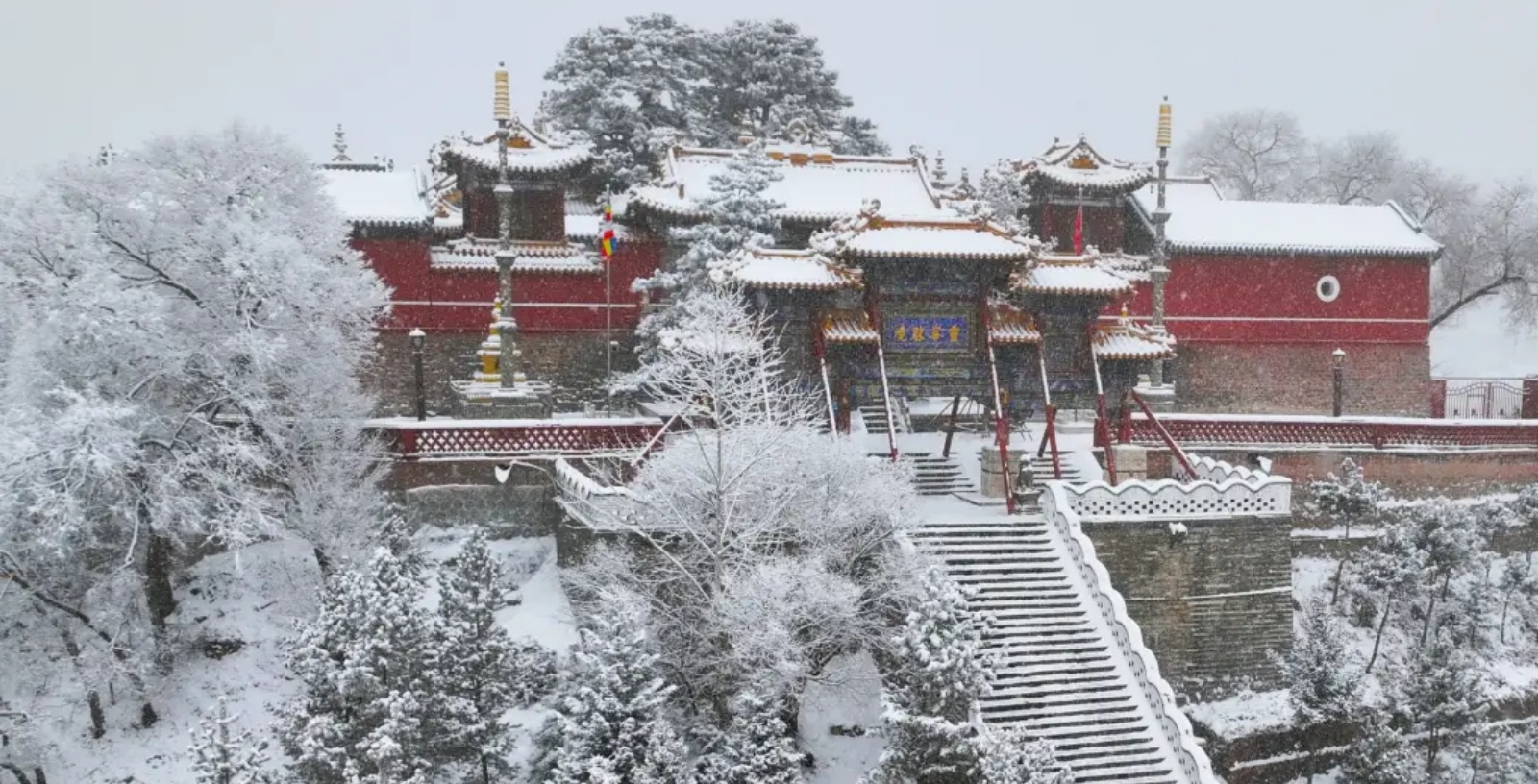
At its peak, Mount Wutai was home to more than 300 temples and monasteries, of which approximately 50 remain standing today. The temple architecture of Mount Wutai spans the full range of Chinese Buddhist construction, from the modest, single-story halls of the Tang dynasty to the elaborate multi-building complexes of the Ming and Qing periods. The Pusa Ding (菩萨顶), or “Bodhisattva Peak,” with its yellow-glazed tiles and ornate Tibetan-style decoration, reflects the Qing emperors’ patronage of Tibetan Buddhism — Wutai is unique among Chinese Buddhist mountains in being equally revered by both Han Chinese and Tibetan Buddhists. The Xiantong Temple (显通寺), the oldest and largest temple in Wutai, contains halls from multiple dynasties, its layered architecture representing a thousand years of continuous religious construction.
🗿 The Pagoda That Guards the Mountain
The visual symbol of Mount Wutai is the White Pagoda (大白塔) of Tayuan Temple, a massive Tibetan-style stupa that rises 54 meters above the main temple complex of Taihuai Town. Built during the Ming dynasty (1368–1644), the pagoda is covered in white lime, making it visible from great distances as pilgrims approach through the mountain passes. Its bulbous form, crowned by a spire of thirteen gilded discs, represents the Buddha’s body, speech, and mind — a physical manifestation of enlightenment. The pagoda is said to contain relics of the Buddha, and for centuries, circumambulating the stupa has been one of the essential rituals of the Wutai pilgrimage. The sound of the brass wind-bells suspended from the pagoda’s eaves, tinkling in the mountain breeze, is one of the defining experiences of Mount Wutai.
🌄 Pilgrimage Across the Five Peaks
Mount Wutai covers an area of 607 square kilometers, with five peaks marking the boundaries of the sacred landscape. The traditional pilgrimage (朝台) involves visiting all five peaks — Northern Terrace (3058 m, the highest), Southern Terrace, Eastern Terrace, Western Terrace, and Central Terrace — on a journey that takes three to five days on foot. Each terrace has its own temple, its own distinctive landscape, and its own architectural character. The Northern Terrace, at 3,058 meters, is the highest point in northern China, offering panoramic views of the surrounding mountains on clear days. On each terrace, pilgrims perform prostrations, light incense, and pray to Manjusri for wisdom — continuing a tradition that has been practiced since the Northern Wei dynasty, more than 1,500 years ago.
🧭 A Pilgrim’s Guide to Wutai
The main base for visiting Mount Wutai is Taihuai Town (台怀镇), located at the foot of the peaks, where most of the major temples are concentrated. The best time to visit is from June to September, when the weather is mild and the mountain trails are free of snow. Winter visits are possible but extremely challenging, with temperatures dropping to -30°C and heavy snow blocking the higher roads. The entrance fee to the Wutai Mountain scenic area is approximately ¥135, with additional fees for individual temples. From Taiyuan, the provincial capital, buses run regularly to Wutai (approximately 4 hours). The journey itself, winding through increasingly dramatic mountain scenery, is a fitting prelude to one of the most spiritually charged landscapes in the Buddhist world.