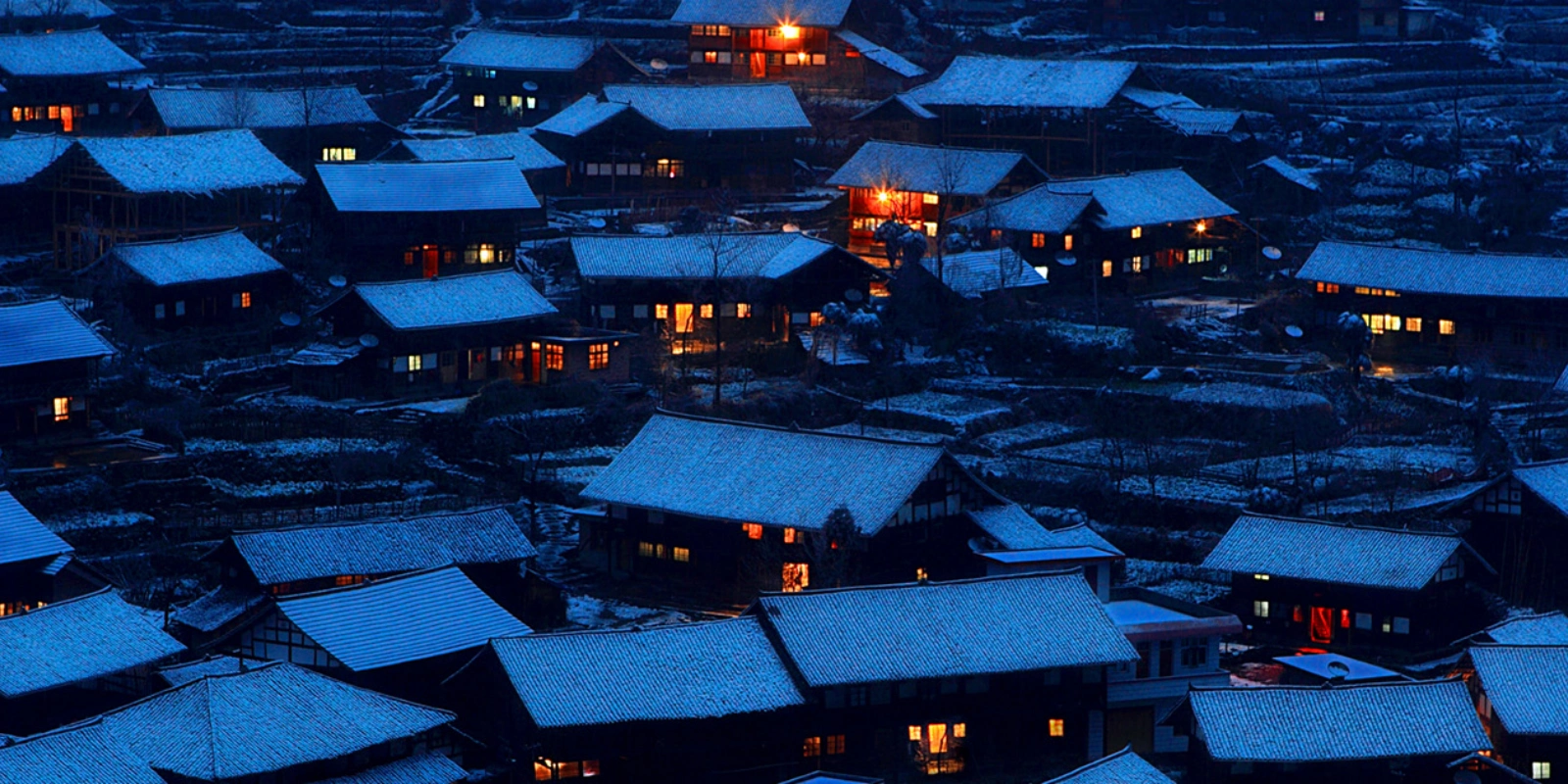
A single drop of water begins its journey on a mountaintop in central-west Hunan, seeps through forest soil, and emerges from a rocky fissure — not as a river, but as a perfectly placed trickle onto a terraced rice paddy that has been irrigated the same way for two thousand years. No pumps. No canals. Just mountain, stone, and human patience. This is Xinhua County, born in 1072 AD out of the Song dynasty’s push to tame the Meishan frontier, and today a 3,636-square-kilometer preserve of terraced landscapes, karst wonderlands, and a culture that still hums with the chants of Nuo dancers and the stomp of Meishan martial artists.
🏭 Featured Industries
- Tourism: Xinhua is a national all-for-one tourism demonstration zone and a national leisure agriculture and rural tourism demonstration county. Its UNESCO tentative-listed Ziquejie Terraced Fields, Daxiong Mountain National Forest Park, and Meishan Dragon Palace form the core of a tourism economy that draws visitors from across China and beyond.
- Agriculture: As a national commodity grain base county and one of Hunan’s top ten forestry counties, Xinhua produces commodity grain, seeds, and timber at scale. Specialty crops include tea, flue-cured tobacco, coix seed, and a range of medicinal herbs such as honeysuckle, magnolia bark, eucommia, and gastrodia.
- Mining: Thirty-six minerals have been discovered in Xinhua’s underground, twenty-six of them commercially viable. Known reserves include 305 million tons of coal, 550,000 tons of antimony, 200,000 tons of graphite, 7.5 million tons of kaolin, and over 1 billion cubic meters of granite.
🗺 Tourist Attractions
- Ziquejie Terraced Fields: Located in Shuiche Town, these terraces were first carved during the Qin and Han dynasties and expanded through the Song and Ming periods. Spanning 17,333 hectares in total, with a core area of 5,333 hectares, they rely on a natural gravity-fed irrigation system sustained by forest vegetation and soil water storage, requiring no mechanical pumping whatsoever. The site holds national scenic area, national AAAA, and national natural-cultural dual heritage status, and is on China’s tentative UNESCO World Heritage list.
- Daxiong Mountain National Forest Park: Covering 8,100 hectares, this park in northern Xinhua reaches 1,622 meters at Jiulong Peak — the highest point in central Hunan. With 93 percent forest cover and over 2,000 hectares of primitive secondary broadleaf forest, it is known as the “Southern Plant and Animal Museum.” Local legend holds it as the birthplace of Chiyou, the ancient warrior god, and historical records state that the Yellow Emperor visited.
- Meishan Dragon Palace: Twenty-eight kilometers from the county seat, this karst cave system extends 2,876 meters with 58,600 square meters developed for tourism, including a 466-meter underground river. Its five signature formations — Canyon Sky, Nezha’s Birth, Yuhuang Heavenly Palace, Golden Mountain in Water, and the Ancient Riverbed — have earned it the reputation of the world’s finest karst cave.
- Fengjia Ancient Taohuayuan: Located in Fengjia Town near the western border, this ancient settlement was historically part of Wuling Commandery. The Feng clan’s genealogy records them as descendants of Duke Xian of Qin, who fled south to escape Shang Yang’s Legalist reforms, changing his surname from Qin to Feng.
- Youxi River Drifting: A 12-kilometer river course cutting through eight gorges, 36 pools, 48 shoals, and 39 bends. With a flow rate of 8 cubic meters per second, it is widely considered the best canyon drift in Jiangnan.
- Other Scenic Spots: The Xijiang Bay Stone Forest, Suxi Lake (known as “Central Hunan’s Thousand Island Lake”), the 250-meter Bailong Waterfall, the Chedianjiang and Meihua Cave reservoirs, and Weishan Peak.
🎭 Culture
- Xinhua Folk Songs: A National Intangible Cultural Heritage, Xinhua folk songs are known for their high pitch, wide melodic leaps, and rough, passionate delivery. Singer Wu Xizhen famously performed the song “The Gods Descend Hard to Guess” before Chairman Mao and Premier Zhou in Beijing.
- Meishan Nuo Opera: Also a National Intangible Cultural Heritage, this ritual art traces its roots to ancient Chu shamanism. Performances are conducted by hereditary shaman-actors and include startling feats such as “boiling oil hand-dipping,” “climbing a mountain of knives,” “walking on a fire plow,” and “swallowing fire.”
- Meishan Martial Arts: A provincial Intangible Cultural Heritage, this is considered the oldest continuous martial arts tradition in China. Chiyou is revered as its founding ancestor. The style is characterized by the concept of “man” — a local word meaning unyielding toughness — and historically nearly half of Xinhua’s population practiced it.
- Nuo Lion Dance: Originating in Shuiche Town, this silent dance-drama is performed in 16 sections and 36 combinations. The lion mask features a distinctive red-faced, bulging-eyed design depicting the taotie motif, believed to represent Chiyou, and retains primitive elements of matriarchal and fertility worship.
🚗 Getting There
- Rail: The county is served by two stations on the Shanghai-Kunming corridor. Xinhua South Station handles high-speed trains, putting Changsha about an hour away. Xinhua Station on the conventional Shanghai-Kunming Railway provides regular connections to Loudi, Huaihua, and beyond.
- Road: The S70 Loudi-Huaihua Expressway and National Highway G354 traverse the county, linking Xinhua to Loudi (about 40 minutes), Changsha (roughly 2 hours), and western Hunan. Provincial roads extend into all 30 townships.
- Air: Changsha Huanghua International Airport is the most practical gateway for most travelers, reachable in about 2.5 hours by expressway. Huaihua Zhijiang Airport and the under-construction Loudi Airport offer closer regional alternatives.
🍜 Local Cuisine
- Three-Combination Soup: A signature Meishan dish selected for the 2008 Olympic menu. Made from beef, beef belly, and beef blood, served in a fiery broth of chilies, ginger, and mountain peppercorns.
- Meishan Three Big Bowls: A traditional set of three dishes featuring braised pork, farm-style tofu, and seasonal vegetables, now served in restaurants across China.
- Baixi Tofu: A silky white tofu from Baixi Town, made with local spring water and known for its delicate texture and sweet aftertaste.
- Shuiche Fish Jelly: Freshwater fish slowly simmered until the natural collagen sets the broth into a semi-solid jelly, served cold. A summer delicacy from Shuiche Town.
- Daxiong Mountain Smoked Pork: Pork belly cured and cold-smoked over pine and camellia branches, producing an intense, resinous flavor. Sliced thin and pan-fried until the fat turns translucent.
- Xinhua Rice Wine and Leicha: A sweet fermented rice wine and a pounded-tea drink mixed with peanuts, sesame, and ginger that form part of the traditional “ten drinks” of Meishan cuisine.
Data Source: Xinhua County Official Website