Jinzhai County, Anhui Province

Jinzhai County occupies 3,919 square kilometers in the upper reaches of the Pi and Shi rivers, under Lu’an prefecture, making it the largest county in Anhui by area. Its permanent population is 492,000, against a registered figure of 680,000. The county was created in 1932, during the Nationalist government’s Fifth Encirclement Campaign, when Chiang Kai-shek carved territory from five counties on both sides of the Anhui-Henan border and named it Lihuang County after his general Wei Lihuang, who had captured…

Shucheng County, Anhui Province

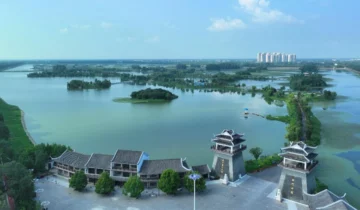
In 141 BC, a son of what is now Shucheng County founded the first government-run school in Chinese history. His Stone Chamber academy in Chengdu has operated continuously for over 2,100 years — today’s Chengdu Shishi Middle School — a lineage that makes it one of the world’s longest-running educational institutions. The man was Wen Weng, an official dispatched west to govern the Shu region, and his educational reforms were so transformative that the Han historian Ban Gu named him…

Huoqiu County, Anhui Province

Huoqiu County occupies the largest area of any county under Lu’an prefecture, covering 3,239 square kilometers on the northern slope of the Dabie Mountains, along the south bank of the middle Huai River. Its registered population is 1.58 million, though the resident count is 916,000. The county was established in 599 AD, during the Sui dynasty, on what had been the territory of the ancient Liao state in the Western Zhou period. It is classified as an old revolutionary base…

Sixian County, Anhui Province

In the 7th century, the Sui dynasty carved a 2,500-kilometer canal network from the Yangtze to the Yellow River — the largest artificial waterway the world had ever seen, and the circulatory system of imperial China for the next 1,400 years. Of all those kilometers, a 28.1-kilometer stretch through what is now Sixian County is the only section that still carries water in its original form: a living fragment of the Sui-Tang Grand Canal, inscribed as a UNESCO World Heritage…

Lingbi County, Anhui Province

In 1762, the Qianlong Emperor composed a poem about a place he had never visited – but whose name, bestowed upon it by a different emperor nearly four centuries earlier, had caught his attention. The name was Mingguang, “bright light,” and it came from the Hongwu Emperor himself, the founding emperor of the Ming dynasty who was born here. The poem, titled Qinci Mingguang (Bestowed Mingguang), calls the landscape “mountains embracing waters, scenery so fine.” Today Mingguang is a county-level…

Xiaoxian County, Anhui Province

In Xiaoxian, no banquet is complete without lamb — the local saying goes “no lamb, no feast” — and the county’s lamb soup tradition runs three centuries deep. Summer or winter, the broth simmers: rich, peppery, ladled out from street stalls and restaurant kitchens across the county. The specialty comes in many forms: hand-grabbed lamb, lamb tripe stuffed with seasoned meat, and a dish called “fish bites lamb” — mandarin fish and lamb loin braised together until the two proteins…

Dangshan County, Anhui Province

Dangshan County sits at the far northern edge of Anhui, wedged against the borders of Jiangsu, Shandong, and Henan — a four-province junction that has made it a crossroads for centuries. It belongs to Suzhou prefecture, covers 1,197 square kilometers, and is home to nearly a million people. But the number that matters most here concerns pears. Dangshan holds a Guinness World Record for the largest contiguous orchard on the planet: nearly 1 million mu — roughly 66,700 hectares —…

Jieshou City, Anhui Province

Jieshou, a county-level city in the northwest of Fuyang prefecture, is Anhui’s smallest city by land area at 667 square kilometers, with 831,000 registered residents. It sits on the border with Henan and describes itself as a “two-way bridgehead” linking the Central Plains with the Yangtze River Delta. The modern city has two distinct historical identities. During the Anti-Japanese War (1937–1945), Jieshou became a rare pocket of relative safety and commercial activity between the Japanese-occupied zones of eastern China and…

Yingshang County, Anhui Province

The Huai River meets the Ying River in northern Anhui, and at that meeting point lies Yingshang — a name meaning “on the upper Ying,” fixed in 606 CE, and the only county in Fuyang recognized as a Millennium Ancient County. The rivers that gave the place its name also gave it its shape: the land is laced with waterways, described locally as “five rivers, three bays, seventy-two lakes,” and the convergence that began with water continued with people. The…

Funan County, Anhui Province

Funan County lies at the southern edge of Fuyang, in the northwestern corner of Anhui, where the Huai River bends north toward the Henan border. It covers 1,801 square kilometers and registers 1.73 million people on its household rolls, though the actual resident population is lower. The name Funan means “south of Fuyang,” and the county was created in 1950 from the southern districts of its parent city. But the area had already been a named place for more than…

Taihe County, Anhui Province

In 1958, a Han dynasty tomb in northern Anhui yielded a stone object that would become emblematic of an entire county. It was an inkstone — circular, three-legged, topped with a carved lid — and its monumental replica now sits at the center of Taihe’s Confucian Temple Square. The county calls itself China’s Land of Calligraphy and Painting, and the inkstone is its symbol. Taihe County, in Anhui‘s northwest under Fuyang prefecture, counts 43 members of the China Calligraphers Association…

Linquan County, Anhui Province

Li Bai – the Tang dynasty’s most celebrated poet – lived in Nanling three times. In 742, he received an imperial summons there and wrote one of the most famous lines in Chinese poetry: “I went out the door with a loud laugh – how could I be forever a man of the weeds?” Nanling, part of Wuhu prefecture in southeastern Anhui, covers 1,260 square kilometers with a population of about 540,000 across 8 towns and one provincial economic development…

Mingguang City, Anhui Province

Every county-level city in China has a founding myth, but Mingguang has a founding emperor. The Hongwu Emperor — born Zhu Yuanzhang, the peasant rebel who founded the Ming dynasty — was born on the slopes of what is now Mingguang, and the city’s name comes from his poem: “Mountains embracing water, scenery so fine / Bright light bestowed on this treasured land.” The poem is titled Qinci Mingguang — “Bestowed Bright Light” — and the name has stuck for…

Tianchang City, Anhui Province

On a map of the eastern seaboard, Tianchang looks like a geographic curiosity — a wedge of Anhui driven deep into Jiangsu territory, bordered by neighboring Jiangsu counties on three sides. It sits between Nanjing, Yangzhou, and Huai’an, just 75 kilometers from downtown Nanjing, and is counted among the member cities of the Nanjing metropolitan area. Of its 293-kilometer boundary, 270 kilometers run along the provincial border — one of the highest ratios in the province. The Tang dynasty established…

Fengyang County, Anhui Province

Fengyang County sits on the south bank of the middle Huai River, in the northeast of Anhui, at the geographic line that divides northern and southern China. It covers 1,950 square kilometers in Chuzhou prefecture, with 639,000 permanent residents and a history that reaches back further than almost any other county in the province. During the Spring and Autumn period, this was the state of Zhongli; in the Sui dynasty, it became Haozhou; but the name that stuck came from…

Close