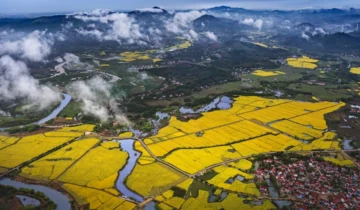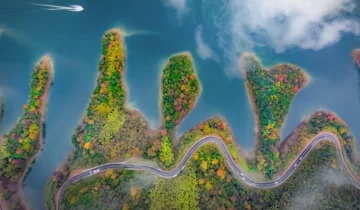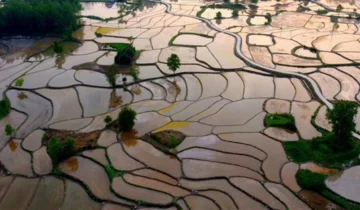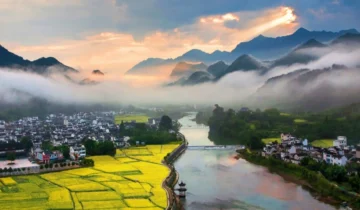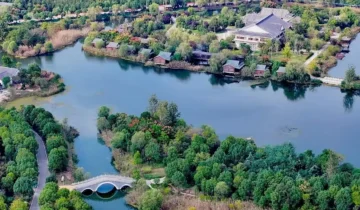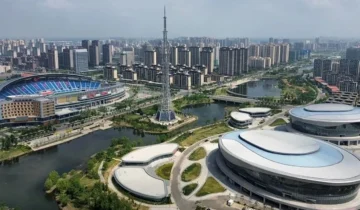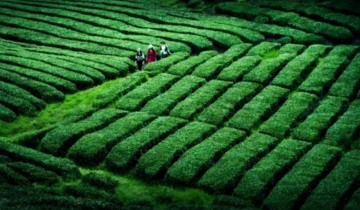
Guangde City, Anhui Province

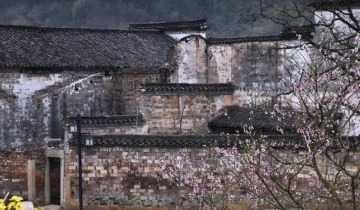
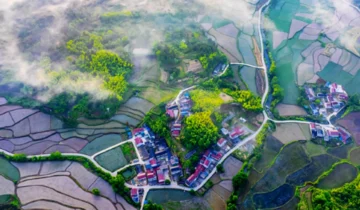
Guangde City is wedged into the southeastern corner of Anhui, squeezed between the borders of Jiangsu and Zhejiang — the only county-level division in Anhui that touches both provinces. It covers 2,165 square kilometers under Xuancheng prefecture and had a household population of 505,800 at the end of 2025. The city was upgraded from county status in 2019, but its written history begins much earlier. It was first established as Guangde County in the Eastern Han, around 200 AD, under…

Jingde County, Anhui Province

Jingde County, under Xuancheng prefecture, is the smallest county-level division in Anhui by population, with just 140,900 registered residents spread across 907 square kilometers of the southern mountain range. It was established in 763, during the Tang dynasty, under a name drawn from the Confucian virtue tradition, combining the characters for “honor” and “virtue.” Tiny as it is, Jingde holds an outsized place in the history of Chinese printing. ✎ A literary county Wang Zhen — Yuan-dynasty agronomist who revolutionized…

Jixi County, Anhui Province

Jixi County lies at the eastern edge of the Huangshan massif, under Xuancheng prefecture, occupying 1,126 square kilometers of the mountainous divide between the Yangtze and Qiantang river systems. Its resident population is 136,000, the third-smallest among Anhui counties. The county was established in 766, during the Tang dynasty, and its name comes from a local description of two streams that “flow separately and then merge like strands of thread.” That name proved consequential: in 1121, when the Song court…

Jingxian County, Anhui Province

Jingxian County lies on the southern slope of the Yangtze delta, under Xuancheng prefecture, with the Huangshan range to its south and Jiuhua Mountain to its west. It covers 2,054 square kilometers and has 270,000 permanent residents. The county was established during the Qin dynasty, more than 2,200 years ago, and has retained the same name ever since, a continuity reflected in the old saying “the Han family’s old county.” Jingxian is best known as the place where Xuan paper…

Langxi County, Anhui Province

Langxi County, under Xuancheng prefecture, sits at the junction of Anhui, Jiangsu, and Zhejiang, covering 1,105 square kilometers with 337,000 registered residents. It was established in 988, during the Northern Song, under the name Jianping, a label it held for nearly a millennium until the present name was restored in 1914. The county describes its topography as “three mountains, two waters, four fields, and one road and homestead,” a formula that accurately conveys the mix of low hills, lakes, and…

Qingyang County, Anhui Province

In the Ming dynasty, a theatrical form from a small Anhui county swept across China and reshaped Chinese opera. It was called Qingyangqiang — flexible verse, call-and-response singing, spoken narrative interludes — and it broke the formal constraints of earlier opera styles so completely that it is regarded as a direct precursor to Peking Opera. Today its traditional repertoire is collected into the China Music Map, a national project that documents 213 instruments and 1,056 pieces across nearly 40 ethnic…

Shitai County, Anhui Province

Li Bai sailed the Qiu Pu River five times. The Tang poet, China’s most restless traveler, wrote 54 poems about this stretch of water — among them the cycle Seventeen Poems of Qiu Pu, some of the most lyrical nature writing in Chinese literature. The county through which the Qiu Pu flows is Shitai, a mountain county of 1,413 square kilometers under Chizhou that backs its claims with numbers: 84.68 percent forest cover, seven national 4A scenic areas, and one…

Dongzhi County, Anhui Province

Dongzhi County sits at the southern edge of Anhui, where the Yangtze River bends eastward before entering Jiangxi. It is the largest county in Chizhou prefecture, covering 3,250 square kilometers with 536,000 residents. The name Dongzhi means “the east arrives,” a reference to the river that flows along its 85-kilometer western border. The county was created in 1959 from the merger of two historical entities: Dongliu, named for the eastward current, and Jiande (later Zhide), whose county seat dates to…

Lixin County, Anhui Province

The name Ningguo comes from the Yijing – “the host emerges above the myriad things, and all lands enjoy peace.” Established as a county in 208 AD during the Eastern Han, it became a county-level city in 1997. Ningguo sits in southeastern Anhui near the Zhejiang border, part of Xuancheng prefecture, covering 2,487 square kilometers with 387,000 permanent residents across 13 towns and 6 subdistricts. Ningguo is Anhui’s top-performing county-level economy, ranking 57th among China’s top 100 counties for comprehensive…

Mengcheng County, Anhui Province

Mengcheng County is the traditional hometown of Zhuangzi, the Daoist philosopher of the 4th century BC, and a provincial-level historical and cultural city. It lies in northwestern Anhui, in the eastern part of Bozhou prefecture, covering 2,144 square kilometers with 1.06 million permanent residents. The county administers 2 townships, 12 towns, 3 subdistricts, and one industrial park. Mengcheng is the only county in northern Anhui with full vehicle-production capability. The Jianghuai Motors plant builds MPV and VAN models here, and…

Guoyang County, Anhui Province

Two transformative events, more than two millennia apart, unfolded on what is now Guoyang County in northern Anhui. Around 571 BC, a boy was born here who would grow up to write the Tao Te Ching, becoming the founder of Daoism and one of the most influential philosophers in human history. Two and a half millennia later, in 1852, a local leader named Zhang Lexing gathered his followers at a guild hall in the market town of Zhiheji and launched…

Huoshan County, Anhui Province

Huoshan County sits deep in the Dabie Mountains, in the west of Lu’an prefecture, at the headwaters of the Pi River, a major tributary of the Huai. Its 2,043 square kilometers are largely mountainous — the local formula is “70 percent mountain, 10 percent water, 10 percent farmland, and 10 percent roads and homesteads” — and its population is correspondingly small: 353,600 registered, with 279,000 permanent residents. The county was the site of four historical firsts during the revolutionary period:…

Close