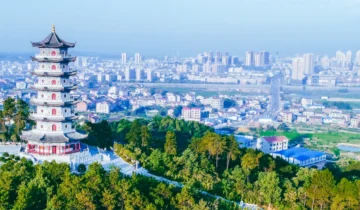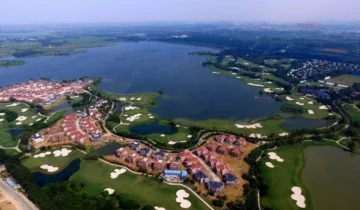
Changfeng County, Anhui Province

In 1965, the Chinese State Council carved a new county out of the borderlands of three existing ones — Hefei, Shou, and Dingyuan — and named it Changfeng, meaning “lasting peace and abundant harvests.” It sits in central Anhui, wedged between Hefei, Huainan, and Bengbu, covering 1,841 square kilometers with 842,000 permanent residents. Today it ranks 49th among China’s top 100 counties, up from a national poverty designation in 1994. The land itself records far older transformations. During the Shang…
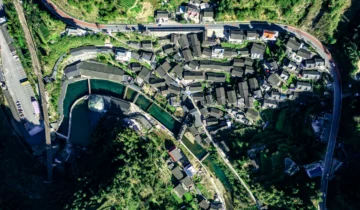
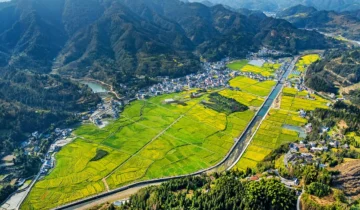
Guzhang County, Hunan Province

On the southern bank of the You River, a brass marker the size of a dinner plate is bolted to a Cambrian limestone outcrop. It marks the Guzhangian Stage — a defined interval of geological time, named after this county, approved by the International Union of Geological Sciences in 2008. Only eight such markers exist in China. The rock beneath it contains the first appearance of a trilobite called Lejopyge laevigata, a creature that lived when the land that is…

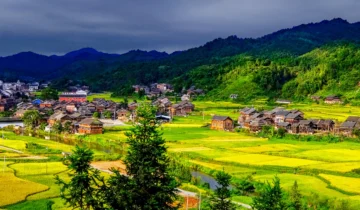
Baojing County, Hunan Province

The You River runs for much of its length through the mountains of western Hunan, most of it inside the territory of the Xiangxi Tujia and Miao Autonomous Prefecture, and on its middle reaches, where it narrows between limestone cliffs and accelerates over gravel beds, the river produced a distinctive sound for at least two centuries: the call-and-response work songs of the boatmen who hauled cargo up the gorges. The songs had different names for different tasks — the oar…

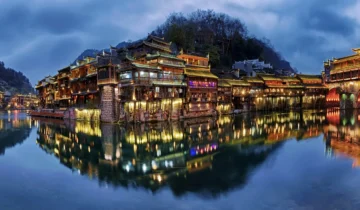
Fenghuang County, Hunan Province

Somewhere in the mountains west of the county seat, a stone wall runs along the ridgeline for 190 kilometers, snaking over peaks and through valleys in a line that looks, from a distance, like the Great Wall of China — but thinner, rougher, built of local granite instead of brick. This is the Miaojiang Southern Great Wall (also called the Miao Border Wall), a Ming dynasty fortification that was never meant to impress visitors. Its purpose was separation: on one…

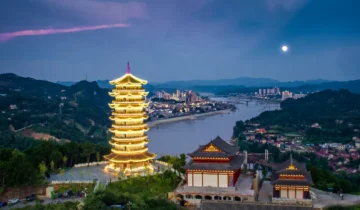
Chenxi County, Hunan Province

Morning on the Yuan River, and the water is the color of wet coal. A barge loaded with limestone drifts past the old dock at Chenxi, its engine coughing diesel smoke across a waterfront that — apart from the engine — has looked much the same for a hundred years: stone steps slick with river mist, a row of timber houses leaning into one another, a woman unloading bundles of greens from a flat-bottomed boat. Shen Congwen, who passed through…

Daoxian County, Hunan Province

At Moon Rock, the mountain ridge opens like a wound. Three chambers cut through the limestone by water and time, the roof gone, so that standing at the eastern mouth on a clear morning you watch the light pour through the western opening like a blade — a band of gold that narrows, widens, and narrows again as the sun traces its arc across the sky. The local name comes from the shape: when viewed from the right angle, the…

Dong’an County, Hunan Province

In the autumn of 1972, when Chairman Mao served Dong’an Chicken to Richard Nixon at a state banquet in Beijing, the dish arrived at the table already carrying more than a thousand years of history. Multiple origin stories compete for authenticity — one traces it to a Western Jin innkeeper around 290 CE who threw vinegar and chili into a wok of diced chicken; another to a Tang dynasty tavern run by three elderly women. Either way, the dish outlived…

Guidong County, Hunan Province

Guidong, a county in Chenzhou on the eastern edge of Hunan, stands at 900 meters. In a province built on river plains and lowland basins, that elevation is the highest any county reaches. Twelve peaks here push above 2,000 meters. Almost five hundred rise past 1,000. The air at that height is thin enough to notice. A visitor arriving from Changsha — four hours south by road — steps out of the car into air that holds 46,000 negative oxygen…

Anren County, Hunan Province

At the vernal equinox each year, the county of Anren in southeastern Hunan holds a market that has no equivalent anywhere else in China. Farmers and herb traders from a hundred kilometers around converge on the county seat for the Ganfenshe — literally “the spring-equinox gathering” — a fair that has run continuously since the Song dynasty and is devoted almost entirely to the trading of medicinal roots, leaves, barks, and fungi. The scene has not changed much over the…

Close