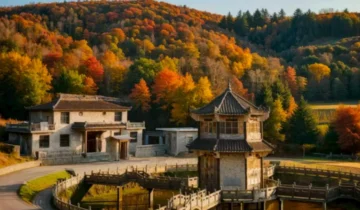
Guiyang County, Hunan Province

The air changes at the entrance of the Baoshan Mine in Guiyang, a county in Chenzhou that sits on some of the richest mineral deposits in Hunan. One step in, the temperature drops. The walls go damp. Wooden timbers, replaced every decade since the Han dynasty, hold up a ceiling that carries the weight of the mountain above. A tunnel railway, once used to haul lead and zinc ore to the surface, now carries visitors into the darkness where the…
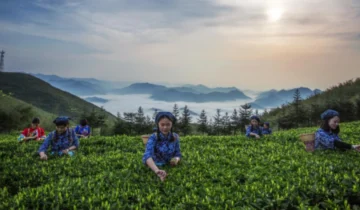
Anhua County, Hunan Province

There is a road that begins in the mountains of central Hunan and ends, 4,000 kilometers later, on the steppes of Mongolia. For three centuries it carried practically nothing except compressed bricks of dark tea, loaded onto horses and mules and moved in caravans that threaded the gorges of the Xuefeng Range, crossed the Yangtze at Wuhan, and pushed north through the Yellow River basin into the Gobi. That route was the Wanli Tea Road, and its southern anchor point…

Cili County, Hunan Province

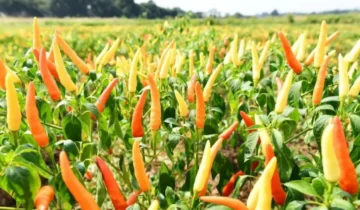
Seven chili peppers, each no bigger than a child’s index finger, growing from the same stem in a cluster so tight they look like seven sisters huddled together. That is the Dongxi Qizimei Chili, a geographical indication product from the township of Dongxi in Cili County, Hunan. They grow only between 500 and 800 meters of elevation, where the temperature swings sharply between day and night and the soil is naturally selenium-rich. Locals say they go “up the forehead but…

Hanshou County, Hunan Province

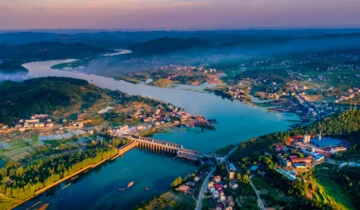
Hanshou County has two faces. One is ancient and wet, turned toward the western shore of Dongting Lake, where the Yuan and Li rivers meet and the water spreads across a landscape of marsh and reed. The other is modern and fast, turned toward the expressway. Four major highways cross this county. Two railways cut through it. The Changsha-Yiyang-Changde high-speed rail puts the county seat 30 minutes from Changde and just over an hour from Changsha. A county of 2,021…

Anxiang County, Hunan Province

In the spring of 1952, as the Chinese government mobilized to build the Jingjiang Flood Diversion Project in northern Hunan, the construction sites were loud not only with machinery but with song. Teams of a dozen men each pulled or lifted a heavy stone rammer called a wo, dropping it in rhythm to compact the earth of the new levees, and a designated leader would chant a line that the team answered in chorus — a call-and-response work song known…

Chengbu Miao Autonomous County, Hunan Province

The most famous generals in Chinese folklore are the Yang Family Generals of the Northern Song — the patriarch Yang Ye, his sons, and the women who took up arms after the men fell in battle. What is far less known is that a parallel line of Yang generals emerged from the mountains of southern China, and that the original headquarters of that southern lineage sits in a small Miao autonomous county in western Hunan called Chengbu. The Yang Official…

Dongkou County, Hunan Province

On a mountain slope in Changtang, in the Yao township of the Xuefeng Mountains, a man wraps his head in palm fiber until only his eyes are visible. He is preparing for the Zongbaonao dance — an exorcism ritual nearly a thousand years old, first recorded in the Shaoyang prefectural gazetteer in 1074 CE, when the Song court dispatched troops to subdue the mountain strongholds of Meishan. According to the record, the Yao defenders wrapped themselves in palm bark to…

Changning City, Hunan Province

Changning is the kind of place that shows, in a single craft, how a city reinvents itself when its primary industry runs out. The craft is printmaking — banhua in Chinese, literally “board painting” — and Changning has practiced it since the early 1960s, when a group of local art teachers began carving rural scenes into woodblocks and printing them onto paper using the same linseed-oil ink that mechanics used for industrial stencils. Over six decades the hobby grew into…

Close