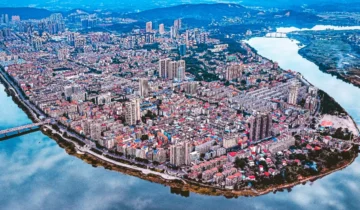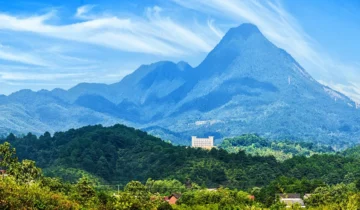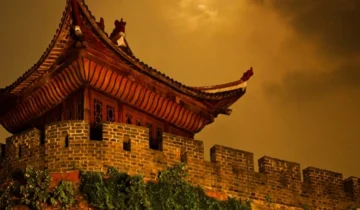
Qidong County, Hunan Province
A Hunan county that produces more than 70 percent of China’s daylily, sits on central-south China’s largest iron ore reserves, and has kept Qiju Opera alive for 400 years.
A Hunan county that produces more than 70 percent of China’s daylily, sits on central-south China’s largest iron ore reserves, and has kept Qiju Opera alive for 400 years.
When Marshal Luo Ronghuan — the only man from Hunan among the Ten Marshals of the People’s Liberation Army — was born in the small village of Nianziwan, no one could have predicted that the boy from the Hunan hills would grow up to become the subject of a famous poem by Mao Zedong. Mao’s Commemoration of Luo Ronghuan, written in 1963, remembers the siege lines where “the enemy besieged us thousands-fold, but you held firm, holding aloft the red…
In the winter of 1928, a 28-year-old communist named Xia Minghan walked to the execution ground in Changsha. Offered a chance to renounce the Party, he instead picked up a piece of chalk and wrote eight characters that every Chinese schoolchild would come to know: “Beheading is nothing to me — as long as the ideal is true.” His hometown, Hengyang County, sits at the southern foot of Mount Heng. Spanning 2,558 square kilometers across 25 townships, it has a…
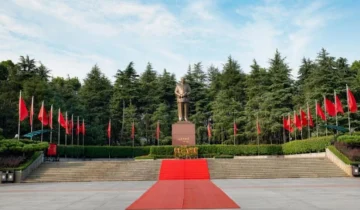
The birthplace of Mao Zedong, where a 247-square-kilometer valley contains his 18-room farmhouse, a museum with 50 million visitors, and a peak named for the music of Emperor Shun.
Chaling is the only county in China whose name derives from tea, a fact noted by Lu Yu in the eighth-century Classic of Tea, which lists the county as the leading producer of what was then the Hunan region’s most important commodity. The name predates even Lu Yu: it comes from the mountain that rises east of the county seat, Tea Mountain, and from the legend that the Divine Farmer Shennong, the mythical inventor of agriculture, tasted hundreds of herbs…
Drive east from Changsha’s city center toward the Huanghua International Airport, and the towers of the provincial capital give way to something flatter and louder: kilometer after kilometer of factory roofs, blue and gray, stretching back from the expressway. Behind their walls, a tunneling machine is bored from solid steel, a crane arm is welded into position, an electric sedan rolls off the assembly line every 53 seconds. These are the plants of SANY Heavy Industry, CRRC Heavy Industry, GAC…
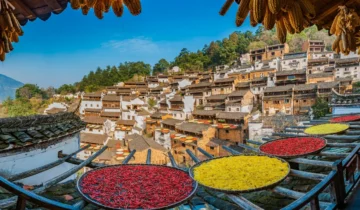
Wuyuan sits in the northeast corner of Shangrao, at the junction where Jiangxi meets Anhui and Zhejiang, and it is beautiful in a way that is hard to exaggerate. In spring, rapeseed flowers turn the terraced hillsides into sheets of yellow that seem to glow from within. White-walled Hui-style houses with horse-head gables rise through the morning mist, exactly as they have for centuries. The entire county — all 2,967 square kilometers — is certified as a 3A-level tourist attraction,…
In 1995, archaeologists working in a limestone cave in northeastern Jiangxi pulled a single rice phytolith from the sediment and changed the timeline of human agriculture. The grain was between twelve and fourteen thousand years old — the oldest domesticated rice ever found. The cave was Xianrendong, in the county of Wannian, and the discovery placed Wannian at the origin of the world’s rice cultivation. The same excavation uncovered pottery shards ten thousand years old, the earliest known ceramics on…
Most people assume Poyang Lake gave its name to the county. It was the other way around. The county was founded in 221 BCE, more than two millennia before the lake acquired the name that now appears on every map of China. It sits on the eastern shore of that immense body of water, in the west of Shangrao prefecture, covering 4,215 square kilometers—the second-largest county area in Jiangxi—with a registered population of nearly 1.6 million, the largest in the…
In the corner of Jiangxi where the Xin River meets Poyang Lake, the county of Yugan stretches along the lake’s southeastern shore for dozens of kilometers. The lake defines almost everything here. It was on these waters that Zhu Yuanzhang and Chen Youliang fought their great naval battle in the fourteenth century, and it is here still that fishermen in small wooden boats set out with rows of cormorants perched on the gunwales, the birds diving for fish under the…
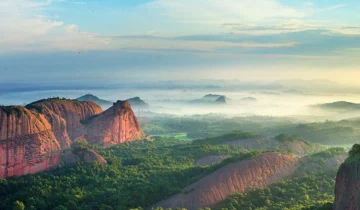
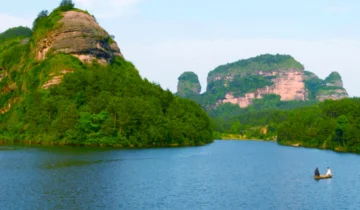
The hills of southern Yiyang rise in rounded humps of red sandstone, clusters that resemble a herd of giant turtles gathered on the landscape. The county’s best-known landmark, Guifeng (Turtle Peak), covers some 200 square kilometers of Danxia peaks and holds UNESCO World Natural Heritage status, a World Geopark designation, and the highest 5A tourism rating. A Ming-dynasty traveler called it “a rare sight under heaven.” But Guifeng is only the most visible layer of a county that has accumulated…
Hengfeng is one of the smallest counties in Jiangxi by area— it covers barely 655 square kilometers and holds a population of 210,000— but the scale of what sits inside those borders is disproportionate to the size of the map. The county’s subsoil contains the largest reserves of tantalum and niobium in Asia, two rare metals essential for electronics and aerospace. Its kilns once produced celadon that rivaled Jingdezhen and sold across the Yangtze River delta for five centuries. And…
In the autumn of 1175, two of the most formidable minds in Chinese philosophy sat down across from each other at Ehu Academy, in what is now Yanshan County. On one side was Zhu Xi, the architect of Neo-Confucianism. On the other, Lu Jiuyuan, who argued that the mind itself is principle. For three days they debated human nature, knowledge, and the path to moral understanding, before an audience of scholars who had traveled from across the empire. The event…
Yushan was not yet called the “World Billiard City” when the first Star-table billiard ball rolled off a local assembly line, but the connection had been there underground for millions of years. The county sits on one of China’s largest deposits of high-quality limestone — 3.3 billion tons, the biggest in Jiangxi province — and it was this raw material, essential for producing the slate bed that gives a billiard table its true plane, that drew the billiard industry to…
The largest lotus flower cluster on Earth blooms every summer in one county in eastern Jiangxi. Recognized by Guinness World Records, the lotus sea at Yaoxi — an endless white-and-pink carpet that draws visitors from across China. But Guangchang has a second life that has nothing to do with petals. Some 60,000 of its residents— roughly one in four of the workforce— run trucking and logistics companies in over 100 Chinese cities, generating nearly 100 billion yuan in annual revenue.…