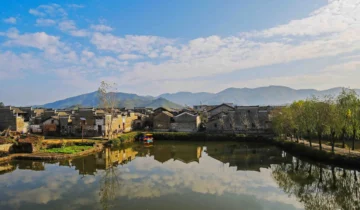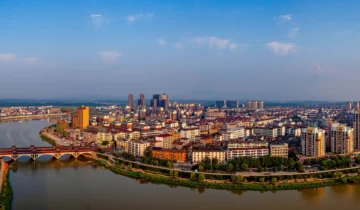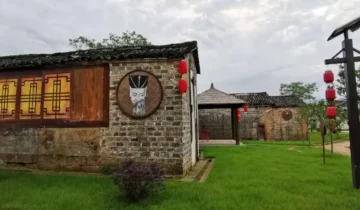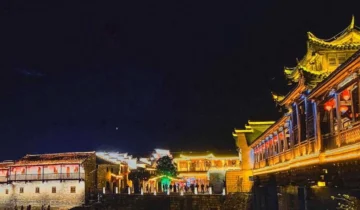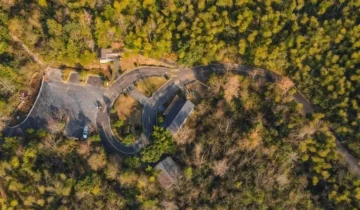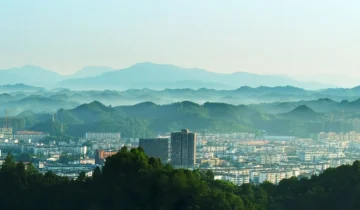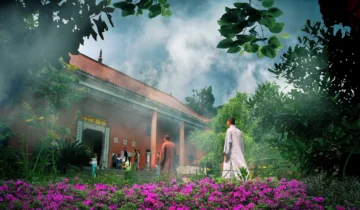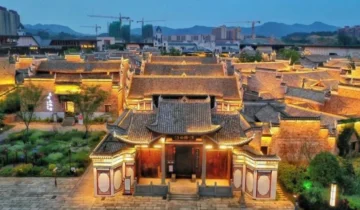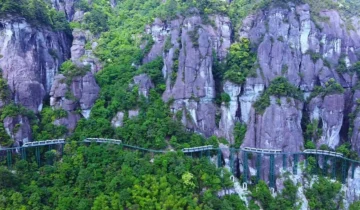
Zixi County, Jiangxi Province

Zixi sits deep in the Wuyi Mountains at the far eastern edge of Jiangxi, up against the Fujian border, and one thing few outsiders expect to find here is bread. Yet the county sends more than ten thousand bakers across China every year. The brands they founded — Boss Bun, Luxi River Bakery, Zhanji Pastry — now have storefronts in dozens of Chinese cities, selling flaky egg tarts, soft-crust mooncakes, and the char siu puff pastries that have made “Zixi…
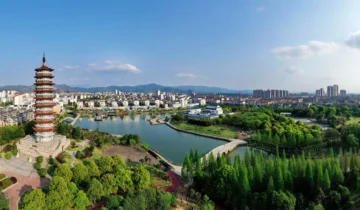
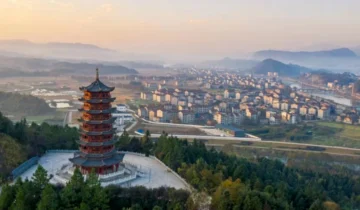
Jinxi County, Jiangxi Province

The county name means gold stream — a reference to the gold and silver that once colored the mountain waters. Jinxi sits in eastern Jiangxi , part of Fuzhou, where the Wuyi Mountains slope toward Poyang Lake across 1,358 square kilometers. It holds 310,000 people and a landscape the old records describe as six parts mountain, two parts fields, and one and a half parts water and homestead. But the county’s true wealth is neither in its soil nor its…

Yihuang County, Jiangxi Province

In the spring of 1933, with the Kuomintang’s fourth encirclement campaign bearing down on the Central Soviet Area, the Red Army set a trap in the mountains of what is now Yihuang County. At Huangpi and Dongpi, they destroyed three of Chiang Kai-shek’s best divisions, captured two division commanders, and seized more than 20,000 rifles. Mao Zedong called it “an unprecedented glorious great victory.” The county was the northern gate of the Soviet republic, and more than 570 founding generals…

Le’an County, Jiangxi Province

Le’an County sits at the geographic center of Jiangxi, in the southwest of Fuzhou. It arrived late by Chinese county standards — founded in 1149 during the Southern Song — but made up for it by landing at the intersection of two of Jiangxi’s great cultural streams: Linchuan and Luling. The result is a county that crams a millennium of scholarship, revolution, and industrial transformation into 2,413 square kilometers of river valleys and camphor forests. Barely a fifth of its…

Chongren County, Jiangxi Province

For a county of 380,000 people tucked into the western edge of Fuzhou city, Chongren has produced an improbable amount of intellectual history. More than 170 men from here passed the imperial examinations, but what sets it apart are the two Neo-Confucian masters: Wu Cheng (1249— 1333), known as Wu Caolu, who synthesized the rival schools of Zhu Xi and Lu Jiuyuan into a synthesis that later scholars called the Caolu School; and Wu Yubi (1391— 1469), known as Wu…

Nanfeng County, Jiangxi Province

In Nanfeng, time is measured in millennia. The county’s boosters list five things that have endured for roughly a thousand years each: its tribute oranges, its Nuo dance, its ancient porcelain kilns, its walled city, and the memory of its most famous scholar, the Song-dynasty essayist Zeng Gong. Together they make up the “five cards” of Nanfeng—a shorthand for a county in southern Fuzhou that has spent 1,700 years accumulating layers of history. Established in 257 CE during the Three…

Lichuan County, Jiangxi Province

A line of hills separates Jiangxi from Fujian, and Lichuan County sits in the gap. The territory covers 1,709 square kilometers of the Wuyi Mountains’ western slope, shaped by the old formula of “seven-tenths mountain, one-tenth water, one-and-a-half-tenths farmland.” Its population of 250,000 is spread across 15 townships, and the county has been Jiangxi’s eastern door since it was founded in 257 AD, during the Three Kingdoms period. Within Fuzhou’s prefecture, it leans against four Fujian counties on one side…

Nancheng County, Jiangxi Province

For 2,200 years, Nancheng has held a strategic corner of Jiangxi where the mountains meet the lake. It is one of the province’s 18 oldest counties, founded before the common era, and its territory—spread across 1,713 square kilometers in central Fuzhou—sits astride the historical corridor linking Jiangxi, Fujian, and Guangdong. Sun Yat-sen, in his Strategies for National Reconstruction, identified Nancheng as a natural transport hub for the middle and lower Yangtze. That vision has since been borne out by the…

Gao’an City, Jiangxi Province

Gao’an has a habit of grouping things in threes. Locals describe their city through three treasures, three masters, and three good names—a way of saying that this county-level city in central Jiangxi happens to hold one of the world’s largest collections of Yuan dynasty blue-and-white porcelain, a folk opera that once performed for China’s top leadership, more calligraphers than any other county in Jiangxi, and a history that produced an imperial tutor to the Qianlong emperor, a physicist whose students…

Zhangshu City, Jiangxi Province

In 1973, surveyors mapping a reservoir site in a corner of Jiangxi made a discovery that rewrote the prehistoric geography of China. The Wucheng Site, excavated over the following decade by archaeologists from Peking University and the Jiangxi Provincial Museum, revealed a walled Shang-dynasty city spanning 613,000 square meters — the first major Bronze Age settlement ever found south of the Yangtze, with palaces, bronze foundries, pottery kilns, drainage systems, and sacrificial altars intact. For two thousand years, Chinese historical…

Fengxin County, Jiangxi Province

In the 1630s, a county magistrate named Song Yingxing did something unusual for a Chinese civil servant: he spent his spare time visiting farms, mines, kilns, and workshops, watching how things were actually made. The result was Tiangong Kaiwu— roughly The Exploitation of the Works of Nature— a 17th-century encyclopedia of agriculture, salt, ceramics, metallurgy, paper, silk, and weaponry that recorded the full technological repertoire of the Ming dynasty. The book was largely ignored in China but became a sensation…

Jing’an County, Jiangxi Province

“Search the world for Jing’an, always at the edge of white clouds.” The old poem is quoted on the county website for good reason: Jing’an, part of Yichun in northwestern Jiangxi, is a place the clouds have trouble leaving. Eighty-four percent of its 1,377 square kilometers are under forest canopy, and on the upper slopes of the Jiuling Mountains the air carries 100,000 negative oxygen ions per cubic centimeter. The result is a landscape that drifts in and out of…

Yifeng County, Jiangxi Province

One flower blooms into five petals; two fall in Yifeng. The Chan Buddhist saying refers to the five classical schools of Zen, two of which were born in this single county in northwestern Jiangxi. In 859 AD, the monk Liangjia crossed a stream at Dongshan, saw his reflection in the water, and achieved enlightenment on the spot. He went on to found what became the Caodong school of Chan — the direct ancestor of the Sōtō tradition, which today claims…

Shanggao County, Jiangxi Province

Shanggao means “rising higher every day,” and the county has been doing so for a long time. It was founded as Shangcai County in 184 CE—the twilight of the Eastern Han—which gives it more than 1,830 years of continuous administrative history. Today it covers the geographical center of Yichun prefecture in northwestern Jiangxi, with 382,000 residents and a transport network—the Shanghai-Kunming HSR, the Da-Guang and Chang-Li expressways, and the Haoji Railway—that crosses the county in a “three horizontal, two vertical”…

Wanzai County, Jiangxi Province

The county of Wanzai in western Jiangxi sits on a bedrock of gunpowder. Its name has been tied to fireworks since the Tang dynasty, when local makers began packing sulfur, charcoal, and saltpeter into bamboo tubes. Fourteen centuries later, Wanzai is one of China’s four main fireworks production centers — the industry accounts for a third of the county’s fiscal revenue and employs 150,000 people across 4,000 product varieties. Wanzai shells lit the sky over the Beijing Olympics, the Shanghai…

Close