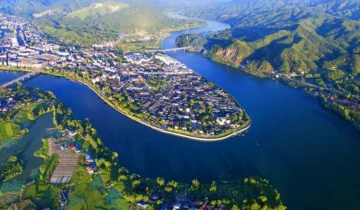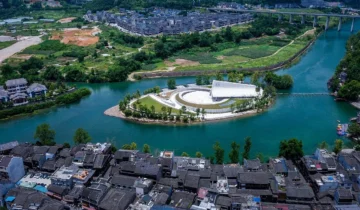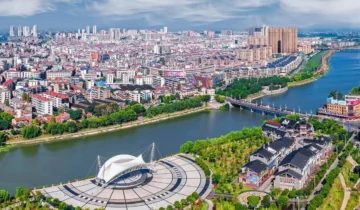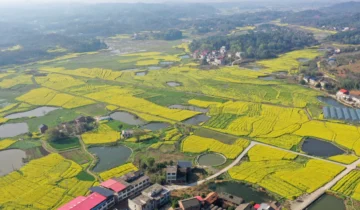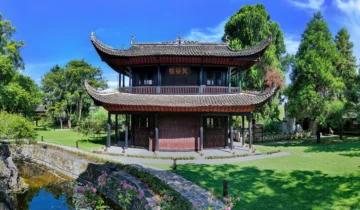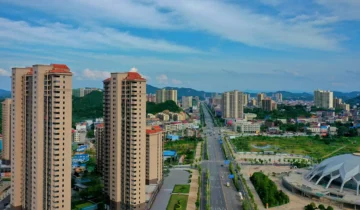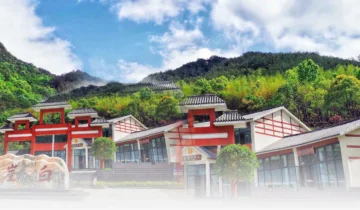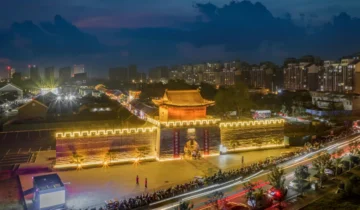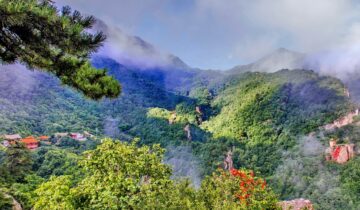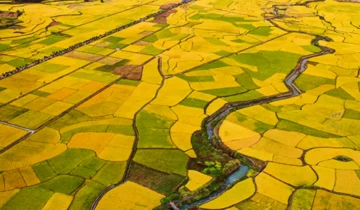
Jiahe County, Hunan Province
The smallest county in Hunan by area packs an outsized punch – the foundry capital of the south, home to two Mao Dun Literature Prize winners, and a folk-song tradition that dates back to Shennong.
The smallest county in Hunan by area packs an outsized punch – the foundry capital of the south, home to two Mao Dun Literature Prize winners, and a folk-song tradition that dates back to Shennong.
With 72 percent forest cover – the highest in Hunan – Huitong is a land of timber villages, the childhood home of a founding general, and a 600-year-old Dong settlement where wood tells the story.
The headpiece alone can weigh two kilograms. Silver flowers, silver butterflies, silver chains layered from crown to waist — a Miao woman in festival dress carries her family’s wealth on her body. Coiled neck rings, three to seven deep. Bracelets that clatter with every step. Earrings long enough to brush the shoulder. This tradition of wearing silver as armor, as identity, as portable savings, has its strongest expression in Yayou, a mountainous township of Huayuan County in western Hunan. The…
The oldest lacquer vessel ever found in the middle Yangtze was lifted from the mud of a pond inside a prehistoric city wall. It is a wooden bowl, 9.5 centimeters across, with walls no thicker than two sheets of paper. The red paint on its interior still shines. The black paint along its rim still holds its gloss. The bowl was made 5,000 years ago by people of the Qujialing culture, who built a double-walled city here on the Dongting…
Inside the Wang clan hall, the roof is held up by dougong brackets — interlocking wooden joinery that architects compare to the Forbidden City. Five distinct styles of bracket arm carry the load. At the center of the stage, an octagonal caisson ceiling carved with stars and celestial flowers rises above the floorboards. The building has survived a Mongol invasion, seven dynastic transitions, and the Cultural Revolution. It was founded in 1061, during the Song dynasty, and when the Ming emperor Yongle’s…
The seed that changed what a billion people eat was found in a flooded field outside Anjiang. A single panicle of wild rice carrying a natural male sterility trait, discovered by a technician working for a young agronomist named Yuan Longping, who had been assigned to the Anjiang Agricultural School in the mountains of western Hunan. From that one seed head came the first generation of hybrid rice, and from that, a technology that now covers half the world’s rice…
On three sides, mountains encircle the county seat like walls. On the fourth, the Xiang River runs south, wide enough for thousand-ton cargo ships. At the center rises the peak that gives the county its name — Mount Heng (Nanyue), the Southern Sacred Mountain. The county of Hengshan, part of Hengyang in central-eastern Hunan, covers 934 square kilometers across 12 townships. It has carried this name since the Western Jin dynasty, when an administrative reorganization in 290 AD renamed it…
“Two men drink facing mountain blossoms, one cup, then another, then another. I’m drunk and about to sleep — you may go, but come tomorrow with your zither if you’d like.” That is Li Bai, China’s most beloved poet, writing in what is now Susong County. The valley where he sat has changed little, but the poem itself has become a kind of landmark: this is a place that has always welcomed visitors with open bottles and unhurried afternoons. Li…
In the autumn of 1959, when the newly founded People’s Republic served its tenth anniversary National Day banquet, the wine at the head table came from a county in northern Anhui. Suixi produces Kouzi, a spirit whose name means “at the gate” and has been brewed on the same land for at least 600 years. The banquet was a single data point in a much longer story: Suixi has been making wine since the Spring and Autumn period, when a…
In 594 BCE, the state of Jin established two counties on the western edge of the Fen River plain. One became Xiaoyi. The other, Fenyang — 1,179 square kilometers, 410,000 permanent residents, on the Lüliang side of the Fen River — would go on to spend 1,690 of its more than 2,600 years as a prefecture, governing a territory far larger than itself. For most of Chinese imperial history, this was not a county-level city on the western edge of…
In the winter of 1936, Mao Zedong crossed the Yellow River into Shanxi with a force of 20,000 men and spent the next 75 days fighting through the province. He spent 62 of those days — more than four-fifths — in one small county carved out of the Lüliang Mountains 35 years later. He visited every one of its seven townships, stayed in seven different villages, and from its hills commanded the battles that defined the Eastern Expedition. That county…
In 627 CE, the second year of the Zhenguan era, Emperor Taizong of Tang heard a story from Xiaoyi: a man named Zheng Xing had cut flesh from his own thigh to feed his starving mother. Taizong was moved enough to rename the entire county. He combined the characters for filial piety (xiao) and righteousness (yi), creating a place name that has outlasted the Tang dynasty by more than a millennium. Xiaoyi — 937.6 square kilometers, 477,000 permanent residents, in…
Two mountains embrace a plain; a single river divides the basin. The landscape gave the place its name: Zhongyang — “center of the sun’s side of the river,” a county seat that has sat in this valley for 2,200 years. In Lüliang, Zhongyang County spans 1,441 square kilometers with 155,500 registered people and a 2024 GDP of 20.1 billion yuan. Zhongyang’s identity comes in layers. Its cultural signature is paper-cutting — Zhongyang jianzhi — among the first crafts inscribed on…
The Yongle Encyclopedia records a mountain in present-day Lüliang whose name gave the county its own: Fangshan — “Square Mountain” — where the “red flood” river originates. Nestled in the heart of the Lüliang Mountains, Fangshan County (1,434 square kilometers, 112,600 people) is known as Lüliang’s Back Garden, a green stretch with 41 percent forest cover and 109 million cubic meters of water — the prefecture’s main drinking water source. The county produced Yu Chenglong — the Qing dynasty governor-general…
Lanxian County — 1,512 square kilometers, 187,000 people — sits on the northern end of the Lüliang Mountains, named for the nearby Kekan Mountains. It produced Zhang Minjue, the “Test-Tube Baby Father” — a world-renowned reproductive physiologist. The county reaches further back. The Xiurong Ancient City, founded in 204 BCE by Liu Bang’s Han dynasty and expanded in 410 CE by the Xianbei commander Erzhu Yude, served as a commandery capital for 730 years before being burned by Gao Huan…