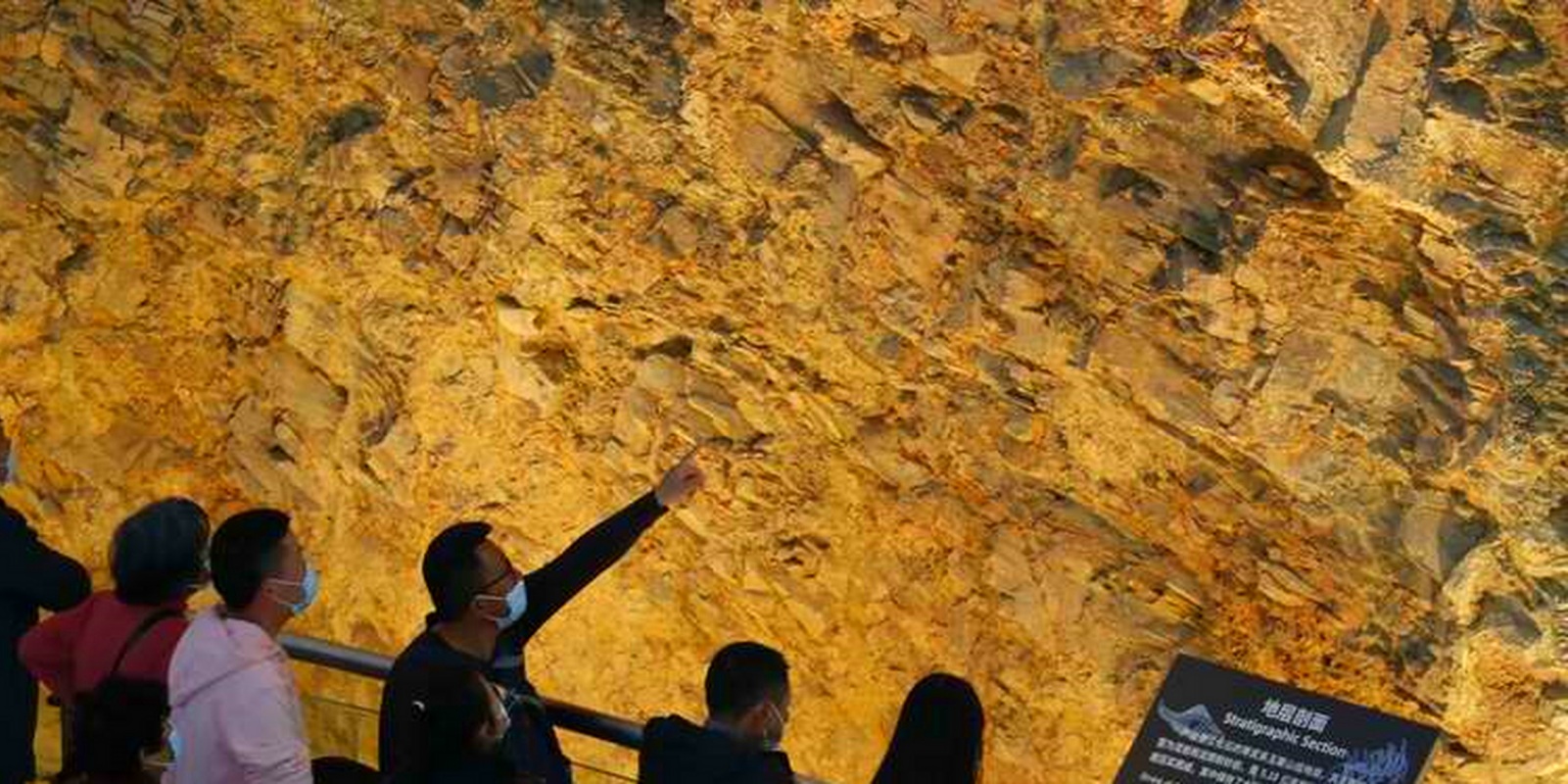
The Chengjiang Fossil Site, located in Yunnan Province near the shore of Fuxian Lake, is one of the world’s most important paleontological sites — a deposit of Middle Cambrian fossils so exquisitely preserved that it has fundamentally reshaped our understanding of the Cambrian Explosion, the most dramatic evolutionary event in the history of animal life. Inscribed as a UNESCO World Heritage Site in 2012, the site contains over 200 species of early Cambrian animals, many preserved with their soft tissues intact — muscles, gills, digestive tracts, and even nerve cords — offering a window into the dawn of animal evolution that exists nowhere else with such clarity.
🪔 The Moment Life Became Visible
Somewhere between approximately 541 and 485 million years ago, spanning the duration of the Cambrian Period, something extraordinary happened in the ancient oceans of the Cambrian Period. The vast majority of the major animal groups that exist today — arthropods, mollusks, annelids, chordates — made their first appearance in the fossil record within a geological instant of less than 20 million years, primarily during the late Early Cambrian (approximately 518 million years ago). This was the Cambrian Explosion, the most rapid diversification of animal life in Earth history. Before the Cambrian, life was mostly microscopic and soft-bodied — jellyfish, worms, and microbial mats. After the Cambrian, the oceans teemed with animals of every shape and design, many of them armored with exoskeletons and equipped with sophisticated sensory organs. The Chengjiang fossil bed captures this moment of transformation with a fidelity that borders on the impossible. The sediments that form the Maotianshan Shale were deposited in a deep, quiet basin on the edge of the Cambrian Yangtze Sea, where fine-grained mud settled gently over dead animals, burying them in an oxygen-free environment before scavengers could disturb them or bacteria could decay their soft tissues. Over 518 million years, these sediments were compressed into rock, preserving each animal as a two-dimensional carbon film — a shadow of the original organism, but a shadow that retains details invisible in any other Cambrian fossil site. Where the famous Burgess Shale in Canada shows the external anatomy of Cambrian animals, Chengjiang shows their internal organs: the three-lobed brain of the early arthropod Fuxianhuia, the musculature of the swimming worm Ottoia, and — most remarkably — the nerve cord and brain of the earliest known fish-like chordate, Myllokunmingia, the first known vertebrate ancestor with a skull.
🔬 The Menagerie of the Early Cambrian Ocean
More than 200 species have been described from the Chengjiang biota, and new ones are discovered every year. The deposits preserve a complete Cambrian ecosystem, from the top predators to the bottom sediment-feeders. Anomalocaris, a meter-long apex predator with compound eyes on stalks and a circular mouth ringed with razor-sharp plates, was the terror of the Cambrian seas — one of the largest known Cambrian predators. Its grasping appendages, each tipped with a spine, are preserved at Chengjiang in such detail that scientists can count every individual plate on the oral cone. Naraoia, a soft-bodied trilobite relative, is preserved with its digestive tract intact, the last meal still visible inside its gut — tiny ostracods and fragments of shell revealing exactly what it ate on the day it died, 518 million years ago. The priapulid worm Ottoia is preserved curled in the burrows it dug in the sediment, its proboscis everted in the act of feeding, frozen in time mid-meal. The site has yielded some of the oldest known examples of eyes with crystalline lenses, of limb joints, of gills, of compound vision — the first instances of evolutionary innovations that would later become standard equipment across the animal kingdom. Each new fossil from Chengjiang is like a single frame from a film that recorded the first act of the animal story — a film of which we have only a few seconds, but those seconds are the most important in the history of life on Earth.
🧬 Myllokunmingia: Our Oldest Ancestor?
The most extraordinary fossil from Chengjiang, discovered in 1999, is Myllokunmingia fengjiaoa — a fish-like animal just 2.8 centimeters long, preserved in a slab of dark shale with all its internal anatomy visible. Myllokunmingia has a skull, a backbone precursor (a notochord), a heart, a liver, paired eyes, and gill slits — the earliest known example of a chordate with a skull, making it one of the oldest known ancestors of all vertebrates, including ourselves. The fossil shows a pair of V-shaped muscle blocks (myomeres) along its body, a black carbon film marking the position of the liver, and the impression of a brain Case in the head region. It was a small filter-feeder, swimming in the Cambrian seas 518 million years ago, entirely unaware that its body plan — the body plan of all vertebrates — would one day produce dinosaurs, blue whales, and philosophers. The preservation of Myllokunmingia is so complete that scientists have been able to reconstruct its swimming mode, its feeding ecology, and even its sensory capabilities. It had a lateral line system — a row of sensors along its flanks that detect water movement, still present in modern fish — making it one of the earliest animals able to sense its environment with a specialized organ system. Standing before the single slab that contains the Myllokunmingia holotype — barely larger than a thumb — is a humbling experience. In this tiny fish-shaped carbon film lies the earliest chapter of our own evolutionary story, compressed into a space smaller than a human hand, buried for half a billion years before being exposed by the careful hammer of a paleontologist working at dawn on a Yunnan hillside.
🌏 Fuxian Lake: Where Science Meets Serenity
The Chengjiang Fossil Site sits on the shores of Fuxian Lake, one of the deepest and clearest freshwater lakes in China. The lake reaches depths of 155 meters and holds water so transparent that visibility extends to 12 meters — a clarity that is itself a scientific curiosity, explained by the lake’s low nutrient levels and a unique zooplankton population that filters the water continuously. Fuxian Lake is also a living fossil site: it harbors a population of the endemic Kanglang fish (Anabarilius polylepis), a species that has remained virtually unchanged for 5 million years. The juxtaposition is poignant: on one shore lies the evidence of the moment animal life began its diversification; on the other swims a fish that has remained unchanged since the Pliocene — a reminder that evolution moves at different speeds for different lineages. The Maotianshan Geological Park at the site includes a museum where visitors can see the actual fossil slabs and watch scientists preparing new discoveries under microscopes. The quarry itself, a hillside of dark laminated shales, is still being excavated — each rainy season erodes new exposures, and every year yields new species. The best time to visit is from October to April, when the Yunnan sun is warm and the excavation season is open. The fossils of Chengjiang do not need a grand landscape to tell their story — they tell it in the grain of the rock, in the carbon traces of animals that swam in an ocean that existed before the first mountain was raised, before the first flower bloomed, before any living thing had ever crawled onto land.