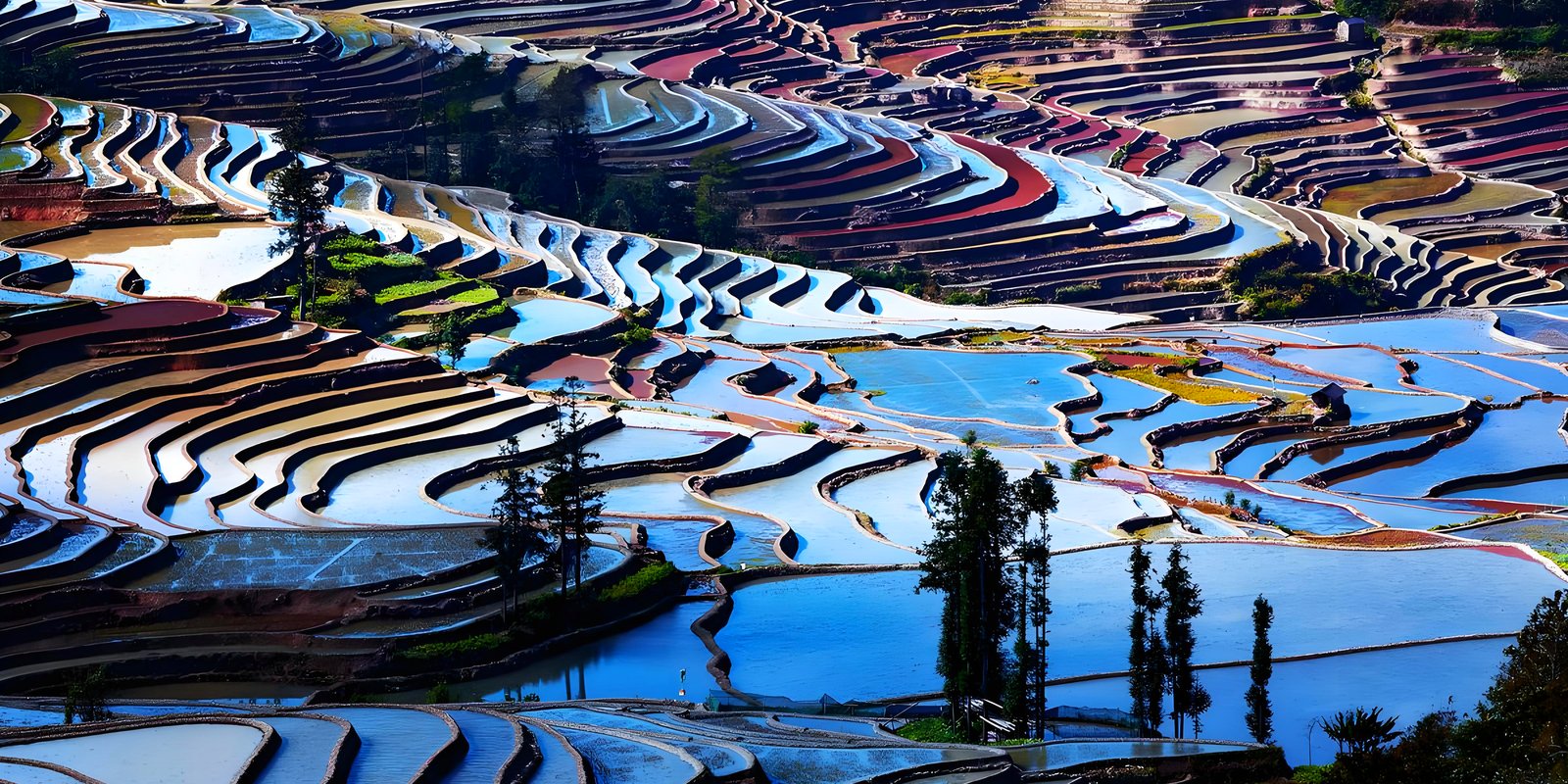
The Honghe Hani Rice Terraces Cultural Landscape, inscribed as a UNESCO World Heritage site in 2013 in the mist-shrouded Ailao Mountains of Yunnan Province (23°05’N, 102°46’E), represents one of the most remarkable examples of human agricultural ingenuity on Earth. For over 1,300 years, the Hani people have carved terraced rice paddies into the steep mountain slopes, creating a cascading landscape of breathtaking beauty that stretches from the rushing valleys to the cloud-shrouded peaks — a living testament to the harmony possible between human civilization and the natural world.
🌾 The Four-Element System: Forest, Water, Terrace, Village
At the heart of the Hani terraces lies an elegant ecological system known as “四素同构” (the four-element structure). Dense forests cap the mountain summits, capturing moisture from the clouds and monsoon rains. This water percolates through the soil and emerges as springs that feed an intricate network of irrigation channels. The channels carry water down through the terraced paddies, each terrace spilling into the next like a giant staircase of liquid mirrors. At the middle elevations, Hani villages nestle among bamboo groves, their mushroom-shaped houses (known as “mushroom houses” or 蘑菇房) built from rammed earth and thatch. This integrated system — forest above, villages in the middle, terraces below — represents a sustainable model of mountain agriculture that has operated successfully for more than a millennium.
🌅 The Sea of Mirrors
From the viewpoint at Duoyishu, the Hani Rice Terraces present one of the most photographed landscapes in China. At sunrise, the flooded terraces catch the first rays of light, transforming into thousands of mirrored fragments that reflect the changing colors of the sky — from deep violet to rose to blazing gold. During the rainy season (May to September), the terraces are filled with water and young rice shoots, creating a shimmering mosaic that stretches to the horizon. In autumn, the ripening rice turns the mountains into a golden patchwork before the harvest. The terraces are never the same from one moment to the next; their appearance shifts constantly with the light, the season, and the weather.
💧 An Indigenous Masterpiece of Water Management
The scale of the Hani irrigation system is staggering. The total length of the hand-dug irrigation channels exceeds 4,000 kilometers — roughly the distance from Beijing to Singapore. These channels, many of which have been in continuous use for centuries, distribute water from the forested mountaintops to every individual terrace according to a complex system of water rights managed by village councils. The “muzhazha” (木杈杈) system — a simple wooden divider placed in irrigation channels — allocates water to different households based on ancient agreements that are passed down through oral tradition. This indigenous water management system has sustained the terraces through droughts and floods, dynasties and revolutions, for over a thousand years.
🎭 The Hani People: Guardians of the Landscape
The Hani ethnic group (哈尼族), numbering approximately 1.6 million people, are among China’s most distinctive minority cultures. Their oral traditions trace their origins to the highlands of the Tibetan Plateau, from which they migrated southward over many centuries. The Hani have no written language of their own, but their culture is rich in oral poetry, song, and ritual. The annual Kuzhazha Festival, or “Drinking New Rice Wine Festival,” celebrates the harvest with feasting, dancing, and ceremonial offerings to the ancestors. The Hani’s relationship with the terraces is not merely economic — it is spiritual, with mountain gods and water spirits playing a central role in their traditional belief system.
🌐 A Model for the World
In an era of climate change and environmental degradation, the Honghe Hani Rice Terraces offer profound lessons in sustainable agriculture. The UNESCO citation specifically recognized the terraces as “an outstanding example of traditional human settlement and land-use” — a rare acknowledgment that indigenous knowledge systems can be as sophisticated, and as effective, as modern industrial approaches. In 2025, the Hani Rice Terraces were also added to the World Heritage Irrigation Structures list, further confirming their status as a global model of sustainable water management. As the world grapples with how to feed a growing population without destroying the planet, the Hani people’s 1,300-year experiment in sustainable agriculture has never been more relevant.
🧭 Visiting the Terraced Mountains
The core terrace area is located near Yuanyang County, approximately 300 kilometers south of Kunming. The best time to visit is from December to April, when the terraces are filled with water and the reflective effect is at its most spectacular. The rainy season (May to September) brings lush green rice and dramatic cloud formations but also frequent downpours. Key viewpoints include Duoyishu (famous for sunrises), Bada (afternoon light), and Laohuzui (panoramic views). Visitors can also stay in Hani villages, hike the irrigation channels, and sample local specialties such as purple rice and bamboo shoots harvested from the mountain forests.