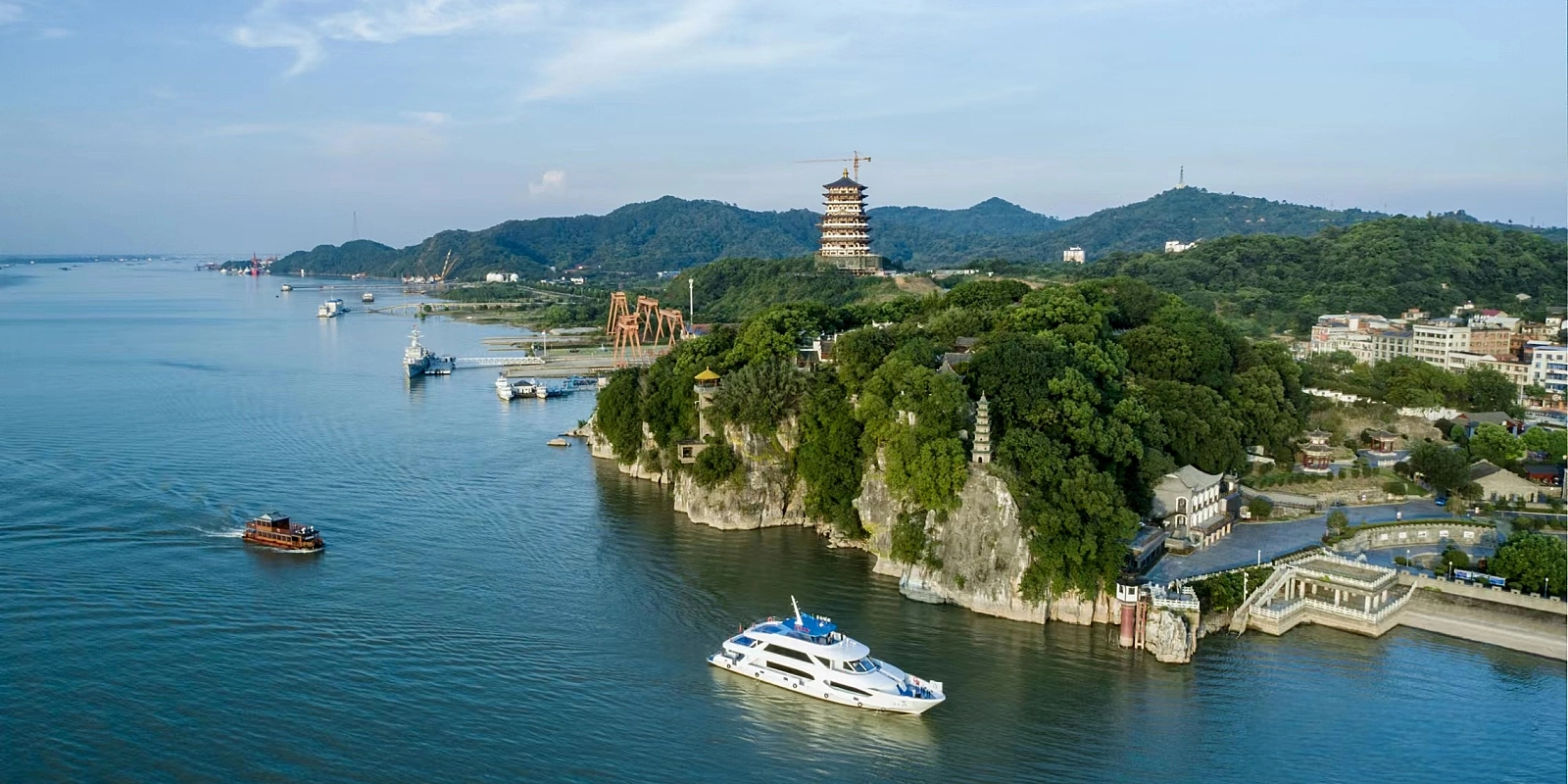
At the mouth of China’s largest freshwater lake, where the waters of Poyang Lake merge into the Yangtze River, a visible line divides the two bodies of water — clear blue on one side, muddy brown on the other. This natural phenomenon, known as “Two Rivers, Two Colors,” has drawn poets and painters for over a millennium, and the best place to witness it is from the ancient Stone Bell Mountain in Hukou County. Established as an administrative division in 950 AD during the Southern Tang dynasty, Hukou covers 673 square kilometers at the junction of Jiangxi, Hubei, and Anhui provinces, with a population of 300,000 across 5 townships and 7 towns. Its name literally means “mouth of the lake,” and with 24 kilometers of Yangtze riverfront — including 10 kilometers of deep-water shoreline — Hukou serves as Jiangxi’s “Northern Water Gateway.”
💡 Featured Industries
- Port and Waterway Economy: With 24 kilometers of Yangtze River coastline including 10 kilometers of deep-water berths, Hukou is Jiangxi’s premier water transport hub. 10,000-ton vessels can reach Wuhan and Chongqing upstream, and Nanjing and Shanghai downstream. The port economy is a cornerstone of Hukou’s industrial development, with growing cargo and container throughput serving the entire province’s import-export needs.
- Advanced Manufacturing and Metallurgy: Hukou’s riverside industrial zone hosts a significant metallurgical and chemical industry cluster. The county benefits from its strategic position at the intersection of the Poyang Lake Eco-Economic Zone and the Yangtze River Economic Belt, attracting large-scale industrial investments in steel, non-ferrous metals, and heavy chemicals.
- New Materials and Chemicals: The county’s industrial parks are home to enterprises in synthetic materials, fine chemicals, and construction materials. Leveraging deep-water port access for bulk raw material transport, Hukou has developed a competitive edge in heavy industrial production serving both domestic and export markets.
- Shipbuilding and Marine Engineering: Hukou’s waterfront location supports a shipbuilding and marine equipment industry, taking advantage of the deep-water shoreline and direct access to the Yangtze River shipping lane. The sector serves both commercial vessel construction and specialized marine equipment manufacturing.
- Modern Logistics: The county’s integrated “water-rail-highway-air” transportation network — including the Hangzhou-Ruili Expressway, Pengze-Hukou Expressway, Tongling-Jiujiang Railway, and Jiujiang-Jingdezhen-Quzhou Railway — positions Hukou as a regional logistics hub. Three airports within 90 minutes (Nanchang Changbei, Jiujiang Lushan, and Jingdezhen) complete the multimodal transport system.
🗺 Tourist Attractions
- Stone Bell Mountain: A nationally renowned scenic area and major cultural landmark, Shizhongshan is Hukou’s most famous landmark. The mountain sits at the confluence of Poyang Lake and the Yangtze River, where the famous “Two Rivers, Two Colors” phenomenon is visible — clear lake water meeting muddy river water in a sharp dividing line. Su Dongpo’s essay “Record of Stone Bell Mountain” is a staple of Chinese textbooks and immortalized this site in literary history. The mountain features caves, pavilions, and hundreds of historical cliff-side inscriptions.
- Dagu Mountain: A solitary island-mountain rising from Poyang Lake, known as “Shoe Mountain” for its distinctive shoe-like shape. It is a national-level scenic spot featuring unique geological formations, temple buildings, and panoramic lake views. The mountain is accessible by boat from the Hukou lakeside and is a popular day-trip destination.
- Yanlie Mountain National Forest Park: A national forest park featuring lush mountains, hiking trails, and commanding views over Poyang Lake and the Yangtze River. The park’s dense forest cover and diverse ecosystem make it a popular destination for eco-tourism and outdoor recreation.
- Poyang Lake Waters (Hukou Section): The vast expanse of Poyang Lake within Hukou offers spectacular lake scenery, migratory bird watching during winter months, and boat tours exploring the lake’s islands and waterways. The lake’s western shore provides some of the best vantage points for the famous “lake-mouth” panorama.
- Historical Battlefield Sites: Hukou’s strategic location made it a battleground for centuries — including the 18-year-long struggle between Zhu Yuanzhang and Chen Youliang on Poyang Lake, the Taiping Army versus the Xiang Army, and the 1913 “Second Revolution” led by Li Liejun. The site where the People’s Liberation Army first crossed the Yangtze River in 1949 is also located in Hukou.
🎭 Culture
- Qingyang Opera: Hukou is home to Qingyang Opera, a national-level intangible cultural heritage and one of the oldest surviving forms of Chinese opera. In 2015, the art form was performed internationally at South Korea’s “Arirang Festival.” Its distinctive singing style and theatrical conventions have influenced opera traditions across Jiangxi and beyond.
- Hukou Grass Dragon: Another national intangible cultural heritage, the Hukou Grass Dragon is a unique folk art form where dragons are intricately woven from rice straw. These magnificent creations — sometimes dozens of meters long — are paraded during festivals and have been exhibited as far as Macau. The craft requires exceptional skill passed down through generations.
- Hukou Ba (Rice Cake) Custom: A provincial-level intangible cultural heritage, this tradition encompasses the making and sharing of various rice cakes for festivals, ceremonies, and daily life. Each type of ba has its own symbolic meaning and is prepared using specific techniques and ingredients.
- Poets’ and Calligraphers’ Legacy: Hukou is known as the “Hometown of Chinese Folk Art,” “Hometown of Opera,” and “Hometown of Chinese Poetry.” Over 100 famous historical figures — including Su Dongpo, Tao Yuanming, Li Bai, Lu You, and Huang Tingjian — composed over 600 poems about Hukou. Wei Zheng, Zheng Banqiao, Mi Fu, Zeng Guofan, and Peng Yulin left over 100 cliff-side inscriptions and steles that survive to this day.
- Hukou Fermented Black Beans: A provincial intangible cultural heritage and recognized “China Time-Honored Brand”, Hukou fermented black beans are made using traditional techniques passed down for centuries. The beans are prized for their rich umami flavor and used extensively in Chinese cooking.
🚗 Getting There
- Road: Hukou is served by the Hangzhou-Ruili Expressway (G56) and Pengze-Hukou Expressway. The county is 26 kilometers from Jiujiang city center and 160 kilometers from Nanchang, connected by well-maintained highways.
- Rail: The Tongling-Jiujiang Railway and Jiujiang-Jingdezhen-Quzhou Railway both pass through Hukou. The county is also on the planned Chizhou-Jiujiang intercity line and the Hefei-Anqing-Jiujiang passenger dedicated line, which will further enhance rail connectivity.
- Water: With 24 kilometers of Yangtze River shoreline, Hukou’s deep-water port can accommodate 10,000-ton vessels. Shipping routes reach Wuhan and Chongqing upstream, and Nanjing, Shanghai, and the East China Sea downstream.
- Air: Three airports are within 90 minutes’ drive: Nanchang Changbei International Airport, Jiujiang Lushan Airport, and Jingdezhen Luojia Airport, providing both domestic and international connections.
🍜 Local Cuisine
- Hukou Fermented Black Beans: A “China Time-Honored Brand” product made using centuries-old techniques. The beans are steamed, fermented, and aged to develop a deep, savory flavor. Used as a seasoning for meats, vegetables, and steamed fish, this is Hukou’s most iconic culinary export.
- Wine-Fermented Fish: Fresh fish from Poyang Lake, cured and fermented with rice wine lees, salt, and spices. The resulting product has a distinctive fermented aroma and tender texture, often steamed or pan-fried as a savory side dish.
- Poyang Lake Fish Head Stew: A hearty stew made with large freshwater fish heads from Poyang Lake, slow-cooked with tofu, ginger, scallions, and chili in a rich broth. The dish is prized for its silky texture and deep lake flavor.
- Hukou Rice Cakes: Made from glutinous rice flour, these traditional cakes come in many varieties for different occasions — sweet osmanthus ba for festivals, savory vegetable ba for daily meals, and leaf-wrapped zongzi-style ba for Dragon Boat Festival.
- Lake Shrimp with Spring Onions: Freshwater shrimp caught from Poyang Lake, simply stir-fried with spring onions, ginger, and a touch of rice wine. The minimal preparation lets the natural sweetness of the lake shrimp shine through.