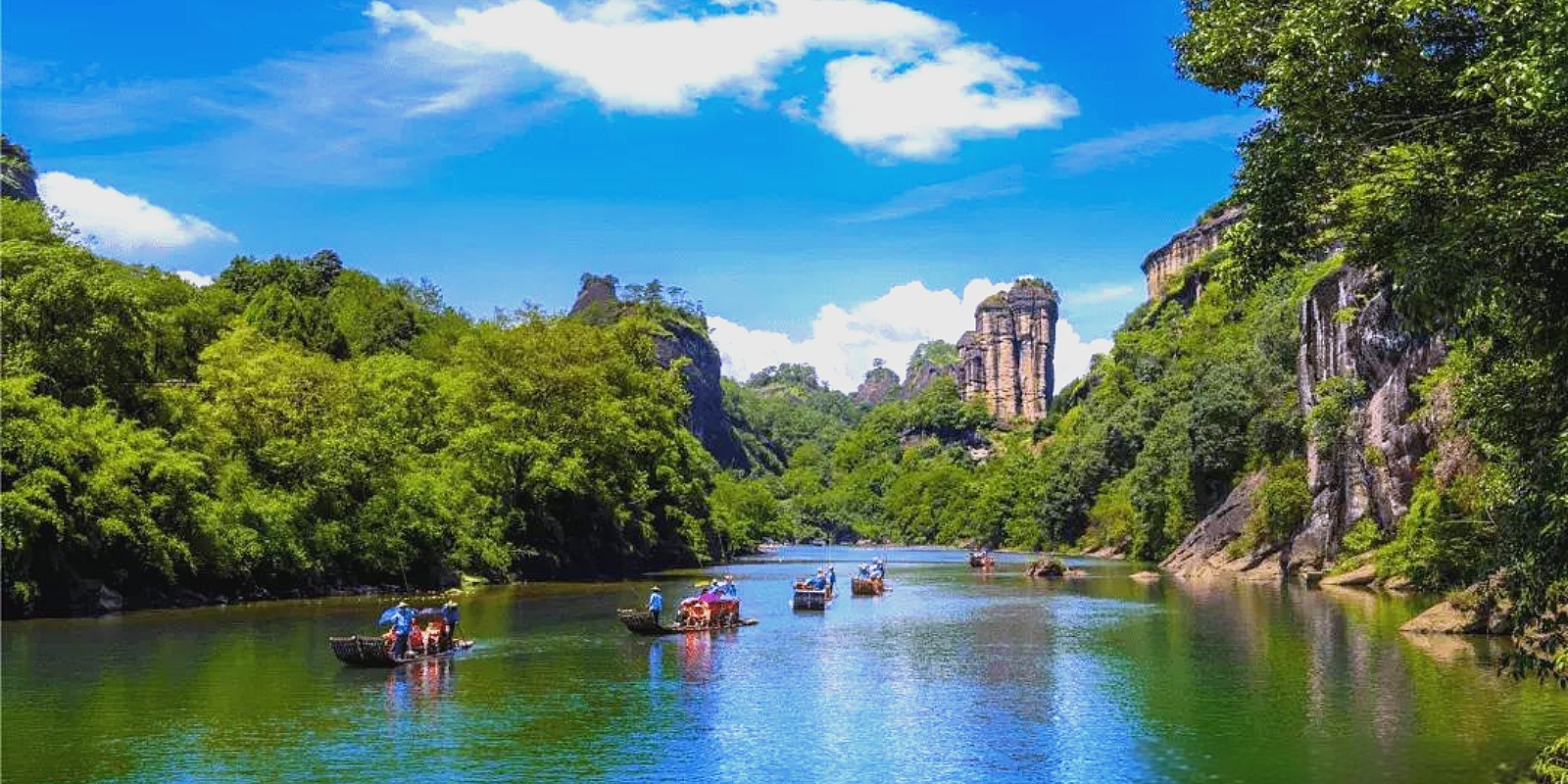
Mount Wuyi (Wuyishan), located in the Wuyi Mountains of northern Fujian Province, is the most culturally layered of China’s World Heritage dual sites — a landscape where a dramatic Danxia red sandstone topography of cliffs, gorges, and river bends has been continuously inhabited, cultivated, and worshiped for over 2,000 years, and where the most influential philosopher of the last millennium formulated the ideas that shaped East Asian civilization. This UNESCO World Heritage dual site (1999) covers a vast area and protects not only a distinctive landscape but also the birthplace of Neo-Confucianism, the cradle of the world’s finest tea, and the largest surviving complex of ancient cliff tombs in China.
🏜️ The Danxia Landscape: A Red Sandstone Masterpiece
Mount Wuyi’s landscape is built from Cretaceous red sandstone — the same Danxia formation that produces the dramatic red cliffs of China’s Danxiashan sites, but here expressed in a distinctive topographical form. Roughly 100 million years ago, the Wuyi region was a continental basin. Rivers carried sand and gravel from surrounding mountains into the basin, depositing thick sequences of sediment that were alternately red (oxidized during dry periods) and gray-green (reduced during wet periods). Over millions of years, the sediment was buried and cemented into the Wuyi Formation. Then, during the Eocene epoch, the Indian-Eurasian collision transmitted compressional forces through the continental crust, uplifting the basin and gently tilting the sandstone layers. The resulting joint system — vertical fractures spaced at intervals of several hundred meters — guided the erosion that followed. The Nine-Bend River flows through the heart of the tilted sandstone mass, following the major joints and creating spectacular meanders between the red cliffs. The cliffs rise dramatically from the water’s edge, their red faces streaked with minerals seeping from the bedding planes. The vegetation — a dense subtropical forest of bamboo, camphor, and pine — clings to every horizontal surface, and in the autumn, the red cliffs, green forest, and blue water create a primary-color landscape that looks like a Chinese painting made real — which is appropriate, because the landscape of Wuyi has been a subject of Chinese painting for over a thousand years, and the visual vocabulary of the Wuyi landscape (the red cliff, the winding river, the bamboo grove, the scholar’s pavilion) has become one of the standard elements of the Chinese landscape tradition.
🍵 The Birthplace of Dahongpao: The Emperor of Tea
Mount Wuyi is the birthplace of the most famous tea in China — Da Hong Pao (Big Red Robe), the legendary oolong grown on the red sandstone cliffs and presented to emperors for centuries. The six original mother bushes are considered a living national treasure. Since 2007, they have been permanently retired from harvesting; the final plucking was presented to the Palace. The “rock rhyme” (yan yun) flavor of Wuyi oolongs — a complex profile combining floral notes with the taste of stone — is a direct product of the geology: tea roots grow through weathered sandstone. Over twenty varieties are cultivated here, including the famous “Four Great Famous Bushes”: Da Hong Pao, Tie Luohan, Bai Jiguan, and Shui Jin Gui, alongside the popular Rou Gui (Cinnamon) and Shui Xian (Narcissus). The traditional roasting process, giving the teas their dark color and smoky aroma, has been practiced for over a thousand years. In 2006, this craft was recognized by inscription on China’s inaugural National Intangible Cultural Heritage List. The UNESCO designation recognizes the tea gardens and workshops as part of the cultural heritage — making Wuyi one of the rare agricultural landscapes protected within a World Heritage site. Mount Wuyi is also the original source of Lapsang Souchong, the world’s first black tea, created here in the 17th century — a development that would forever change global tea culture.
📜 The Birthplace of Neo-Confucianism: Zhu Xi’s Legacy
Mount Wuyi’s greatest contribution to world civilization is not tea but an idea: Neo-Confucianism, the philosophical system of Zhu Xi (1130–1200 CE), the most influential Chinese thinker after Confucius. He established his Wuyi Academy in 1183, where his commentaries on the Confucian classics became state orthodoxy for over 600 years. The restored academy complex sits on a terraced slope above the Nine-Bend River — a site chosen deliberately, because Zhu Xi believed the landscape itself taught the principles of order and balance central to his philosophy. The “Wuyi Boat,” a stone boat-shaped pavilion where he is said to have written his most important works, remains one of the most evocative spots on the mountain. Zhu Xi wrote nine poems about the Nine-Bend River, one for each bend, aligning the river’s turns with stages of moral self-cultivation — poems recited by Chinese schoolchildren for over 800 years. The Wuyi Mountains also contain ancient cliff tombs — “boat coffins” placed on ledges high on the vertical cliff faces approximately 3,000 to 4,000 years ago, their placement a mystery that remains unsolved. These three layers — cliff tombs, Zhu Xi academies, and tea gardens — make Wuyi one of the most culturally dense landscapes in China.
🛶 The Nine-Bend River: A Journey Through a Painted Scroll
The best way to experience Wuyi is from a Nine-Bend River (Jiuqu Xi), on a bamboo raft that drifts downstream through the heart of the Danxia landscape. The river journey covers roughly 10 kilometers and takes about two hours, passing between red sandstone cliffs that rise on both sides. The raft — a flat platform of bamboo poles lashed together, steered by a boatman with a single pole — moves silently through the water, and the only sounds are the water flowing over the shallows, the birds calling from the cliffs, and the boatman’s commentary, delivered in the local Fujian dialect, pointing out named peaks and rock formations: the “Catcher’s Hat Peak,” the “Jade Maiden Peak,” the “Tiger Roar Rock” — names that have been in local use for a thousand years. Each bend of the river reveals a new composition: a cliff face veined with black manganese dendrites, a bamboo grove at the water’s edge, a tea terrace climbing a hillside, a pavilion perched on a rock outcrop. The red cliffs glow at dawn and deepen through the afternoon. The comparison is not accidental: the Song Dynasty painters directly inspired by this landscape developed their visual vocabulary from the experience of the Nine-Bend River. A visit to Mount Wuyi is accessible by high-speed rail from major Chinese cities to Wuyishan North Station, followed by a short bus ride to the scenic area. The best time to visit is in the autumn, when the weather is mild, the air is clear, and the tea harvest is in its second flush. Drifting down the Nine-Bend River in the late autumn light, with the red cliffs glowing against the green of the bamboo and the scent of the roasting tea drifting down from the hillside workshops, is to experience a landscape that has been the subject of more poetry, painting, and philosophical meditation than any other in China — a landscape where the human engagement with nature has been so long and so deep that the boundary between the natural and the cultural has become impossible to draw.
Data Source: UNESCO World Heritage Centre