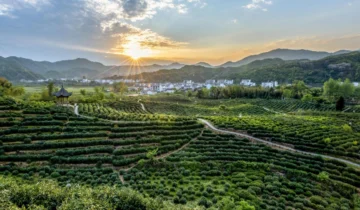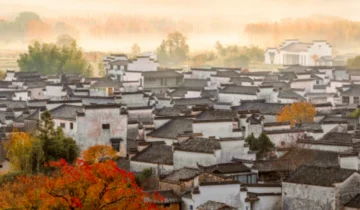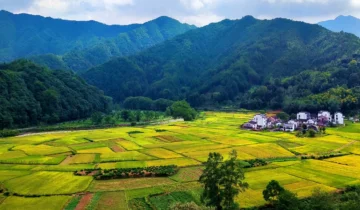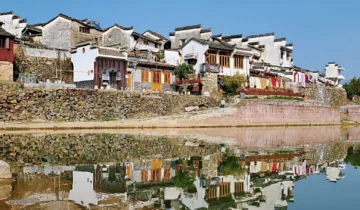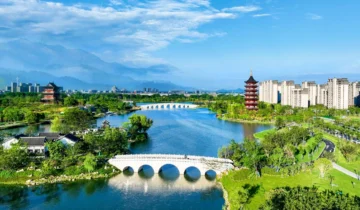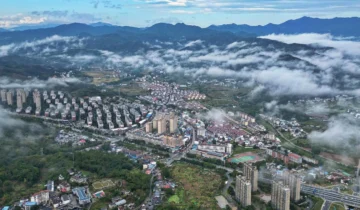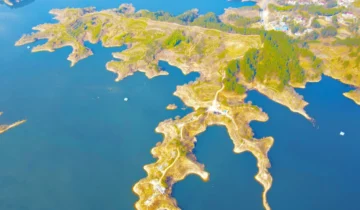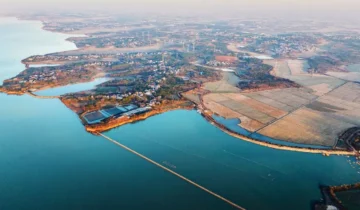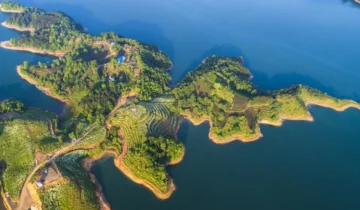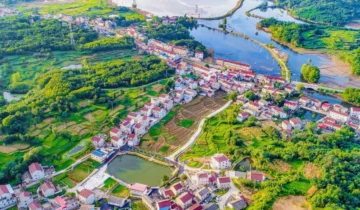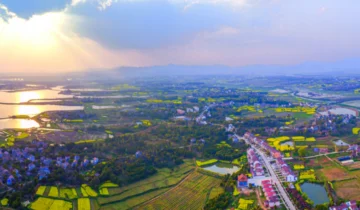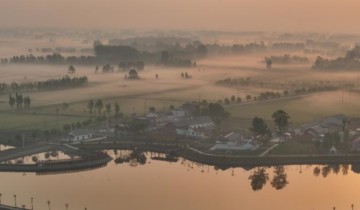
Dingyuan County, Anhui Province

Dingyuan County covers 3,002 square kilometers in central Anhui, making it the largest county by area in Chuzhou prefecture. It holds 676,000 permanent residents — about a third fewer than its registered population of 977,000, a gap that reflects the steady outward pull of Hefei and Nanjing, both reachable within 30 minutes by high-speed rail. The county’s name dates to 524 AD, during the Liang dynasty, when Emperor Wu sent a general named Cao Shizong to recapture the territory from…

Quanjiao County, Anhui Province

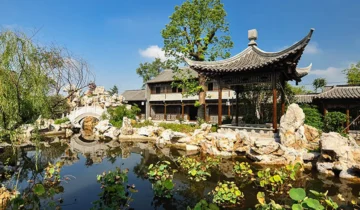
In the early 18th century, a scholar from an eastern Anhui county sat down to write a novel about the examination system, the vanity of official life, and the men who pursued both with desperate earnestness. The book was The Scholars — Rulin Waishi — and its author, Wu Jingzi, produced what Lu Xun called “China’s first true work of literary satire.” The county that produced him is Quanjiao, 1,568 square kilometers under Chuzhou, with a history that reaches back…

Lai’an County, Anhui Province

Lai’an County is the administrative division of Anhui closest to Nanjing, under Chuzhou prefecture, covering 1,494 square kilometers with a registered population of 478,000. Its southern town of Chahe sits just 12 kilometers from the Nanjing Yangtze River Bridge, and the county seat is 60 kilometers from downtown Nanjing, 80 kilometers from Nanjing Lukou International Airport, and 145 kilometers from Hefei. This location, at the junction of the Anhui plains and the Jiangnan water network, has shaped the county’s history…

Yixian County, Anhui Province

The character ? (yi) means “black” – the color of old roof tiles and aged timber, the color that runs through this county in southern Anhui like a brushstroke. Yixian shares its name with the mountain beside it: Huangshan, “Yellow Mountain,” was once called Mt. Yi, and the county founded in 221 BC at its southern foot still carries the ancient word. It belongs to Huangshan city today, one of the oldest county-level units in China, with a “Millennium Ancient…

Xiuning County, Anhui Province

Nineteen. That is how many top scholars — zhuangyuan — this county produced between the Song and the Qing dynasties, more than any other county in all of China. Xiuning, a small county of just 260,000 people tucked into the southern tip of Anhui where the province meets Zhejiang and Jiangxi, earned its title as the “Number One Zhuangyuan County” through six centuries of relentless scholarship. But the same county that gave the empire its most brilliant examination candidates also…

Shexian County, Anhui Province

Walk through Shexian’s old town and you pass under stone archways that bear the marks of emperors. There are 73 of them still standing — more than any other county in China — each one carved in granite and decreed from Beijing to mark the achievements of scholars, the virtue of widows, the memory of officials. One eight-legged specimen from 1584 has no precedent in Chinese architectural history. This is what 1,400 years as the seat of Huizhou prefecture looks…

Qianshan City, Anhui Province

The abbreviation for Anhui province — the single character Wan (皖) — comes from a Spring and Autumn period fiefdom called the Wan State, whose capital stood on the site of what is now Qianshan City. The mountain was Wan Shan, the river Wan Shui, the city Wan Cheng, and the legacy survives in the province’s official one-character shorthand: no other place in Anhui can claim that. Qianshan lies in the Anqing area of southwestern Anhui, covering 1,688 square kilometers…

Tongcheng City, Anhui Province

“A letter home about a wall, / let him yield three feet, what harm at all. / The Great Wall still stands today, / yet its builder Qin Shi Huang is long gone.” When Zhang Ying, the Grand Secretary of the Kangxi Emperor, wrote those lines from Beijing in the late 1600s, he turned a property dispute into one of China’s most enduring lessons in humility. The lane that resulted — both sides stepping back three feet, creating a passage…

Yuexi County, Anhui Province

Eighty percent mountain, ten percent water, five percent farmland, and five percent roads and homes — that is Yuexi’s geography in one line, a breakdown that locals recite the way other places quote their elevations. The county sits in the belly of the Dabie Mountains, where the average altitude is 600 meters, where 69 peaks clear 1,000 meters, and where the highest point — Tuojian at 1,755 meters — is the second-tallest summit in the entire Dabie range. It belongs…

Wangjiang County, Anhui Province

Every Chinese speaker knows the phrase “don’t dare to step beyond Leichi” — a warning against overstepping a boundary. Few know that the original Leichi was a real place, a lake that spread across the flatlands where Anhui meets the Yangtze, and that the idiom began as a military order. In 327 AD, during a rebellion against the Eastern Jin court, the official Yu Liang wrote to the general Wen Qiao: “I worry more about the western front than about…

Taihu County, Anhui Province

In the history of China’s imperial examinations, a single county produced three top scholars, each the highest-ranked graduate in the empire. That county — Taihu — also produced the saying “one family produced four jinshi, and ten li yielded two zhuangyuan.” Its roll of 82 jinshi and 342 juren has given it the title “Land of Zhuangyuan” for centuries, and the scholarly tradition persists: the county’s college examination pass rates consistently rank among the highest in Anhui. In the 20th…

Huaining County, Anhui Province

Huaining County lies southwest of Anqing, on the northern edge of the Yangtze floodplain, covering 1,276 square kilometers with a population of roughly 700,000. It was established during the Eastern Jin dynasty, more than 1,600 years ago, and for much of its history the county seat shared a location with the prefectural capital of Anqing — a 690-year arrangement that earned Huaining the epithet “first county at the seat of the first prefecture.” The arrangement ended in the mid-20th century…

Zongyang County, Anhui Province

Zongyang produced three of Qing-dynasty China’s most influential prose writers, contains a dormant volcano whose last eruption happened 100 million years ago, and served as the command center for the central line of the 1949 Yangtze crossing. These three facts belong to the same 1,473-square-kilometer county on the north bank of the Yangtze — a combination that feels less like coincidence and more like a definition of the place itself. The water, the stone, and the printed page have all…

Hexian County, Anhui Province

Hexian County sits on the north bank of the Yangtze, in the easternmost corner of Ma’anshan, with Nanjing about 50 kilometers to the northeast. It covers 1,313 square kilometers and has a household population of 530,000, though the resident count is lower at 412,000. The county has been a named place since 221 BC, when the First Emperor established Liyang County here. In 555 AD, during the Southern and Northern Dynasties, the Northern Qi and Southern Liang made peace at…

Close