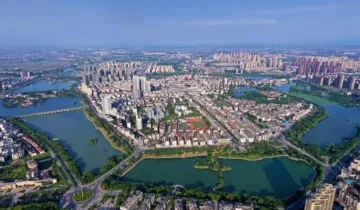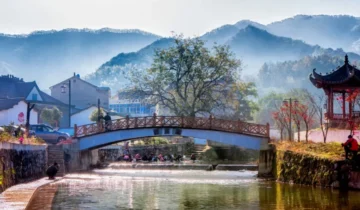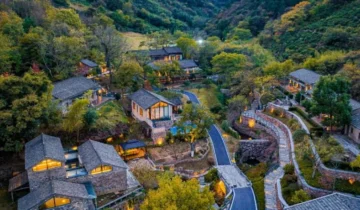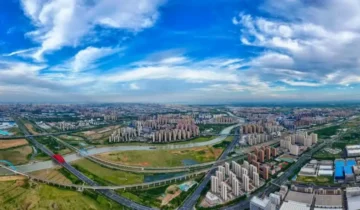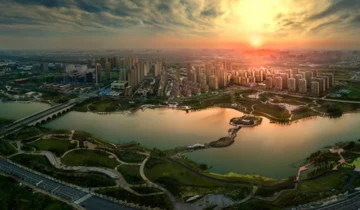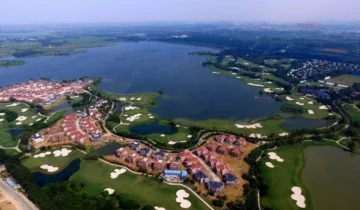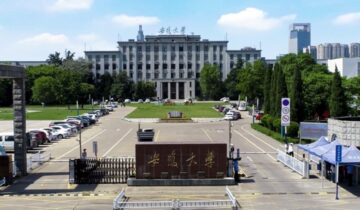
Hanshan County, Anhui Province

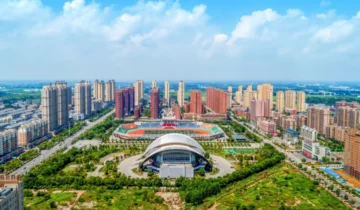
Hanshan County occupies 1,028 square kilometers in the eastern part of Ma’anshan, at the point where Anhui narrows between the borders of Jiangsu. Its registered population is 431,700, and its name — adopted when the county was established in 623 AD, during the Tang dynasty — comes from the surrounding mountains, which “stand arrayed as if swallowing up the land.” The county’s main claim to historical significance is the Lingjiatan site, a Neolithic settlement discovered in the 1980s near the…
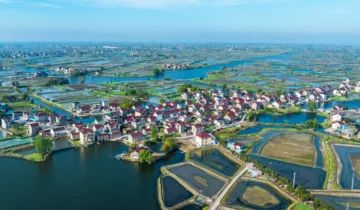
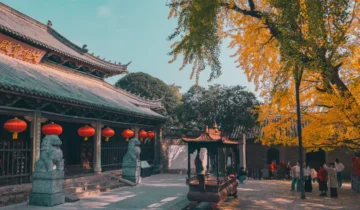
Dangtu County, Anhui Province

Dangtu County sits on the south bank of the Yangtze River, wedged between Ma’anshan, Nanjing, and Wuhu — a position that makes it Anhui’s eastern gateway and, increasingly, a satellite of its giant neighbor, Nanjing. The county covers 886 square kilometers and holds 419,000 permanent residents. Its landscape, famously described as “one part mountain, four parts water, five parts farmland,” is flat for the most part — alluvial plains shaped by the Yangtze and the network of rivers that feed…

Shouxian County, Anhui Province

In 241 BC, as Qin armies pressed southward, the kingdom of Chu made a fateful decision: it moved its capital to a city called Shouchun. For the next 18 years, this was the last seat of the dynasty that gave China its written script and its name — a kingdom whose bronze-casting, silk-weaving, and philosophical traditions had shaped the Central Plains for four centuries. Today Shouchun is known as Shouxian, a county of 2,986 square kilometers under Huainan, with a…

Fengtai County, Anhui Province

Fengtai County sits on the southern edge of the Huaibei Plain, where the Huai River runs through its midsection before turning east. It belongs to Huainan prefecture and covers 894 square kilometers, home to 538,000 permanent residents out of a registered population of 683,000. The name comes from a phoenix terrace: Qing dynasty records note that “a phoenix once came, and so it was called Fengtai.” The county was formally established in 1733, during the Yongzheng reign, but the territory…

Guzhen County, Anhui Province

Guzhen County is a rectangle of flat farmland in northern Anhui, 1,361 square kilometers in Bengbu prefecture, with roughly 650,000 residents. It is one of the youngest counties in the province — established in July 1965, drawn from parts of Su County, Lingbi, and Huaiyuan — but it contains some of the region’s oldest history. Within its borders lies the Gaixia site, a Neolithic walled settlement dating to the Dawenkou culture, roughly 4,500 years old. When archaeologists confirmed its age…

Wuhe County, Anhui Province

The name means “Five Rivers,” and it is almost an understatement. Wuhe sits at the confluence of the Huai, Hui, Chong, Tong, and Tuo rivers in northeastern Anhui — one of Bengbu‘s counties, spread across 1,429 square kilometers and home to 693,000 registered residents. The waters that give the county its name also gave it a role in Chinese history that began long before anyone wrote the first character of its name. The oldest trace comes from Xiyou Village, where…

Huaiyuan County, Anhui Province

Huaiyuan County lies on the middle Huai River, where its tributary the Guo River joins the main stream, about 20 kilometers west of Bengbu. It covers 2,192 square kilometers and has a registered population of 1.34 million, though fewer than a million live there year-round. The county was established in 1291, during the Yuan dynasty, taking its name from the “Huaiyuan Command” that guarded this strategic river junction through the Song period. But the location itself is central to earlier…

Wuwei City, Anhui Province

The name is built on a classical Daoist phrase — wuwei, meaning a state of effortless action — and the full line from which it was taken reads: “when the world is at peace and free of strife, rule by non-action.” Wuwei has carried that name since the Sui dynasty, more than 1,400 years, through dynasties, wars, and the 2019 transition from county to county-level city. Today it sits in central Anhui along the Yangtze’s northern bank, administered by Wuhu,…

Nanling County, Anhui Province

Li Bai – the Tang dynasty’s most celebrated poet – visited Nanling on three occasions. In 742, he received an imperial summons there and wrote one of the most famous lines in Chinese poetry: “I went out the door with a loud laugh – how could I be forever a man of the weeds?” Nanling, under Wuhu’s jurisdiction in southeastern Anhui, covers 1,260 square kilometers with a population of about 540,000 across 8 towns and one provincial economic development zone.…

Chaohu City, Anhui Province

Chaohu takes its name from the lake it sits beside — China’s fifth-largest freshwater body, a sheet of water so wide that on misty mornings the far shore vanishes entirely. The city of 728,000 people occupies a 2,046-square-kilometer swath of central Anhui, south of Hefei, hugging the lake’s northern rim. Its name means “nest lake,” a direct reference to Youchao, the legendary inventor of wooden dwellings, who tradition says was born here and gave humanity its first roof. Youchao is…

Lujiang County, Anhui Province

The name Lujiang first appears in the Classic of Mountains and Seas, one of China’s oldest geographical texts, where it originally referred to a river. The county was established during the Western Han dynasty. Today it belongs to Hefei prefecture, at the junction where the Dabie Mountain foothills meet the Chaohu Lake plain, spanning 2,344 square kilometers with 884,000 permanent residents. Lujiang holds four mineral deposits that rank among Anhui’s top five – pyrite and alumstone at first place, copper…

Feixi County, Anhui Province

Feixi County sits directly west of Hefei, sharing a border so close that Metro Line 3 and Line 4 now terminate within its main town of Shangpaihe. The county covers 1,695 square kilometers on the southern slope of the Jianghuai watershed, with low, rolling hills that rise to 289 meters at Mount Daqianshan and then fall away into the Chaohu Lake basin. Established in December 1948 from the western half of the old Hefei County, Feixi was named simply for…

Feidong County, Anhui Province

Feidong County lies east of Hefei, straddling the Jianghuai watershed that divides the Yangtze and Huai river systems. Established in 1949, it covers 2,179 square kilometers and governs 12 towns, six townships, three subdistricts, and two development zones. Its traditional reputation, still printed in tourism materials, runs: “strategic pass of Wu and Chu, hometown of Lord Bao” — an acknowledgment of both its geographic position at the intersection of ancient states and its status as the birthplace of Bao Zheng,…

Changfeng County, Anhui Province

In 1965, the Chinese State Council carved a new county out of the borderlands of three existing ones — Hefei, Shou, and Dingyuan — and named it Changfeng, meaning “lasting peace and abundant harvests.” It sits in central Anhui, wedged between Hefei, Huainan, and Bengbu, covering 1,841 square kilometers with 842,000 permanent residents. Today it ranks 49th among China’s top 100 counties, up from a national poverty designation in 1994. The land itself records far older transformations. During the Shang…

Anhui University: From Mao’s Signature to a Quantum Refrigerator

Not every university in China can claim that Mao Zedong wrote its name. Anhui University (AHU) can. On September 16, 1958, Chairman Mao personally inscribed the university’s name in his own calligraphy — a wordmark that remains its official identity to this day, making AHU one of a handful of Chinese universities with a founding signature from the country’s paramount leader. But what makes AHU remarkable today is not just the Mao connection. It is the dizzying breadth of its…

Close