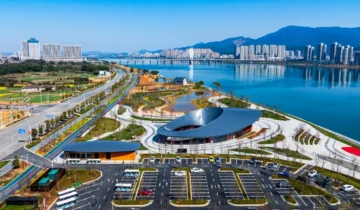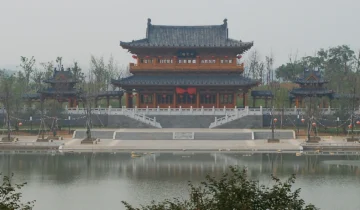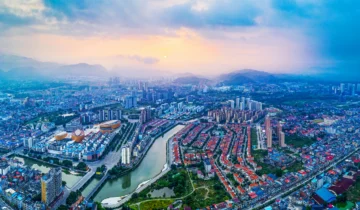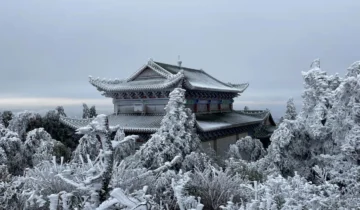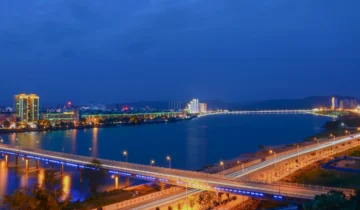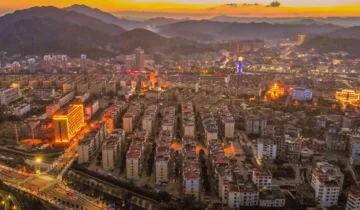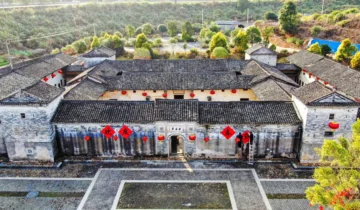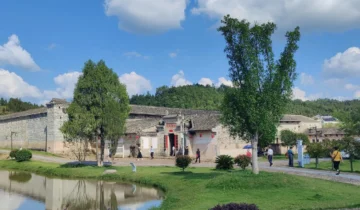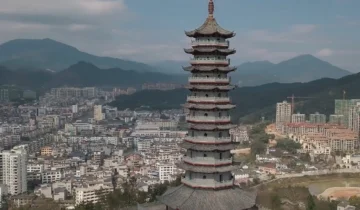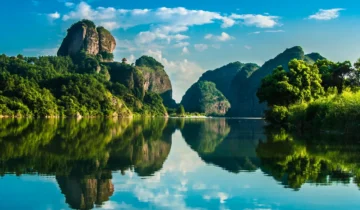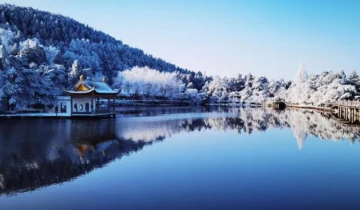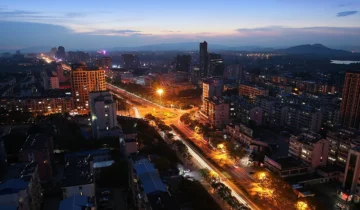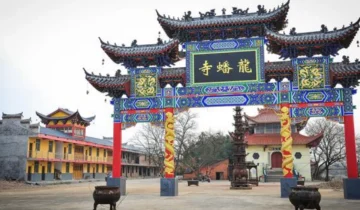
Yongfeng County, Jiangxi Province

In December 1930, at a pass called Longgang in southern Yongfeng, the Red Army encircled and destroyed the Kuomintang’s 18th Division. More than 9,000 soldiers were captured, along with their commander, Zhang Huizan. It was the first major counter-encirclement victory of the Jiangxi Soviet, and Mao Zedong, who directed the battle alongside Zhu De, marked it with a poem — The Fishermen’s Pride — Against the First Encirclement Campaign. The county went on to become the main battlefield of the…
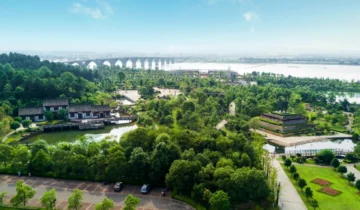
Xingan County, Jiangxi Province

In 1989, farmers repairing the Gan River embankment near Dayangzhou, in Xingan County, struck something hard with their shovels. It turned out to be a Shang dynasty tomb from roughly 1200 BC, and what they uncovered — 1,478 artifacts in a 40-square-meter chamber, including 475 bronze vessels, 754 jade pieces, and 139 pottery items — reshaped the understanding of ancient China. The site was named one of the “100 Major Archaeological Discoveries of the Century” and has been compared in…

Xiajiang County, Jiangxi Province

The Gan River flows south to north through Jiangxi for 750 kilometers, and its narrowest point lies at a place called Baqiu, in the county of Xiajiang. Here the river pinches to just 400 meters wide, squeezed by bluffs on both banks — a natural gorge that gives the county its name (gorge). The Xiajiang Water Conservancy Project, a multi-purpose dam with flood control and hydropower, now occupies this bottleneck. The county seat, meanwhile, was moved from Baqiu to Shuibian…

Jishui County, Jiangxi Province

Jishui was founded in 96 AD, during the Eastern Han dynasty, under its original name Shiyang County. That makes it older than most cities in China that tourists know by heart. The county was renamed Jishui in the Sui dynasty, drawing on the Gan River that cuts through its center. Today it spreads across 2,506 square kilometers in the hills northeast of Ji’an, where the Gan River broadens as it flows north toward Poyang Lake. The terrain drops from forested…

Ji’an County, Jiangxi Province

A single sycamore leaf, stripped to its veins and fused into black glaze, sits under museum glass in Japan. It was made at the Jizhou Kiln in Yonghe, a town in central Jiangxi where potters were producing world-class ceramics centuries before Jingdezhen rose to prominence. The technique was called wood-leaf tenmoku, and the conditions required to produce it — precise kiln temperature, the right leaf species, exact glaze chemistry — defeated potters everywhere else. As an old industry saying puts…

Longnan City, Jiangxi Province

Longnan City sits at the southernmost tip of Jiangxi, pressed against the border with Guangdong. Its 1,646 square kilometers hold 376 fortified Hakka weiwu — enclosed clan houses built like small fortresses — which represent more than 70 percent of all surviving weiwu in southern Jiangxi. Longnan has earned the name World Weiwu Capital, and the title is backed by a Guinness record: no county or city anywhere keeps more of these structures. Founded in 953 AD during the Southern…

Xingguo County, Jiangxi Province

One evening in 1929, Mao Zedong sat down to dinner with local Red Army commanders in Xingguo. The meal was a bamboo steamer of fish fillets with rice noodles, ringed by four side dishes of peanuts, bamboo shoots, eggs, and vegetables. Mao asked what it was called. “Steamed fish,” they said. He laughed and renamed it “Four Stars Surrounding the Moon” — a name that stuck so well the dish later appeared on state banquets in Beijing. In the years…

Yudu County, Jiangxi Province

On an October evening in 1934, at the Dongmen Ferry in the Jiangxi county of Yudu, more than 86,000 troops of the Chinese Red Army assembled on the riverbank and began crossing the Yudu River on eight pontoon bridges. Local residents had dismantled their own houses for timber, donated eight hundred boats, and organized a thousand porters to help build the crossing. Within four nights, the main force of the Central Red Army had moved south of the river and…

Quannan County, Jiangxi Province

Quannan calls itself Jiangxi’s Southern Gate, and the name fits. Founded in 1903 as “Qiannan”—south of Qianzhou, the old name for Ganzhou—it sits in the southwestern corner of Ganzhou prefecture, where 60 percent of its border touches four Guangdong counties. The Da-Guang Expressway reaches Guangzhou in two and a half hours, and the Ganzhou-Shenzhen high-speed rail puts the Greater Bay Area an hour away. The county covers 1,534 square kilometers, holds a population of 210,000, and wears its frontier position…

Dingnan County, Jiangxi Province

Dingnan County is the southernmost point of Jiangxi, wedged against the Guangdong border in a way that has earned it two nicknames: the South Gate of Jiangxi and the Gateway between Jiangxi and Guangdong. It is also the only county in China that fields two professional football clubs, hosts a round of the U-14 Globe Cup (brought from Europe for the first time in 2024), and stages night triathlons— and that is before you get to the rare earth and…

Anyuan County, Jiangxi Province

Anyuan County is where the East River starts. The water gathers on the slopes of 300 Mountain, runs into the river that gives the county its name, then cuts south through Guangdong past Heyuan, Huizhou, Dongguan, and Shenzhen. From there it enters the Dongshen water-supply tunnel and eventually comes out of taps in Hong Kong— about 80 percent of the territory’s fresh water travels this route. For Anyuan, that hydrological fact is a binding constraint. The county has banned logging,…

Dayu County, Jiangxi Province

In 1907, a German missionary named Wu Liheng picked up a dark, heavy rock on a mountain called Xihua, just outside what is now Dayu County. He sent it to Europe for analysis. The result was tungsten, a metal with the highest melting point of any element— and the discovery not only launched China’s tungsten industry but gave this corner of southern Jiangxi a nickname it still carries: the World Tungsten Capital. More than a century later, Dayu still accounts…

Guixi City, Jiangxi Province

The name Guixi means precious stream, and two explanations survive for it. One holds that the old county seat curled around the Xu Creek in a jewel-like loop. The other says the stream itself was valued for the fragrant herbs that grew on its banks. Both readings suit a city whose identity has always been shaped by what flows through it— starting with the Xin River, which cuts diagonally across the territory on its way to Poyang Lake. Along that…

Lushan City, Jiangxi Province

The name Lushan means “Hut Mountain,” and it comes from an old story: a hermit named Kuang Xu built a hut on these slopes during the Shang-Zhou period, and locals called it the Immortal’s Hut. The name survived two millennia of dynasties, wars, and revolutions. But a hut, however enchanted, is a small thing—and Lushan turned out to be anything but. Over the centuries, more than 3,500 poets and scholars climbed its trails and left behind 16,000 poems, 1,300 cliff…

Gongqingcheng City, Jiangxi Province

In October 1955, ninety-eight young volunteers from Shanghai stepped off a train in northern Jiangxi with nothing but hoes, tents, and permits. The land they had been assigned was a stretch of barren lakeshore at the foot of Lushan Mountain, a place locally known as Mouse Ridge— not a single structure stood on it. Forty days later, Hu Yaobang, then the first secretary of the Communist Youth League Central Committee, walked through their camp, picked up a bamboo twig, and…

Close