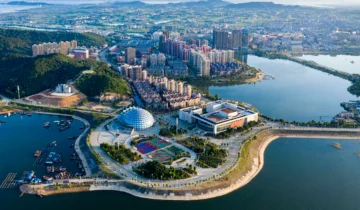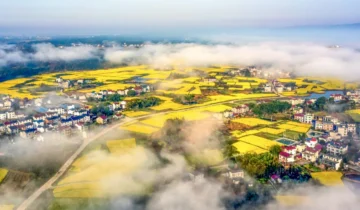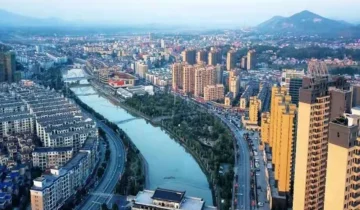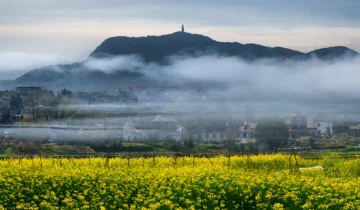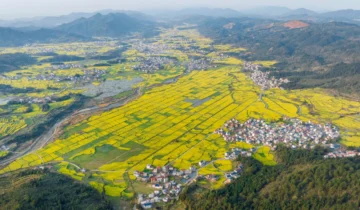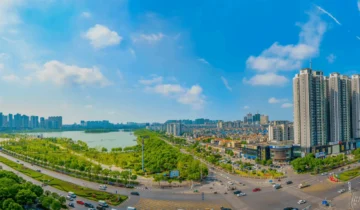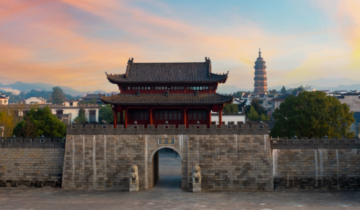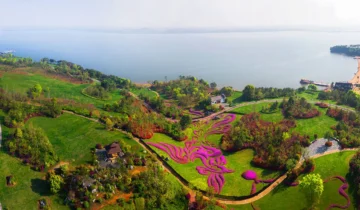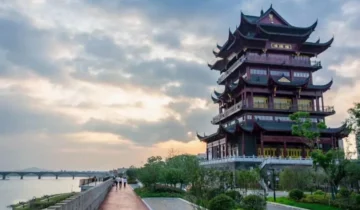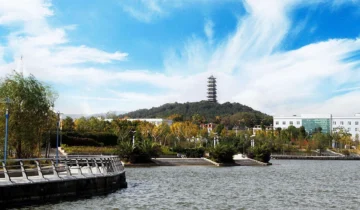
Ruichang City, Jiangxi Province

Ruichang means “auspicious prosperity,” and the name has a story. In 208 CE, on the eve of the Battle of Red Cliffs, the Wu general Cheng Pu led his troops to a garrison west of Chaisang—modern-day Jiujiang—and saw a flock of red crows massing above the camp. He took it as a good omen. The garrison was named Red Crow Town. Later, as the smoke of battle cleared and spring returned, the same sky filled with auspicious clouds, and the…
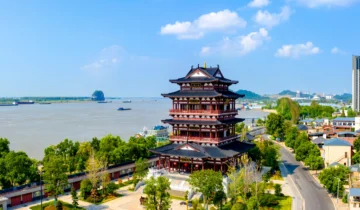
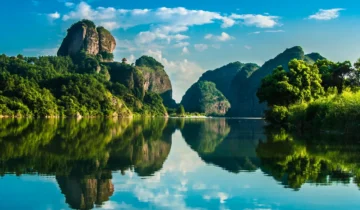
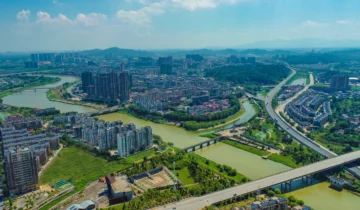
Pengze County, Jiangxi Province

Pengze has always been a place where the Yangtze meets something else: the lake, the province, a border, a story. It sits on the southern bank of the river in northernmost Jiangxi, across from Anhui, at the historical seam where the kingdoms of Wu and Chu once touched. Founded in 201 BCE, it covers 1,544 square kilometers within the prefecture of Jiujiang and holds a population of 380,000. But Pengze’s identity is shaped less by its geography than by two…

Hukou County, Jiangxi Province

Two rivers meet here and paint a clear line across the water. The Yangtze arrives bearing sediment from the upper reaches, coloring itself a dense yellow-brown. Poyang Lake, China’s largest freshwater lake, pours out in deep green. For a stretch below Stone Bell Mountain, the two colors run side by side without fully mixing — a natural spectacle that has drawn poets, generals, and travelers for over a thousand years. The name Hukou means mouth of the lake, and that…

Duchang County, Jiangxi Province

When the Poyang Lake level drops below 10.5 meters, a stone causeway emerges from the receding water near the village of Jianggongling. It is the Thousand-Eye Bridge, built in 1631, stretching 2.7 kilometers across 948 arches and 949 piers— so many openings that locals call it the bridge with a thousand eyes. For most of the year it sits submerged, invisible to the boats that pass overhead. Only in the dry season, when the lake retreats, does this Ming dynasty…

De’an County, Jiangxi Province

The poet Tao Yuanming (365— 427) wrote Peach Blossom Spring, the most famous utopian story in Chinese literature: a fisherman stumbles through a cave into a hidden village where people live in harmony, sharing work and food, unaware of the wars outside. Tao made his home in what is now De’an County, at the foot of Lushan in northern Jiangxi. What few outside the region know is that his homeland later produced an actual, real-world version of that story— the…

Yongxiu County, Jiangxi Province

Yongxiu is the kind of county that refuses to be summarized in a single line. It holds four well-known landmarks at once: a mountain, a temple, a lake, and a town. The mountain is Yunjushan, the “Cloud Dwelling Mountain,” whose 969-meter peak stays cool even in summer and has drawn Chan Buddhist monks for more than a millennium. The temple is Zhenru Temple, founded in 808 AD, one of the three most important Zen monasteries in the Chinese Buddhist world,…

Xiushui County, Jiangxi Province

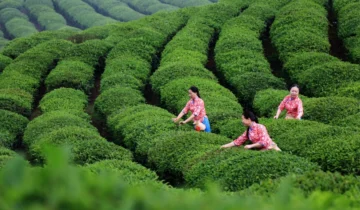
In 1891, a Xiushui tea merchant named Luo Kunhua shipped 100 cases of a new black tea to a Russian buyer, pricing each at 100 taels of silver. The shipment reached St. Petersburg, where the Tsarevich — the future Tsar Nicholas II — tasted it and sent back a plaque with four characters: “Tea that tops China, price that leads the world.” That tea was Ninghong, named after Ningzhou, the ancient name for what is now Xiushui County. Ninghong went…

Wuning County, Jiangxi Province

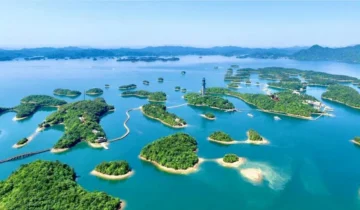
The Lushan West Sea is not a sea. It is a reservoir — the Zhelin Reservoir, built in the 1970s — but the name fits: roughly 31,000 hectares of water dotted with 1,667 islands larger than 0.2 hectares each, their forested humps rising from the surface like the tops of a submerged mountain range. Eighty percent of this landscape lies within the county of Wuning, in the western half of Jiujiang, and the water so defines the place that the…

Luxi County, Jiangxi Province

The name Luxi means “reed creek,” but the county’s real identity is harder to pin down. It is, all at once, a revolutionary battlefield where a young commander fell in 1927, the home of one of Jiangxi’s earliest Confucian academies, the source of the porcelain that lights half of urban China, and a stretch of selenium-rich farmland that the government has marked as a national asset. Spread across 960 square kilometers in eastern Pingxiang, with a population of 300,000, Luxi…

Shangli County, Jiangxi Province

On the eighteenth day of the fourth lunar month, the people of Shangli gather at Yousheng Temple in the southern part of the county seat. They bring incense, offerings, and a set of handcrafted firecrackers. The temple was built in 354 CE, but its central altar is dedicated to a much later figure: Li Tian, a Tang-dynasty alchemist who, according to local tradition, packed sulfur, charcoal, and saltpeter into a bamboo tube in 645 CE and created the first firecracker…

Lianhua County, Jiangxi Province

The county’s name means lotus flower, and it is the only administrative division in China named after a bloom. The lotus appears on the county seal, in the local cuisine, and in the couplets that decorate doorways across Lianhua. But the symbol that defines this place is a rifle — a single bolt-action rifle preserved through betrayal, massacre, and years of terror. Lianhua County sits in the westernmost corner of Jiangxi, in the Luoxiao Mountains of Pingxiang, at the northern…

Nanchang County, Jiangxi Province

In 202 BC, early in the Han dynasty, General Guan Ying built a walled settlement on the flatlands south of the Gan River and called it Nanchang. That settlement grew into a county that, at its founding, covered 7,500 square kilometers and included what are now the separate jurisdictions of Xinjian, Fengcheng, and Jinxian. Over the following centuries, each of those areas split off, and the county shrank to its present shape: a 36-kilometer-wide, 77-kilometer-long belt of land that wraps…

Fuliang County, Jiangxi Province

Every speaker of English who has ever handled a porcelain cup has uttered a word that came from Fuliang County. Kaolin, the standard international term for porcelain clay, is an anglicization of Gaoling— literally High Ridge, the mountain in Fuliang where the world discovered the mineral that made Jingdezhen possible. The German geographer Ferdinand von Richthofen first transcribed it in the 19th century, and the name stuck in every language from French to Japanese. But Fuliang gave the world more…

Jinxian County, Jiangxi Province

The county’s name, Jinxian, means advancing talent. It was chosen 1,700 years ago to honor Tantai Mieming, a disciple of Confucius who had traveled south from the Central Plains to teach along the Fu River. The county was established in 280 AD, and the name was a statement of intent: this was to be a place that draws talent forward. Today Jinxian spreads across 1,971 square kilometers as Nanchang’s eastern gateway, with 620,000 residents and a landscape summed up in…

Leping City, Jiangxi Province

There are 458 ancient opera stages in Leping, scattered across 1,985 square kilometers of Jiangxi’s northeast. They sit in village squares, inside ancestral halls, beside temples. Some are gilded with gold leaf and inlaid with tortoiseshell — the Huyan Stage is so richly carved that it was declared a National Key Cultural Relic. Others are plain timber, held together by mortise and tenon, still sturdy after two centuries of rain and Festival crowds. On any given day during the lunar…

Close