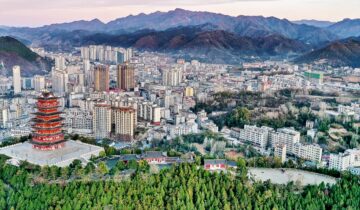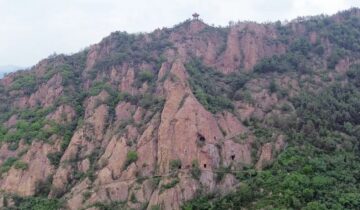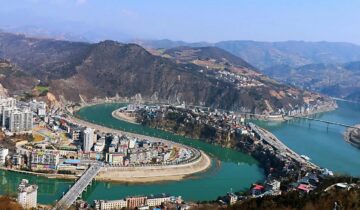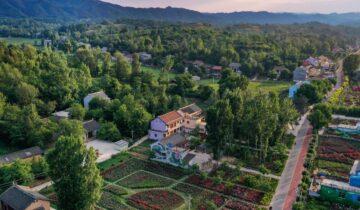
Qingxu County, Shanxi Province

More than 800,000 tons of vinegar flows through Qingxu County each year. That is enough to fill every resident’s bathtub dozens of times over, and it makes this 609-square-kilometer county on Taiyuan‘s southern doorstep the undisputed vinegar capital of China. The county’s vinegar tradition traces back, according to local legend, to the Yao Emperor himself, who is said to have discovered the souring properties of a wild plant called jia on these plains more than 4,000 years ago. The craft…
Zhashui County, Shaanxi Province

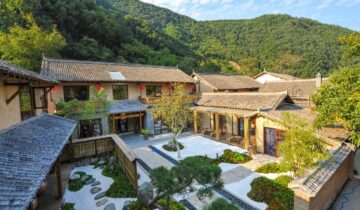
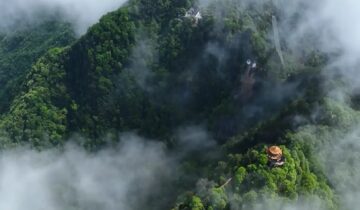
In 2020, President Xi Jinping visited a small county in the Qinling mountains and called its fungus products a Big Industry. But it was a phrase he used years earlier that stuck: a natural oxygen bar unknown to the world, hidden deep in the boudoir. That county is Zhashui, a name derived from the ancient Zuo River, and it sits in western Shangluo, bordering Xi’an’s Chang’an District. Zhashui spans 2,368 square kilometers, with 8 towns and 1 subdistrict, and a…

Zhen’an County, Shaanxi Province

Zhen’an County has produced one of the towering figures of contemporary Chinese literature: Chen Yan, vice-chairman of the China Writers Association, whose novel The Protagonist won the Mao Dun Literature Prize in 2019. That same novel, which follows the life of a Qin Opera performer, feels rooted in Zhen’an’s own cultural soil — the county is known as the Home of Chinese Flower Drum Opera, a folk art form that has earned a national intangible cultural heritage designation. Zhen’an sits…

Shanyang County, Shaanxi Province

Beneath the mountains of eastern Shangluo lies the second-largest vanadium deposit on Earth — 3.1 million metric tons of vanadium metal, more than any single country outside China holds. This single statistic defines Shanyang County, a land of three mountain ridges and two river valleys that spans 3,535 square kilometers — the largest county in Shangluo — with 460,000 people across 18 towns. The Chinese call it the Vanadium Capital, and it is a title backed by solid geology. SHANYANG…

Shangnan County, Shaanxi Province

China’s great central mountain range meets its eastern terminus in Shangnan County, a name that means South of Shang Mountain, earning the county the poetic title The Cover Page of the Great Qinling. Nestled where Shaanxi meets Henan and Hubei, Shangnan covers 2,307 square kilometers across 9 towns and 1 subdistrict, with a population of 249,800. The county is Shangluo’s eastern gateway, a land shaped equally by the yang of the Qinling and the yin of the Han River. SHANGNAN…

Danfeng County, Shaanxi Province

Shang Yang, the Qin reformer who rewrote the rules of Chinese governance, was enfeoffed here. The Four White-Haired Sages, whose refusal to serve the first Han emperor became a legend, retreated to its mountains. And the novelist Jia Pingwa, winner of the Mao Dun Literature Prize, was born within its borders. This is Danfeng County, a land of 2,438 square kilometers and 309,000 people in southeastern Shangluo. 👨‍⚖️ Shang Yang Reformer’s FiefQin reformer, enfeoffed here 👴👴👴👴 Four Sages Hermits’ RefugeRefused…

Xunyang City, Shaanxi Province

The Han River meets the Xun River at a perfect bend, forming a shape the Chinese call the Natural Taiji City — an expanse of water and land that mirrors the yin-yang symbol without any human intervention. Xunyang, a county-level city since 2021, sits at this confluence in southeastern Ankang, covering 3,541 square kilometers across 21 towns, with a registered population of 447,000. It is the only place in China with a town simply called Red Army Town, a name…

Luonan County, Shaanxi Province

Five thousand years ago, Cangjie — the legendary historian of the Yellow Emperor — stood on a riverbank in what is now Luonan County and created 28 Chinese characters, reportedly by reading the patterns of animal tracks in the mud. This moment, whether myth or fact, is celebrated as the origin of China’s written script, and Luonan carries the title Homeland of Chinese Characters. The county sits on the southern slope of the eastern Qinling Mountains in Shangluo, covering 2,830…

Pingding County, Shanxi Province

In December 2025, a road construction crew working near Miaogoucun in eastern Shanxi hit something hard. What they uncovered turned out to be a forest of Cordaites fossils, a genus of extinct seed plants that grew during the Permian period 290 million years ago. The largest specimen measured four to five meters in length, nearly a meter in diameter, with the bark pattern still visible in the stone — one of the largest fossil logs ever found in the province,…

Zhenping County, Shaanxi Province

A single ridge on the border of three provinces marks the geometric heart of China’s national territory. Known as Jixinling (Chicken Heart Ridge), it lies in Zhenping County — the southernmost tip of Ankang and of all Shaanxi. With just 45,100 residents spread across 1,502 square kilometers, Zhenping is the smallest county by population in the prefecture, a quiet mountain territory where Shaanxi, Chongqing, and Hubei meet in a single point. NATURAL HEART OF CHINA — ZHENPING POSTMARKS JIXINLING ⭐…

Langao County, Shaanxi Province

With a vertical rise of over 2,300 meters from its low valleys to its highest peak, Langao County packs as much ecological variety into 1,957 square kilometers as many provinces manage across entire prefectures. Sitting at the northern foot of the Daba Mountains along the Chongqing border, the county claims the title of China’s Konjac Capital while sustaining 81.3 percent forest cover and vegetation coverage above 90 percent. It administers 12 towns across Ankang, with a total population of 165,000.…

Pingli County, Shaanxi Province

The man who introduced Marshal He Long to the Chinese Communist Party, helped plan the Nanchang Uprising, and served as a founding political officer of the People’s Army — Liao Qianwu — was born in Pingli County. Situated in southeastern Ankang at the junction of Shaanxi, Hubei, and Chongqing, Pingli spans 2,647 square kilometers with 11 towns and a registered population of 230,000. The county promotes itself through four signature identities, each capturing a different facet of its cultural and…

Ziyang County, Shaanxi Province

On the northern slopes of the Daba Mountains where the Han River flows northward, Ziyang County occupies a singular place in Chinese geography: it is the only county in the country named for a Daoist immortal. Zhang Boduan, founder of the Southern School of Daoism and author of the Wuzhen Pian (Awakening to Reality), cultivated the Dao here under the name Master Ziyang, and the county took his name in 1512. Today Ziyang sits at the southern tip of Ankang,…

Ningshan County, Shaanxi Province

Deep in the southern slope of the Qinling Mountains lies Ningshan, a county whose name means Pacify Shaanxi — the only county in China named for the province’s peace. With 96.24 percent forest cover — the highest of any county in the country — and a population of just 70,300, Ningshan is less a county and more a living wilderness preserve. It is the largest administrative area in Ankang at 3,678 square kilometers, yet only 2.73 percent of its land…

Shiquan County, Shaanxi Province

In 2017, Chinese President Xi Jinping told the Belt and Road Forum about a tiny golden treasure: a gilt-bronze silk worm unearthed in a small county in southern Shaanxi — proof, he said, that the Silk Road began not with merchants but with silkworms. That county was Shiquan, and the discovery cemented its identity as nothing less than the origin of the silk trade. Shiquan lies in western Ankang, covering 1,516 square kilometers, with a registered population of 178,600 and…

Close