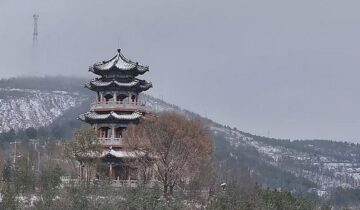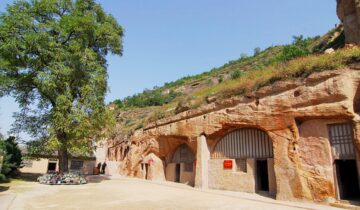
Ningqiang County, Shaanxi Province

A rooster crows near the old street of Qingmuchuan, and its call carries across the borders of Shaanxi, Gansu, and Sichuan. That convergence is the defining geography of Ningqiang County, a 3,260-square-kilometer county in Hanzhong, in the southwestern corner of Shaanxi, where the Qinling Mountains rise to the north and the Bashan range screens the south. The Han River — the Yangtze’s largest tributary — begins its journey here, giving Ningqiang its reputation as the first city on the great…
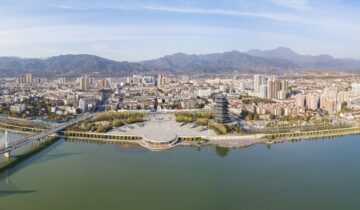

Mianxian County, Shaanxi Province

In the winter of 219 CE, the veteran general Huang Zhong led a surprise attack up Dingjun Mountain, killing the Cao Wei commander Xiahou Yuan and securing the Hanzhong region for Liu Bei’s Shu Han. That battlefield lies in Mianxian County — a 2,386-square-kilometer county in Hanzhong, at the western end of the basin in southern Shaanxi — and it is only the beginning of the story. The same strategic position that made Dingjun Mountain a Three Kingdoms theater later…

Xixiang County, Shaanxi Province

A bone-carved human head in the Shaanxi History Museum was excavated at the Lijiacun Neolithic site in Xixiang County — evidence of human settlement here 7,500 years ago. That deep history is layered over with later chapters: Ban Chao, the Han general who secured the Western Regions, held a noble title here, as did Zhang Fei of the Three Kingdoms. Today Xixiang, the eastern gateway of Hanzhong in southern Shaanxi, is best known for its tea. The county spans 3,240…

Yangxian County, Shaanxi Province

The Crested Ibis — one of the rarest birds on the planet, with feathers that blend into dawn-colored pink — was once thought extinct in the wild until seven individuals were rediscovered in remote mountain forests of Yangxian County in 1981. Today, that population has grown into the thousands, and the county bearing the bird’s name in Hanzhong, southern Shaanxi, has become synonymous with ecological restoration. Yangxian spans 3,206 square kilometers across 15 towns and three subdistricts, with a registered…

Chenggu County, Shaanxi Province

Zhang Qian set out from this county in 138 BCE as an imperial envoy, returning more than a decade later with news of distant civilizations and launching what would become the Silk Road. That county is Chenggu, a 2,265-square-kilometer jurisdiction in central Hanzhong, southern Shaanxi, where the Qinling Mountains rise to the north and the Bashan range screens the south. With 543,000 residents across 15 towns, two subdistricts, 230 villages, and 47 communities, it is Hanzhong’s second-most populous county and…

Zichang City, Shaanxi Province

In December 1935, the Chinese Communist Party convened the Wayaobu Conference in the small town of Wayaobu, laying out the strategy for a united front against Japan — a meeting that set the party’s wartime direction. That town is now part of Zichang City, a county-level city in northern Yan’an named after the revolutionary hero Xie Zichang, who led uprisings in Shaanxi and Gansu before dying of war injuries in 1935. The city covers 2,405 square kilometers across eight towns…

Huangling County, Shaanxi Province

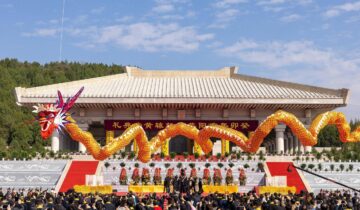
The Mausoleum of the Yellow Emperor in Huangling County — named after the tomb itself — is one of the most important cultural sites in China. For millennia, rulers and commoners alike have made pilgrimages to Qiaoshan, where the legendary Yellow Emperor (Xuanyuan), the mythical ancestor of the Chinese nation, is said to be buried. The site, a 5A-rated scenic area and national key cultural relic, anchors a county spanning 229,200 hectares with 130,000 people in southern Yan’an, where five…

Huanglong County, Shaanxi Province

A skull fossil dated to roughly 50,000 years ago — named Huanglong Man — was unearthed here and helped fill a gap in the record of human evolution in China. A giant stone yue, the largest Neolithic ceremonial axe found in the country, was also discovered on the same soil. But the Huanglong County of today is defined less by ancient bones and more by living green: at 87 percent forest coverage and 92 percent forest-and-grass cover, it is the…

Yichuan County, Shaanxi Province

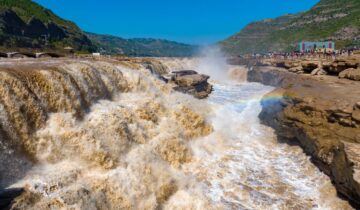
The Yellow River Cantata — the stirring choral work that became a defining anthem of modern China — was born on the banks of the Hukou Waterfall in Yichuan County, southeast Yan’an. The waterfall is the Yellow River’s first major cascade and the world’s only golden-colored waterfall of its size, a 5A-rated scenic area set within a national geopark where the river roars through a narrowing gorge. Yichuan covers 2,931 square kilometers across four towns, two townships, and one subdistrict,…

Luochuan County, Shaanxi Province

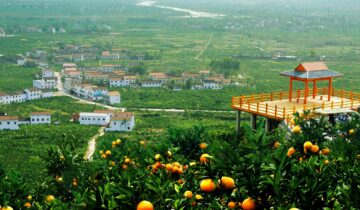
With a brand value of 101.629 billion yuan, Luochuan apples rank first among fruit brands nationally — and they all come from a single county in central Yan’an. Luochuan County, named after the Luo River that runs through its territory, sits on the deepest, thickest section of the loess plateau anywhere in the world, where deposits run 80 to 140 meters deep. That geology, combined with a warm temperate semi-humid climate that delivers 2,579 hours of sunshine and a diurnal…

Fuxian County, Shaanxi Province

Fuxian County was once Fuzhou, a prefecture-level seat that supervised surrounding counties for centuries, and its old name still echoes in local cultural brands. Today it belongs to central Yan’an, where it ranks as the prefecture’s largest county by area and Shaanxi’s fifth-largest — 4,182 square kilometers — yet holds just 151,800 residents, giving it one of the lowest population densities in the region. The county sits at the intersection of six transport routes and three railways, a position its…

Ganquan County, Shaanxi Province

The name Ganquan means sweet spring — a reference to the freshwater spring south of the county seat that has given the area its identity since antiquity. But what makes Ganquan County, part of central Yan’an, extraordinary today is what sits above that water: 76.84 percent forest coverage, the highest density of tree cover in the Yan’an region, earning it the title China Natural Oxygen Bar. This small county of 2,300.7 square kilometers and just 72,000 residents (registered population 85,000)…

Wuqi County, Shaanxi Province

The Warring States general Wu Qi, the author of the Wuzi military classic and a master of frontier warfare, spent 23 years encamped at a strategic pass on the border of what is now Shaanxi and Gansu. The county that grew around his garrison still carries his name. Wuqi County, part of northeastern Yan’an, later became famous for an entirely different journey: on October 19, 1935, the Central Red Army completed the 25,000-li Long March here. Today, Wuqi spans 3,791.5…

Zhidan County, Shaanxi Province

Liu Zhidan was one of the most respected Red Army commanders of the 1930s, and when he fell in battle during the Eastern Expedition in 1936, the county of Bao’an was renamed in his honor. The choice was fitting: Bao’an had already been Zhidan County in all but name. Earlier that same year, the Chinese Soviet Republic had moved its capital here, and for six months Mao Zedong directed the revolution from its caves — orchestrating the peaceful resolution of…

Yanchuan County, Shaanxi Province

The Yellow River runs through Yanchuan County for 68 kilometers, and in that stretch it creates an extraordinary geographic spectacle: a near-perfect S-shaped bend that the Chinese call Qiankun Bay — the First Bend under Heaven. The river enters the county from the northwest, carves its way through the loess plateau in a deep gorge, and loops back on itself in a massive meander before continuing south. On the inside of that bend, at the village of Liangjiahe, a young…

Close