Changwu County, Shaanxi Province

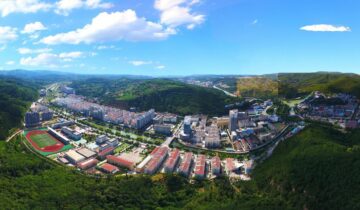
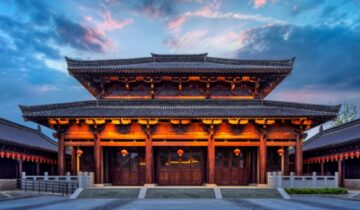
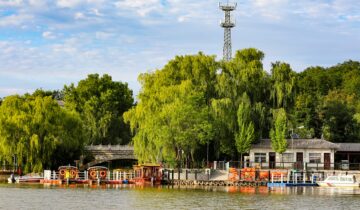
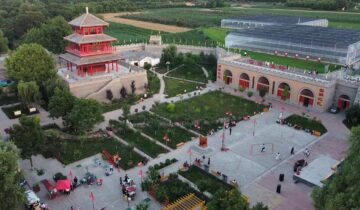
Changwu County is a study in concentration: 90 percent of its 567 square kilometers lies atop the Binchang coalfield, holding 4.84 billion tons of explored coal reserves — 44 percent of the entire coalfield’s total. Five mines, four in operation and one under construction, cover 514 square kilometers of mining permits and ship a combined design capacity of 25.5 million tons per year. This is Xianyang‘s westernmost county — Shaanxi’s Western Gate — the strip of land wedged between Gansu’s…
Yongshou County, Shaanxi Province

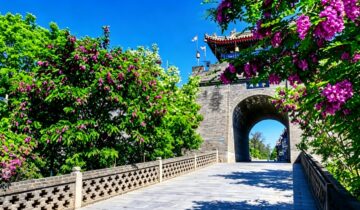
The county of Yongshou was named not by imperial decree but, according to local tradition, by a single word of approval from the Empress Wu Zetian herself — yong meaning perpetual, shou meaning long life — and the name has held since 673 AD. Yet the place had been inhabited for millennia before that. During the Xia and Shang dynasties, this was the territory of the Qi state; under the Han it became Qixian; and by the Western Wei it…

Liquan County, Shaanxi Province

Emperor Taizong of Tang chose the Jiuzong Mountains north of the Wei River as his eternal resting place, and the scale he commanded is staggering: Zhaoling, the largest imperial mausoleum in the world, occupies 20,000 hectares and contains 209 satellite tombs for generals, princes, and officials who served him. The tomb complex holds six of the most famous stone horses in Chinese art — Zhaoling Liujun (Zhaoling’s Six Steeds) — originally carved in high relief on the eastern and western…

Qianxian County, Shaanxi Province

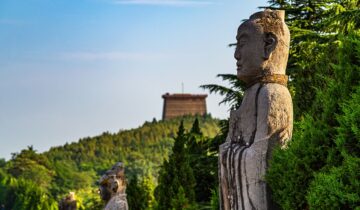
The Qianling Mausoleum, perched on Liangshan hill north of the Guanzhong Plain, is the only tomb in the world that holds two emperors: Emperor Gaozong of Tang and his wife, Empress Wu Zetian, who went on to become China’s only female emperor. The tomb has never been excavated. What survives above ground is a grand spirit way lined with 124 stone statues — foreign envoys, horses, winged beasts — and the famous Stele Without Inscription, a blank monolith deliberately left…

Jingyang County, Shaanxi Province

The Zheng Guo Canal, built in 246 BC, was the most ambitious irrigation project of the ancient world — a 150-kilometer channel that turned the Guanzhong Plain into the granary of the Qin state and funded the unification of China. The canal’s headworks lie in Jingyang County, at the mouth of a gorge on the Jing River, where successive dynasties built, rebuilt, and expanded their waterworks for twenty-two centuries. The result is a dense archaeological zone of over 40 ancient…

Sanyuan County, Shaanxi Province

Sanyuan County takes its name from three ancient plains — Menghouyuan, Fengyuan, and Bailuyuan — that rise in sequence across its territory. The name dates to the Former Qin dynasty in 352 AD, when the area was first organized as a military protectorate. Today this small county of 576.9 square kilometers in the center of the Guanzhong Plain, part of Xianyang, is routinely called the cabbage heart of the 800-li Qinchuan — the richest, most fertile pocket of one of…

Taibai County, Shaanxi Province

In the folk speech of the Qinling Mountains, people describe summer in Taibai County with four short lines: no mosquitoes at night, a blanket even in July, no skirts on the girls, and no need for a fan. The county seat rests at 1,543 meters above sea level — the highest of any county town in Shaanxi — and the average summer temperature hovers around 19°C while the rest of the Guanzhong Plain bakes above 30. Taibai County lies in…

Fengxian County, Shaanxi Province

Fengxian County’s name was born from a line in the old gazetteer: the phoenix sang in Qi, soared over Yong, and alighted in Feng. The bird came to rest in the upper reaches of the Jialing River, deep in the Qinling Mountains, and the settlement that grew beneath it was called Fengzhou for centuries before being demoted to county status under the Ming. Today Fengxian County is a place of remarkable ecological density — 80.4 percent forest cover, over 410…

Linyou County, Shaanxi Province

On an elevation 1,271 meters above sea level, in a pocket of Shaanxi where the average summer temperature scrapes just 9.3°C, a pair of Tang-dynasty emperors built themselves a mountain retreat. The Sui Renshou Palace, later renamed Tang Jiucheng Palace, was the most ambitious imperial summer villa of its era — four emperors from two dynasties used it 21 times over a span of seventy years. It was here that the Sui emperor abolished the old succession system and created…

Qianyang County, Shaanxi Province

More than 2,500 years ago, a young man named Yan Ji left his home on the banks of the Qian River to walk to the state of Lu, where he became a disciple of Confucius. When he returned to his village, now part of Qianyang County, he built a platform of earth and climbed it every day to gaze east toward his teacher. That platform, the Wanglu Tai (Gazing-at-Lu Terrace), still stands and is honored today as China’s Number One…

Longxian County, Shaanxi Province

Longxian lies on the western edge of Shaanxi, part of Baoji, a place where the Guanzhong Plain begins to break into the highlands of Gansu. Its old name, Longzhou, dates back to when it served as the western gateway to the empire: Qin Duke Xiang established his capital here before unifying China; Emperor Wu of Han built the Dazhen Pass on the Longshan slopes, marking the first strategic barrier west of Chang’an; and generations of Silk Road travelers – Zhang…

Meixian County, Shaanxi Province

Zhang Zai, the Northern Song philosopher who founded the Guanxue school of Confucianism, was born in Meixian County. His best-known line — to ordain conscience for Heaven and Earth, to secure life and fortune for the people, to extend the lost teachings of past sages, to establish lasting peace for all generations — has been quoted by Chinese intellectuals and politicians for nine centuries. The county where he wrote these words lies on the northern slopes of the Qinling in…

Fufeng County, Shaanxi Province

The name Fufeng carries a mandate from the Han dynasty: support the capital and spread refinement. It was coined in 104 BC when Emperor Wu divided the Guanzhong region into three protectorates, with Fufeng guarding the western approaches to Chang’an. Two thousand years later, the county remains best known for what that original mandate implied — it is the spiritual heartland of the Zhou civilization and the home of one of the most significant Buddhist archaeological discoveries of the 20th…

Qishan County, Shaanxi Province

Qishan County occupies a corner of the western Guanzhong Plain in Baoji where Chinese civilization took some of its earliest institutional forms. The Zhou people established their capital here before conquering the Shang dynasty. The Duke of Zhou codified the rites and music that shaped Confucian governance. And foundational texts of Chinese medicine — the Huangdi Neijing — are said to have been compiled within these borders. The area was known in antiquity as Xiqi (Western Qi), and its name…

Yijun County, Shaanxi Province

At an average elevation of 1,395 meters, Yijun County lies on the seam where the Guanzhong Plain meets the Loess Plateau — a transition zone that gives it the coolest summers in Shaanxi. The county recorded an average summer temperature of just 19°C over recent years, with 336 days of good air quality annually, numbers that won it the designation China Climate Livable City (County) from the China Meteorological Administration. Its 55.36 percent forest cover, the highest in the region…

Close