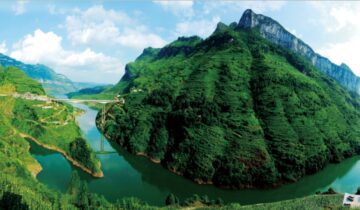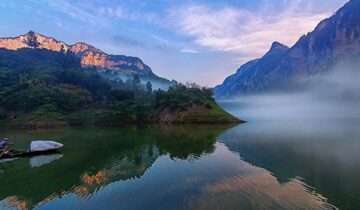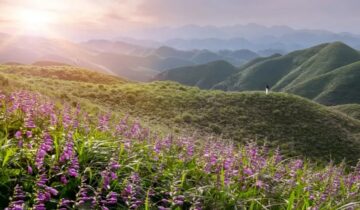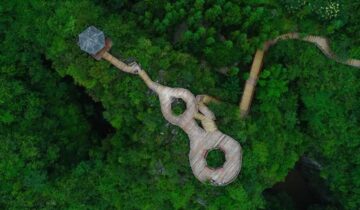
Jiangkou County, Guizhou Province

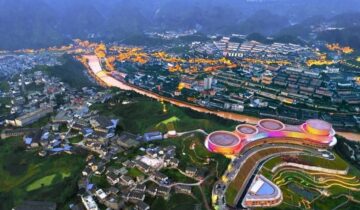
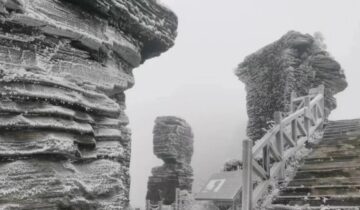
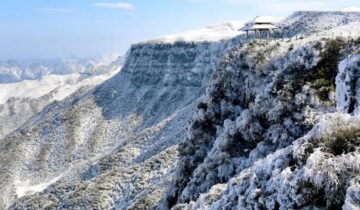
Fanjingshan, a UNESCO World Natural Heritage site, rises within Jiangkou County’s borders. But the official website mentions the mountain only as context. The story it tells about Jiangkou is different: a small county (1869 square kilometers, 250,000 people) that has spent the last decade turning its clean water, deep forest, and cool air into an economic formula. In 2025, it passed the 10-billion-yuan GDP mark for the first time. The county is home to 19 ethnic groups — Tujia, Miao,…
Qianxi City, Guizhou Province

The Chinese archaeological record has two great Paleolithic sites that the textbooks always put side by side: Zhoukoudian in the north, Guanyindong in the south. Guanyindong Cave, on a hillside in what is now Qianxi, in eastern Bijie, was home to hominids half a million years ago — and the city that grew up around its legacy still carries the mark of deep time. But Qianxi’s most extraordinary claim to historical endurance is political: the Shuixi kingdom, whose rulers headquartered…

Hezhang County, Guizhou Province

Hezhang holds the highest point in Guizhou. Xiaojicaiping Peak — “Little Garlic Chives Meadow” — rises to 2,900.6 meters, the roof of Bijie Prefecture and a wildflower meadow that has been named a top ten summer mountain retreat in China for three years running. Below that altitude, the county drops to 1,230 meters in its river valleys and spreads across 3,242 square kilometers of karst ridges, gorges, and plateau grassland. The elevation range is the widest in the province, and…

Weining Yi, Hui, and Miao Autonomous County, Guizhou Province

Weining County enters any atlas with three superlatives: it is the largest, highest, and most populous county in Guizhou. Its 6,298 square kilometers — roughly the size of Ningxia’s largest county — average 2,200 meters above sea level, making it the roof of the province. More than 1.6 million people live here, representing 37 ethnic groups, with Yi, Hui, and Miao communities accounting for nearly a quarter of the population. The county lies at the western edge of Bijie, at…

Nayong County, Guizhou Province

The county’s official website describes its territory as a goat lying on its side, head to the west and tail to the east, stretched between the Liuchong and Sancha rivers in southeastern Bijie at the foot of the Wumeng Mountains. The creature fits: Nayong is narrow, mountainous, and shaped by the watersheds that flow around it — a county of steep slopes and hidden valleys where less than 11 percent of the land is flat. For most of its history,…

Zhijin County, Guizhou Province

A team of surveyors entered a sinkhole in western Guizhou in 1980 and found what they would call “grand, wondrous, complete, and beautiful” — Zhijin Cave. The cave is a limestone labyrinth spanning more than 700,000 square meters across four levels, with halls large enough to fit entire city blocks. Stalagmites rise thirty meters from the floor, stalactites hang in curtains of calcite, and underground pools mirror formations that have been growing for half a million years. It has been…

Jinsha County, Guizhou Province

Jinsha County lies in the eastern part of Bijie Prefecture and entered the map of modern China under a different name. For centuries it was known as Dagu Xinchang — “New Market of the Big Drum” — and ranked as the first among the four great market towns of northern Guizhou. Merchants traveling the Tea Horse Road stopped here to trade, guild halls rose in the town center, and by the late Qing, Dagu Xinchang was one of the busiest…

Dafang County, Guizhou Province

Dafang County traces its deepest roots to 225 CE, when the Shuixi Yi kingdom established its seat at Mu’ege Castle on Yunlong Mountain — a dynasty that would control this corner of northwestern Guizhou for nearly fourteen centuries. A later chapter opened in 1635, when a Ming governor ordered a fortress built on a nearby hill; the deputy commander was named Fang Guo’an, and the walled settlement that rose from his work was called Dafang — “the Great Square.” The…

Ziyun Miao and Buyi Autonomous County, Guizhou Province

In the southwestern corner of Anshun prefecture, where the karst peaks of Guizhou begin their gradual descent toward the Guangxi basin, Ziyun is the only county in China designated specifically as a Miao and Buyi autonomous county. Its name comes from Ziyun Dong — “Purple Cloud Cave” — a cavern on the western edge of the county seat that gives the whole territory a name as poetic as the landscape it describes: “Purple air comes from the east, clouds rise…

Guanling Buyi and Miao Autonomous County, Guizhou Province

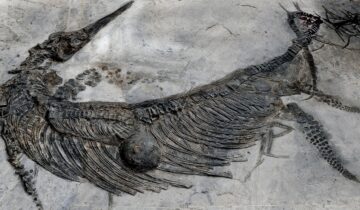
Some 220 million years ago, during the Late Triassic, what is now Guanling County lay at the bottom of a shallow sea. Catastrophic extinction events buried marine reptiles, crinoids, ammonites, and fish in fine-grained limestone, preserving them as fossils so abundant and so complete that scientists have described the Guanling biota as “a unique and unparalleled Late Triassic fossil library.” The fossils were first discovered in 1929, and the core burial zone at Wolonggang was designated a National Geopark in…

Zhenning Buyi and Miao Autonomous County, Guizhou Province

Zhenning Buyi and Miao Autonomous County flanks Huangguoshu, a National AAAAA scenic area but the county has its own identity beyond tourism. Located in the southwestern corner of Anshun prefecture, it is the only autonomous county in Guizhou included in the Guiyang metropolitan economic circle, and it happens to be the birthplace of Ren Zhengfei, the founder of Huawei Technologies. Zhenning covers 1,717.29 square kilometers across 5 subdistricts, 7 towns, and 3 townships. As of 2025, the registered population was…

Puding County, Guizhou Province

In a karst cave on the western edge of Puding County, archaeologists have found the remains of what they call “Chuandong Man” — a population of early modern humans who lived in the mountains of what is now central Guizhou more than 16,000 years ago. It is a site that Chinese archaeologists have called “the lamp of Asian civilization”. Puding, which lies in the southwestern corner of Anshun prefecture, has been continuously inhabited ever since: it was part of the…

Renhuai City, Guizhou Province

In 1109, during the Northern Song dynasty, the court established a new county on the middle reaches of the Chishui River and named it Renhuai — a compound of ren (benevolence) and huai (pacifying the border peoples). Few could have predicted that a thousand years later, this single county would be producing the most recognized liquor in China and posting an annual GDP of over 200 billion yuan. Renhuai, administered as a county-level city under Zunyi prefecture, is the home…

Chishui City, Guizhou Province

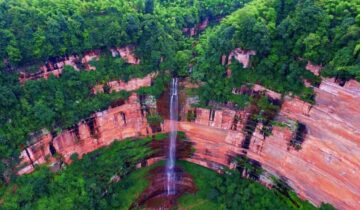
In the northwest corner of Guizhou, where the Chishui River runs its final course before joining the Yangtze, Chishui City lies inside a landscape of red sandstone cliffs, bamboo groves, and thousands of waterfalls. The county-level city, under Zunyi prefecture, covers 1,852 square kilometers with a population of about 316,000. Its official profile describes it as “the reddest, greenest, and most beautiful place in Guizhou” — a claim with real weight: the Chishui Danxia is a World Natural Heritage site,…

Xishui County, Guizhou Province

Xishui County lies at the junction of northern Guizhou, southern Sichuan, and western Chongqing, covering 3,128 square kilometers across 26 townships with a population of roughly 800,000. It is known locally by two nicknames — “Green Oasis” for its forests and “Red City” for its Long March history — and the combination has shaped the county’s identity as a heritage-tourism and baijiu-producing hub within Zunyi prefecture. Xishui was formally established as a county in 1915, after the fall of the…

Close