Yuqing County, Guizhou Province

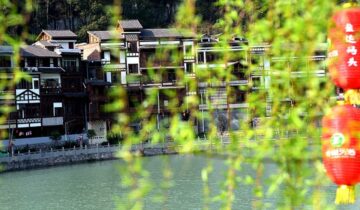
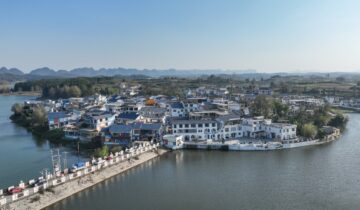
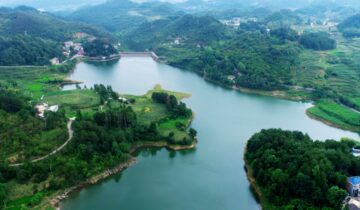
In 1601, at the end of a long military campaign against the Bozhou chieftain, the Ming court merged two small territories — Baili and Yuqing — into a single county. It placed the new county under the newly created Pingyue Military-Civilian Prefecture. The county stretched along the middle reaches of the Wujiang River, Guizhou’s largest waterway, in what is today the southeastern corner of Zunyi prefecture. Four centuries later, that river would be dammed at Goupitan to create Guizhou’s largest…
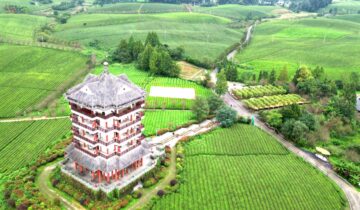

Meitan County, Guizhou Province

Meitan County lies on the north bank of the Wujiang River in eastern Zunyi, a 1,865-square-kilometer wedge of rolling hills that has quietly become the center of Chinese tea production. Its two flagship teas — Meitan Cuiya (green tea, brand value 4.034 billion yuan) and Zunyi Hong (black tea, brand value 2.569 billion yuan) — are among the most recognized tea brands in Guizhou. Nearly 40,000 hectares of tea plantations cover the landscape, and the county’s forest canopy reaches 66.1…

Fenggang County, Guizhou Province

Fenggang County, sitting at the foot of the Dalou Mountains on the north bank of the Wujiang River, calls itself the “eastern gate of Zunyi.” It is a county defined by one strategy — double organic (shuang youji) — which means that every major industry, from tea to beef to sericulture, operates under organic or whole-chain-organic certification. The approach has earned Fenggang a place among China’s National Organic Product Certification Demonstration Zones and a spot in the national top-ten green-development…

Wuchuan Gelao and Miao Autonomous County, Guizhou Province

In 599 CE, the Sui emperor Wen established Wuchuan County on the northeastern slope of the Dalou Mountains, where Guizhou meets Chongqing along the border with Pengshui. The name — meaning “the river of affairs” — referred to a local waterway, but the county’s identity would be shaped by something far older beneath the soil. Wuchuan holds the world’s earliest recorded cinnabar and mercury mining operations, and its Daping Han Tomb Cluster — the largest collection of Han-dynasty graves in…

Daozhen Gelao and Miao Autonomous County, Guizhou Province

Daozhen County carries the name of Yin Zhen — a Han-dynasty scholar whose courtesy name was Daozhen, and who is recognized as bringing formal education to what is now northern Guizhou. The county was established in 1941 to honor him, and in 1987 it was redesignated as the Daozhen Gelao and Miao Autonomous County. It lies at the northern tip of Zunyi, the closest county in Guizhou to downtown Chongqing — 150 kilometers north to the megacity — and has…

Zheng’an County, Guizhou Province

Zheng’an County lies at the northeastern edge of Zunyi, a 2,589.79-square-kilometer stretch of the Dalou Mountain range’s eastern slope where the Furong River begins its course toward the Yangtze. Its position has earned it the label “Gateway of Northern Guizhou” — it is the frontier where Guizhou meets Chongqing, and the upcoming Chongqing-Guiyang High-Speed Railway will pass through its territory. The county has a population of roughly 668,100 across 20 towns, townships, and subdistricts, and holds the Han-dynasty scholar Yin…

Suiyang County, Guizhou Province

Suiyang County was established in 611 CE, during the reign of the Sui emperor Yang Guang, and has held its name for more than 1,400 years. It lies in the middle section of the Dalou Mountains in eastern Zunyi, 30 kilometers from Zunyi’s urban core and 129 kilometers from Chongqing — a position that has made it part of the greater Chengdu-Chongqing economic circle’s catchment area. The county covers 2,566 square kilometers and is home to roughly 570,000 people, plus…

Tongzi County, Guizhou Province

The Red Army scored its first major victory of the Long March here after the Zunyi Conference, and Mao Zedong marked the battle with a poem — Recalling the Nymph · Loushan Pass — a ci poem that has since been widely circulated in China. The battlefield lies within what is now Tongzi County, a 3,207-square-kilometer wedge of mountain terrain straddling the Guizhou-Sichuan border, 160 kilometers south of Chongqing and 180 kilometers north of Guiyang. The county’s modern history and…

Panzhou City, Guizhou Province

Panzhou occupies the southwestern corner of Guizhou, a 4,056-square-kilometer wedge of karst highlands where the province meets Yunnan and Guangxi, in southwestern Liupanshui. Its name is a 2017 upgrade — what was Pan County became Panzhou City — but the territory it covers has been a strategic corridor for centuries. Xu Xiake, the great Ming-dynasty travel writer, passed through in 1638 and recorded his impressions of the Biyun Cave karst formations. More than 380 million years earlier, ichthyosaurs swam in…

Liuzhi Special District, Guizhou Province

The 1960s were a coal rush in western Guizhou. Beijing designated the area around Liupanshui a national coal base, rail lines were laid, and a new kind of administrative district was carved out of the mountains — one that would be called a special district because its primary purpose was resource extraction and industrial construction under the Third Front strategy. Sixty years later, Liuzhi remains the only county-level special district in all of China, a designation that marks its origin…

Qingzhen City, Guizhou Province

In 1687, the Kangxi Emperor merged two Ming-dynasty military garrisons — Weiqing Guard and Zhenxi Guard — into a single county and named it Qingzhen, drawing one character from each predecessor. The city that grew from that administrative act now calls itself the “Lake City of Western Guizhou”, and with good reason: nearly 5.3 percent of its 1,387 square kilometers is lake surface. Qingzhen lies within Guiyang, at the intersection of the provincial capital and the Gui’an New Area, 22…

Xiuwen County, Guizhou Province

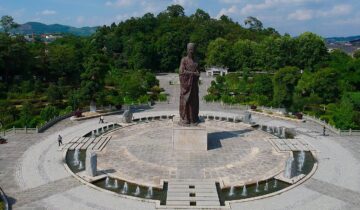
Xiuwen County carries a name that reads like a mission statement. Established in 1687 under the Kangxi Emperor, the characters, mean “to lay down arms and cultivate culture and education” — a phrase that succinctly captures what happened here 179 years earlier, when the great Ming-dynasty philosopher Wang Yangming was exiled to what was then called Longchang (present-day Xiuwen) and experienced the spiritual breakthrough that would define his legacy. Wang’s Longchang Enlightenment (Longchang Wudao) gave Chinese philosophy the doctrines of…

Xifeng County, Guizhou Province

Xifeng — the name itself was an imperial decree. In 1630, the Chongzhen Emperor of the Ming dynasty bestowed the characters, meaning “to extinguish the beacon fires of war”, on this strategic stretch of central Guizhou. The name stuck. Today Xifeng County, part of Guiyang, lies in the narrow corridor between Guiyang (70 kilometers south) and Zunyi (75 kilometers north), and occupies 1,036.5 square kilometers of central Guizhou’s highlands. As of the seventh national census, its registered population stands at…

Kaiyang County, Guizhou Province

Driving south from Zunyi toward Guiyang, the landscape rises into a karst plateau where the Wujiang River has carved a 42-kilometer gorge along the county’s northern edge — the Nanjiang Grand Canyon, one of two National AAAA scenic areas in Kaiyang County. Kaiyang occupies 2,023 square kilometers of central Guizhou’s highlands, straddling the strategic corridor between the provincial capital and Zunyi. Roughly 452,000 people live in the county, the majority Han Chinese alongside Buyi, Miao, Tujia, and Gelao communities. Below…

Close