Juye County, Shandong Province
The only county in China officially called the Hometown of the Kirin, with billions of tons of coal beneath its cotton fields.
The only county in China officially called the Hometown of the Kirin, with billions of tons of coal beneath its cotton fields.
A city built by the Grand Canal where the only surviving Ming customs house in China once collected a quarter of the empire’s canal tax, and where bearings now travel routes that barges once worked.
The largest county in Liaocheng, spanning 138,772 hectares at the Shandong-Hebei-Henan junction, known for the Fire Lion dance, China’s No.1 Vegetable County status, Yi Yin’s culinary legacy, and deep ICH heritage.
Red jujubes that turn golden when split, a single town that seasons 40% of China’s kitchens, and the world’s largest potato seed bank.
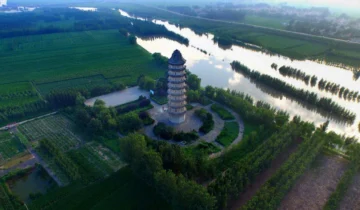
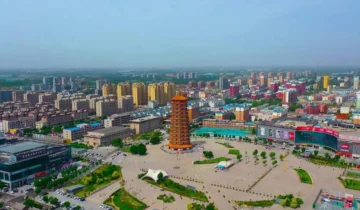
A Dezhou county on the North China Plain where Liu Bei began his imperial career, a 500-year pigeon fair draws thousands, a brick pagoda from 1669 stands beside the railway, and a family vinegar brewery has fermented black rice for five generations.
A Dezhou county on the Yellow River’s hanging bed where a Qing lantern dance and a Yuan bamboo-horse dance survive beside a 1,800-year-old king’s tomb.
A Dezhou county on the North China Plain where a folk opera called Yigougou — known to make listeners forget dinner on the stove — shares the land with 160 factories, a million tons of grain, and the stone steles of a Ming-dynasty calligrapher.
A small Dezhou county that gave China one of its ten major martial arts, a Song-dynasty love poem, and a 1,600-year-old jujube tree that has survived since the Sui dynasty.
A Dezhou county on the Shandong-Hebei border where cricket-fighting (“China’s #1 cricket county,” 3B yuan annual trade) and national-heritage acrobatics share the soil with a 600-year-old brewing tradition, Qing-dynasty noodles, and a 4A park with ski slope and wildlife park.
A Linyi county on the Shandong-Jiangsu border where willow weaving (World Handicraft City), compound fertilizers (a fifth of China’s output), diamond-bearing riverbeds, a Confucius diplomatic victory, and 7,000 years of human occupation all coexist.
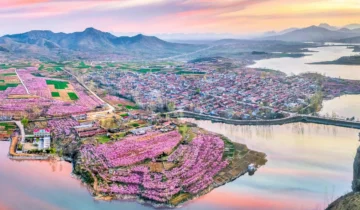
A Linyi county on Mount Meng’s north slope where China’s largest peach orchards, the Daigu landform (5th major geomorphology type), the Great Wall’s first builder, the abacus inventor, the Menglianggu Campaign, and maifan-stone beer share the same hills.
The Reclining Buddha, the first provincial government, and China’s peanut capital at the Shandong-Jiangsu border.
A Linyi county in the Yimeng Mountains where a 390,000-specimen museum with 6 Guinness records, a 5A mountain with the world’s largest rock carving, three intangible heritages, the global honeysuckle capital, China’s canning center, and a gold mine turned park share the same red soil.
A 3,000-year-old wine tradition, the burial place of the Confucian philosopher Xunzi, and enough vegetables to feed a nation.
Five-thousand-year-old writing, a 4,000-year-old ginkgo, and China’s earliest literary critic at the ancient state of Ju.