Guxian County, Shanxi Province

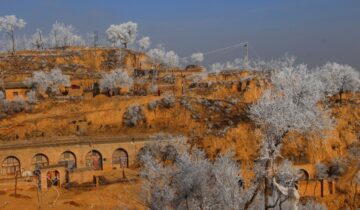
If you drive into Guxian County from the west, the land rises gently through walnut orchards and scattered acacia groves before the Taihang foothills darken the eastern sky. The county — whose name means “old county,” from its history as the former seat of Anze — occupies 1,206 square kilometers in the northeast of Linfen Prefecture and holds 79,816 permanent residents. It was created in 1971 from parts of Anze and Fushan counties, but the human footprint here is far…
Hongtong County, Shanxi Province

“Where do my ancestors live? In Shanxi’s Hongtong, under the big pagoda tree.” This folk rhyme — “问我祖先在何处,山西洪洞大槐树” — has been passed down across northern China for 600 years. It is the most widely known geographic reference in Chinese oral tradition, and it points directly to Hongtong County, on the east bank of the Fen River, under Linfen Prefecture. The county takes its name from two natural features: a red cliff (hong ya) on its southern edge and an ancient…

Xiangfen County, Shanxi Province

Two archaeological sites, spaced 90,000 years apart, occupy the same stretch of the Fen River valley in Xiangfen County, Linfen, and together they reshape what it means to speak of “early China.” The older is Dingcun, a Paleolithic site on the river’s east bank, where in 1954 scientists unearthed three child teeth and a fragment of infant skull. The teeth were shovel-shaped — a distinctive morphology of modern East Asians, not of Europeans. The skull carried evidence of an Inca…

Yicheng County, Shanxi Province

Yicheng County, in the south of Shanxi at the junction of Linfen, Jincheng, and Yuncheng prefectures, takes its name from a mountain. Mount Xiang, a rocky ridge shaped like a roc unfurling its wings, rises just east of the county seat, and “wing city” became the name of the county around it. Home to 260,000 people across 1,170 square kilometers in Linfen, Yicheng has been called the “throat of southern Shanxi and the gateway to Pingyang” — and its history…

Quwo County, Shanxi Province

In the south-central plain of Shanxi, between the Ta’er Mountains and the Zijin range, a narrow basin holds one of the most archaeologically significant stretches of land in the country. On the surface, Quwo County — 437.9 square kilometers, 210,180 people, in Linfen — is a prosperous agricultural county. Beneath it, the soil contains the remains of a kingdom. At Qucun, in the county’s north, archaeologists in the 1990s uncovered the tombs of nine generations of Jin marquises, buried with…

Yuanping City, Shanxi Province

At the edge of the Xinding Basin, where the Taihang Mountains meet the Luliang range and the Hutuo River cuts a wide fertile valley, Yuanping City sits astride two sharply different landscapes. A local saying maps the contrast: “money trees in the eastern hills, a treasure bowl in the western mountains, a grain plain down the middle.” Yuanping, a city under Xinzhou since 1993, covers 2,560 square kilometers and holds 414,000 people across 7 towns, 7 townships, and 4 subdistricts.…

Pianguan County, Shanxi Province

Pianguan County is the only county in China where the Great Wall and the Yellow River meet. At Laoniu Bay, the wall descends from the loess ridges to the river’s edge, and the two great symbols of Chinese civilization — one of stone, one of water — run side by side for 32 kilometers across the county’s western flank. Locals call the most dramatic meeting point “the city and the river shaking hands.” The county earned the nicknames “Key to…

Baode County, Shanxi Province

The county’s name comes from a line in the Zuo Zhuan: “the people are protected by the city, and the city is protected by virtue.” In 993, the Song dynasty established a military garrison here called Dingqiang Army. Eleven years later, in 1004, it became the Baode Army, and in 1007 a prefecture — Baode County, “protected by virtue,” at the Xinzhou end of the Shanxi–Shaanxi–Inner Mongolia border. The name has held for over a thousand years. The county lies…

Hequ County, Shanxi Province

There is a single inhabited island in the entire Yellow River, and it belongs to Hequ County. Niangniang Tan — Queen Island — sits in the middle of the river between Shanxi and Inner Mongolia, a flat half-kilometer of sand and willow trees accessible only by ferry, with a Ming temple on its highest point. The island is a perfect symbol for the county itself, which occupies a narrow triangle of land at the junction of Shanxi, Shaanxi, and Inner…

Kelan County, Shanxi Province

The only Great Wall built by the Song dynasty is not in Henan, where the capital stood, or along the shifting frontier in Hebei. It runs along the ridge of the Qingcheng Mountains in Kelan County, a loess-highland county in western Shanxi – a 4.2-meter-high wall of dry-laid stone stretching for kilometers, with Song porcelain shards and cannon emplacements still lying at its base. It survives as the only Song Great Wall known to exist in China: a national heritage…

Wuzhai County, Shanxi Province

Five military camps were established on this patch of the loess plateau in 1537, the sixteenth year of the Jiajing reign of the Ming dynasty. They were supply depots and garrison posts on the frontier — a staging point between the farming country to the south and the steppe to the north. The camps took root, then grew into a town, and in 1725 the town became a county. The name it kept: Wuzhai County — “five camps” — in…

Shenchi County, Shanxi Province

Somewhere in northwest Shanxi, on the loess plateau between the Guanqin Mountains and the Hongtao range, there is a pool of water that has no visible source, never dries in drought, never overflows in flood, grows no fish or algae, and stays perfectly clear. The local records call it “divine” — shen. That pool gave the county that surrounds it its name: Shenchi County, “divine pool,” in Xinzhou. It is an ancient name. The county as an administrative unit was…

Jingle County, Shanxi Province

In 1940, the first major battle of the Hundred Regiments Campaign was fought not at some famous pass but at a Japanese stronghold in a narrow valley in northwest Shanxi. The 358th Brigade of the Eighth Route Army’s 120th Division struck the Kangjiahui garrison, opening a campaign that would eventually engage 400,000 troops across five provinces. The site is in what is now Jingle County, under Xinzhou Prefecture. A generation earlier, Gao Junyu, one of the earliest members of the…

Ningwu County, Shanxi Province

The Fen River, the longest river entirely within Shanxi and the mother stream of the province, rises in the Guanqin Mountains of Ningwu County, in Xinzhou. So does the Hui River, a headwater of the Yongding River that flows to Beijing. Ningwu sits on the watershed divide: its southern half drains to the Yellow River basin, its northern half to the Hai River basin. This “one mountain, two rivers” geography — the Luya Mountain massif dividing the Fen and Hui…

Fanshi County, Shanxi Province

The Japanese army, confident after four months of uninterrupted victories across northern China, marched into the narrow valley between the Wutai and Heng mountains on the morning of September 25, 1937. They were headed for Pingxing Pass — one of the Nine Great Passes of China, a fortified cleft in the Great Wall that controlled the route from the Mongolian plateau. The pass had guarded the Central Plains for centuries. On this morning, elements of the 115th Division of the…

Close