The Historic Monuments of Dengfeng in “The Centre of Heaven and Earth”, inscribed as a UNESCO World Heritage site in 2010 in Henan Province (34°23’N, 113°09’E), comprise one of the most extraordinary concentrations of sacred architecture in all of China. Eight groups of buildings spanning more than 2,000 years — from the Han dynasty (206 BCE–220 CE) to the Qing dynasty (1644–1912) — are clustered on the slopes of Mount Song, the central and most sacred of China’s Five Great Mountains. Here, at what was long believed to be the physical and cosmic center of the world, the three great philosophical traditions of China — Confucianism, Buddhism, and Taoism — built their most important monuments, creating a landscape where heaven and earth were believed to converge.
☯️ The Mountain at the Center of the World
Mount Song, known as “中岳” (the Central Mountain), was considered in ancient Chinese cosmology to be the navel of the earth — the point from which cosmic order radiated outward. The belief that China was the “Middle Kingdom” (中国) and that the sacred Mount Song was its axis mundi gave the Dengfeng monuments a significance that transcended the merely architectural. The site includes the Zhongyue Temple (中岳庙), one of the largest Taoist temple complexes in China, which was built as a place to worship the god of Mount Song. The temple’s layout, with its axial progression of gates and halls, mirrors the cosmic order that the ancient Chinese believed structured the universe — an ordering principle that begins at the center and extends outward to encompass all creation.
🏛️ The Astronomical Heart of Ancient China
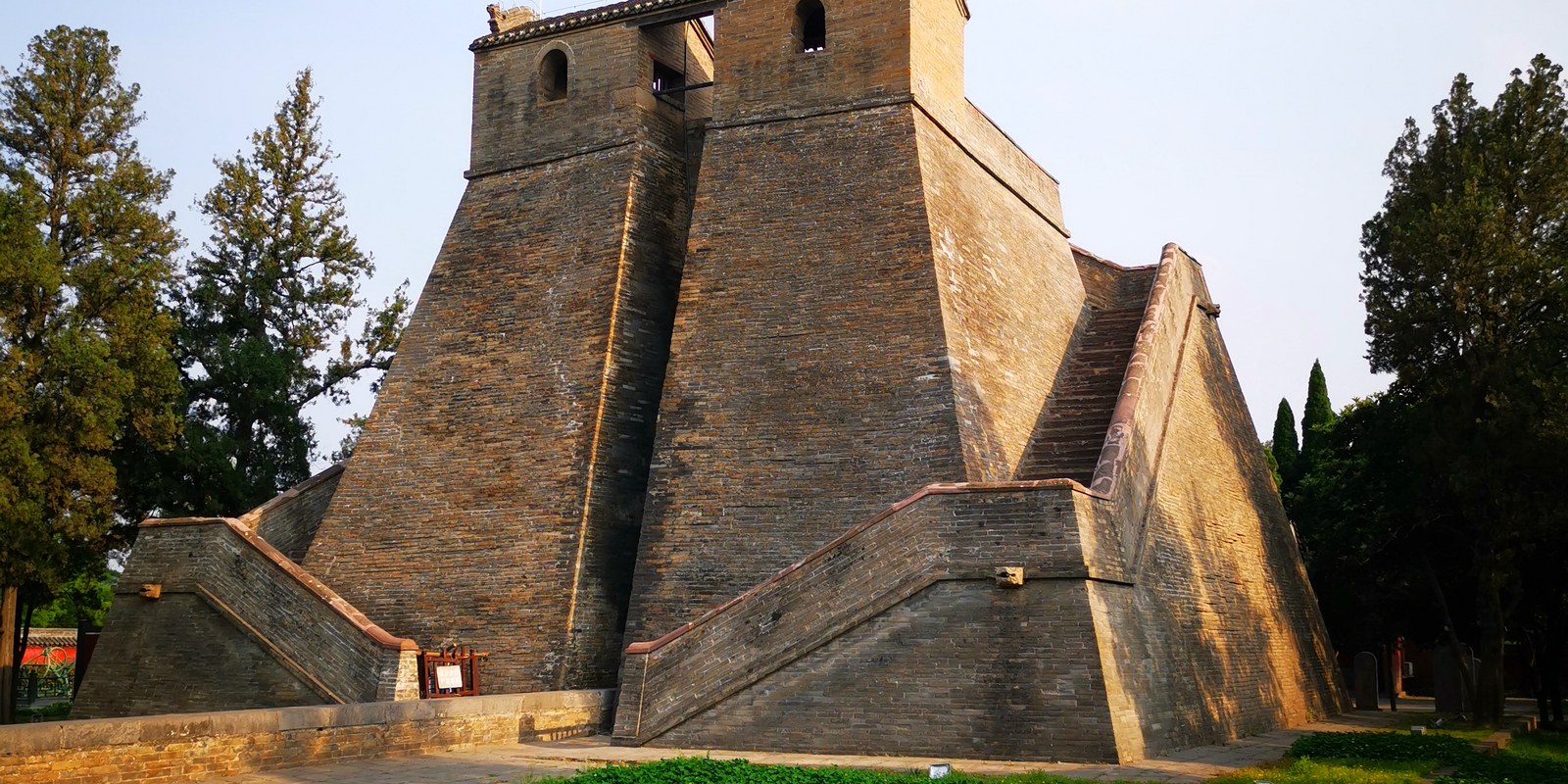
Among the most remarkable structures in the Dengfeng complex is the Duke of Zhou Sundial Platform (周公测景台) and the Dengfeng Star Observation Platform (登封观星台) — the latter built by the Yuan dynasty astronomer Guo Shoujing in 1276 CE. The observatory, constructed of brick and stone, rises to a height of 12.6 meters, with a horizontal stone ruler (known as a “gnomon”) extending 31 meters to the north. By measuring the length of the sun’s shadow at noon throughout the year, Guo Shoujing calculated the length of the solar year with remarkable precision — within 26 seconds of the modern measurement. His calculations were used to establish the most accurate calendar of the medieval world. This fusion of philosophical cosmology with practical astronomy exemplifies the genius of Chinese civilization: the ability to translate cosmic speculation into precise, measurable knowledge.
🙏 Three Teachings, One Sacred Mountain
What makes the Dengfeng monuments unique is the way they embody the coexistence of China’s three great religious and philosophical traditions. The Shaolin Temple (少林寺), perhaps the most famous Buddhist monastery in the world, was founded here in 495 CE and became the birthplace of Chan (Zen) Buddhism and Shaolin martial arts. The Songyang Academy of Classical Learning (嵩阳书院) was one of the four great academies of neo-Confucianism, where the philosopher Cheng Yi taught and the synthesis of Confucian, Buddhist, and Taoist thought that would dominate East Asian philosophy for a millennium was developed. The Zhongyue Temple represents Taoism, with its worship of nature and cosmic harmony. On a single mountain, representatives of all three traditions built their most important institutions, creating a landscape of unprecedented philosophical richness.
🏯 Pagodas That Touch the Sky
The Songyue Temple Pagoda (嵩岳寺塔), built in 523 CE during the Northern Wei dynasty, is the oldest surviving brick pagoda in China, a masterpiece of structural engineering and aesthetic design. Its 12-sided plan — unique among Chinese pagodas — rises 37 meters in 15 tiers, the graceful curve of its silhouette creating a sense of upward movement that seems to defy gravity. Nearby, the Fawang Temple Pagoda (法王寺塔) and the Three Han Que Gates (汉三阙) — ancient stone ceremonial gateways dating from the Han dynasty — represent the earliest surviving examples of Chinese monumental architecture. These structures are not merely old; they are foundational. They stand at the very beginning of the Chinese architectural tradition, embodying principles of form, proportion, and meaning that would influence builders for two millennia.
🪷 The Pagoda Forest: A Cemetery of Monks
Behind the Shaolin Temple lies the Pagoda Forest (塔林), one of China’s most extraordinary funerary landscapes. Over 240 pagodas — small brick and stone towers ranging from simple single-story structures to elaborate multi-tiered monuments — mark the burial places of generations of Shaolin abbots and eminent monks. Dating from the Tang dynasty (618–907) to the present day, the pagodas form a miniature city of the dead, their variety of shapes and decorative styles representing a living history of Chinese Buddhist architecture. The number of tiers in each pagoda reflects the spiritual rank of the deceased monk — higher for those who had achieved greater enlightenment — while the carvings and inscriptions preserve the names, titles, and accomplishments of the men who sustained the Shaolin tradition through the centuries.
🧭 Visiting the Center of Heaven and Earth
The Dengfeng monuments are spread across the city of Dengfeng and the slopes of Mount Song, approximately a 90-minute drive from Zhengzhou, the capital of Henan Province. The Shaolin Temple is the most famous and most visited site, attracting crowds with its martial arts performances and kung fu associations — arriving early in the morning helps avoid the peak crowds. The Songyang Academy, Zhongyue Temple, and Star Observatory are quieter and offer a more contemplative experience. A minimum of two full days is recommended to do justice to all eight monument groups. Spring and autumn provide the most comfortable weather for exploring the mountain and its sacred sites.