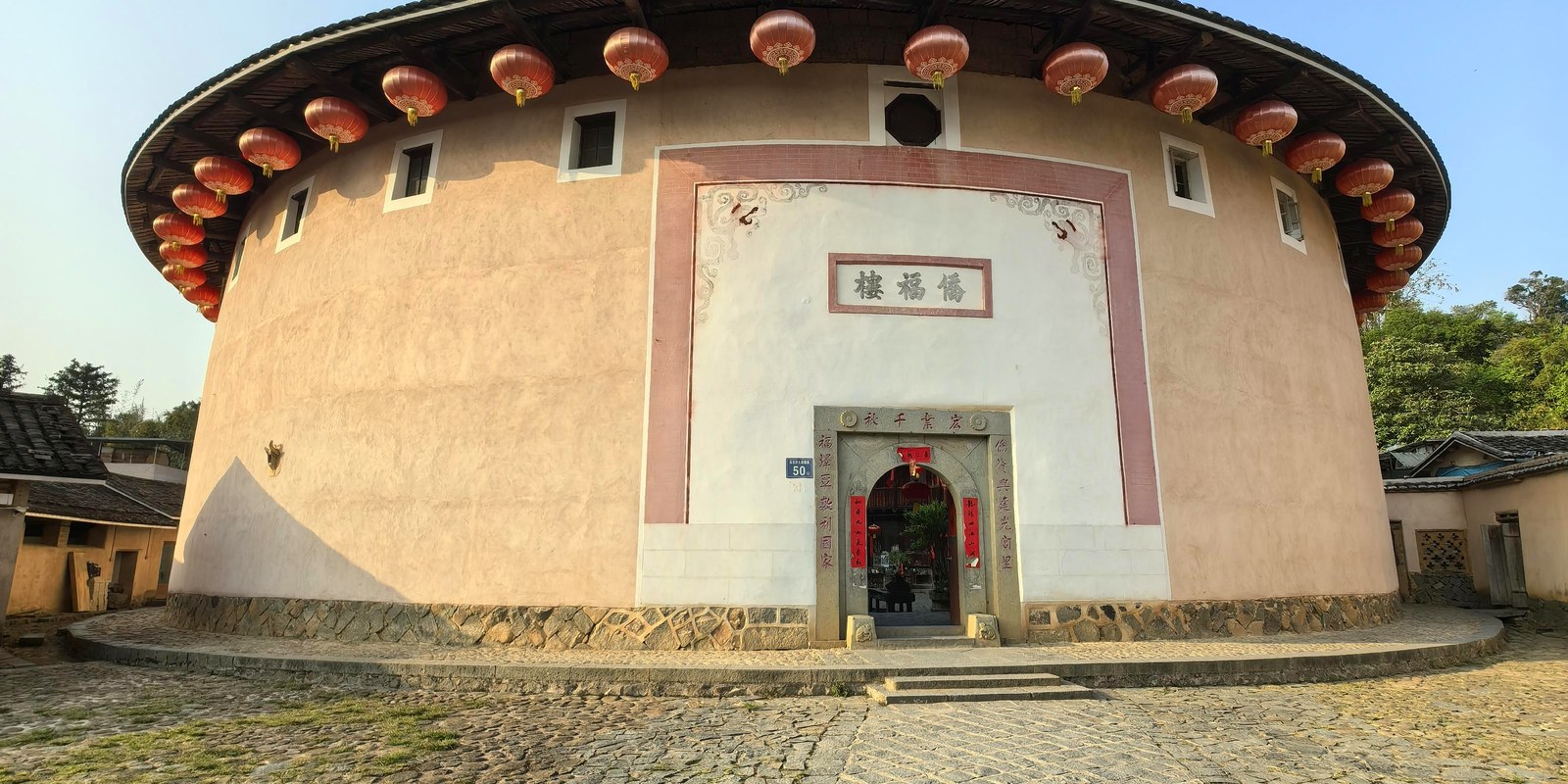
The Fujian Tulou, inscribed as a UNESCO World Heritage site in 2008 across the mountainous interior of Fujian Province (24°32’N, 116°50’E), are among the most extraordinary vernacular buildings ever constructed. These massive earthen fortresses — some housing up to 800 people within a single circular structure — were built by the Hakka and Minnan people of southern Fujian between the 12th and 20th centuries as fortified communal dwellings that combined defensive capability with sophisticated urban planning. From above, they resemble giant mushrooms or ancient flying saucers scattered across the green hills; from within, they reveal themselves as complete self-contained worlds, where generations of extended families lived, worked, worshiped, and defended themselves against bandits and wild animals.
🛸 The Discovery That Shocked the Cold War
One of the most remarkable episodes in the Fujian Tulou story belongs to the Cold War. In the 1960s, American spy satellites passing over the remote mountains of western Fujian detected strange circular structures that appeared to be gigantic missile silos or underground nuclear facilities. CIA analysts scrutinized the images, unable to identify their purpose, and for years, the region was marked as a potential military installation. It was only when American diplomats and journalists were finally allowed to visit the area in the 1980s, following the normalization of US-China relations, that the truth emerged: the “missile silos” were simply ancient Hakka communal houses — earthen buildings that had stood for centuries, harboring nothing more dangerous than families of rice farmers and their livestock.
🏺 The Art of Rammed Earth
The construction technique that made the tulou possible — rammed earth (夯土) — is deceptively simple in concept but extraordinarily refined in execution. A mixture of local clay, sand, lime, and gravel was moistened and poured into wooden forms, then pounded down layer by layer with heavy rams until the wall was compact, dense, and rock-hard. The resulting walls — often more than two meters thick at the base — are naturally earthquake-resistant (many tulou have survived major quakes undamaged), fire-resistant, and capable of regulating interior temperature. Some of the finest tulou incorporate sticky rice water and brown sugar into the earth mixture, a traditional additive that dramatically increases the wall’s strength and durability. After the walls were complete, the exterior was coated in lime plaster, giving the buildings their characteristic pale golden color.
🔄 The Architecture of Communal Life
A typical circular tulou is a study in spatial hierarchy and social organization. The outer ring, three to five stories high, contains the family living quarters, arranged in concentric rings with the innermost structure reserved for the ancestral hall. The ground floor is given over to kitchens, dining rooms, and storage, while the upper floors house bedrooms — the higher the floor, the more storage space (and the lower the ceiling height). The ancestral hall at the center of the tulou is the spiritual and social heart of the community, where weddings, funerals, ancestor worship, and festive celebrations take place. The circular form, according to feng shui principles, promotes harmony and wards off evil spirits. Every element of the tulou’s design — from the single main gate to the narrow windows on the exterior to the open courtyard at the center — is optimized for the dual purposes of defense and community living.
👑 The King and Prince of Tulou
Among the 46 tulou inscribed as World Heritage sites, two stand above the rest. The Chengqi Lou (承启楼) in Yongding County is the largest and most famous — the “King of Tulou,” a four-ringed circular structure that rises four stories high and once housed over 600 people from the Jiang family. Its outer ring measures 73 meters in diameter, enclosing an area of 5,376 square meters. The Zhencheng Lou (振成楼), just down the road, is known as the “Prince of Tulou” and is celebrated for its elegant blend of traditional Chinese architectural elements with Western Art Nouveau influences introduced by its owner, who had studied abroad in the early 20th century. The Zhencheng Lou’s interior features a strikingly modern stage and reception hall, complete with imported glass windows and elaborate wood carvings that tell stories from Chinese opera.
🌿 The Landscape of Round and Square
While circular tulou are the most famous, the UNESCO listing also includes square, rectangular, and even oval-shaped tulous. The “Four Dishes One Soup” (四菜一汤) configuration at the Tianluokeng Tulou cluster in Nanjing County — three circular and one square tulou surrounding a central structure — is one of the most photographed sites in Fujian. Perched on a hillside, the five buildings form a striking composition that seems to grow organically from the landscape. The surrounding terraced rice paddies, tea gardens, and bamboo groves complete a picture of rural life that has remained remarkably unchanged for centuries. The relationship between the tulou and their environment is intimate and symbiotic — the buildings are not imposed on the landscape but emerge from it, using local materials and responding to local conditions.
🧭 Visiting the Earthen Fortresses
The three main clusters of Fujian Tulou are located in different parts of western Fujian: Yongding (the largest and most famous cluster, easily accessible from Xiamen via highway), Nanjing (home to the spectacular Tianluokeng cluster and the unique Hekeng complex), and Hua’an (the most remote and least visited, offering a more authentic experience). The best time to visit is from September to November or March to May, when the weather is mild and the rice terraces are either golden with harvest or freshly flooded with spring water. A minimum of two to three days is recommended to visit the major clusters. Many tulou still serve as homes, and visitors can stay overnight in some of the buildings — sleeping in a 500-year-old earth fortress under a sky full of stars is an experience that no hotel can replicate.