The Archaeological Ruins of Liangzhu City, located in Yuhang District, Hangzhou, Zhejiang Province, is widely recognized as the physical testimony of China’s 5,000-year civilization.As a crucial archaeological discovery of the 20th century, this Neolithic site has transformed our understanding of early Chinese state formation and was inscribed on the UNESCO World Heritage List on July 6, 2019, becoming China‘s 55th World Heritage site.According to UNESCO, the property testifies to the existence of a regional state with a unified belief system, supported economically by rice-cultivating agriculture in late Neolithic China over 5,000 years ago.
📜 An Ancient Civilization Rediscovered
Liangzhu culture dates back approximately 5,300 to 4,300 years (3300–2300 BCE), flourishing in the Yangtze River Delta region.The site consists of a sprawling complex of archaeological remains located in a river‑crossed plain in the eastern foothills of the Tianmu Mountains.
The Liangzhu ruins were first brought to light in 1936 by Shi Xingeng, a 24-year-old researcher with the West Lake Museum in Hangzhou.Carrying out extensive surveys and excavations on the outskirts of Hangzhou, Shi and local farmers discovered pieces of light black pottery and stone artifacts, revealing an ancient civilization for the first time.Over the following decades, understanding of the site grew from being merely a complex of tombs to a comprehensive large‑scale heritage site.
In 2007, Chinese archaeologists achieved a major breakthrough: the discovery of an ancient city dating back about 5,000 years. Renowned archaeologist Zhang Zhongpei, former curator of the Forbidden City Museum, declared: “Liangzhu‘s ancient city is one of its kind in China. It can be rightfully called the first and the foremost city of China.”
🏛️ A Four‑Tier Structure: Palace, Inner City, Outer City, and Water Conservancy System
Liangzhu Ancient City is a capital site featuring a four‑tier structure: palace area, inner city, outer city, and an extensive water conservancy system on the periphery.
The palace area covers 39 hectares. The inner city (including the palace area) encompasses approximately 280 hectares, while the outer city extends over about 351 hectares.The spatial layout of Liangzhu City Site exhibits a concentric triple structure – a typical urban planning technique used in ancient China to construct social hierarchy and highlight the symbolic meaning of power centers.
The outer city comprises scattered settlements and craft production zones, forming a protective and functional belt around the inner city. Together, these three concentric layers reveal a highly organized and stratified society with advanced urban planning capabilities for its time.
💧 China‘s Earliest Large‑Scale Water Conservancy System
One of the most remarkable aspects of Liangzhu is its water conservancy system, located to the northwest of the ancient city.Discovered and confirmed in 2015, this is the earliest known large‑scale water conservancy system in China, pushing the beginning of Chinese water management history back to approximately 5,000 years ago – the Liangzhu civilization period.The system covers more than 100 square kilometers and consists of 11 artificial dams, including valley‑mouth high dams, plain low dams, and a piedmont causeway, along with natural hills and spillways.
The entire water system is estimated to have formed a reservoir covering approximately 13 square kilometers, with a storage capacity of over 46 million cubic meters – the earliest dam system ever discovered in the world.The structure is robust and served complex functions: water storage, flood control, and irrigation for farmland.In recent years, using technologies such as remote sensing, geographic information systems (GIS), and artificial intelligence, archaeologists have discovered more than 20 additional dams, essentially revealing the complete structure of the Liangzhu water system.
The construction techniques, including well‑preserved “bundled grass and clay blocks (cao guo ni)” visible in the dam sections on display at the Tiger Mountain site, provide irrefutable evidence of sophisticated engineering knowledge possessed by the Liangzhu people over 5,000 years ago.
International scholars have noted the unique character of this discovery: in the world‘s major ancient civilizations, such as ancient Egypt and Mesopotamia, water systems were typically built in arid areas, making this discovery in the humid Yangtze River region particularly unusual and significant.
在国际遗产界,曾有国外考古学家如此评价:“在世界古文明中,古城不是唯一的,但良渚的水利系统是唯一的!”
💎 The Jade Culture: A Society Unified by Ritual
Liangzhu is renowned as the highest peak of prehistoric jade culture in China.Liangzhu‘s jade artifacts are not only abundant in variety and exquisite in craftsmanship but are also intricately carved with detailed patterns.
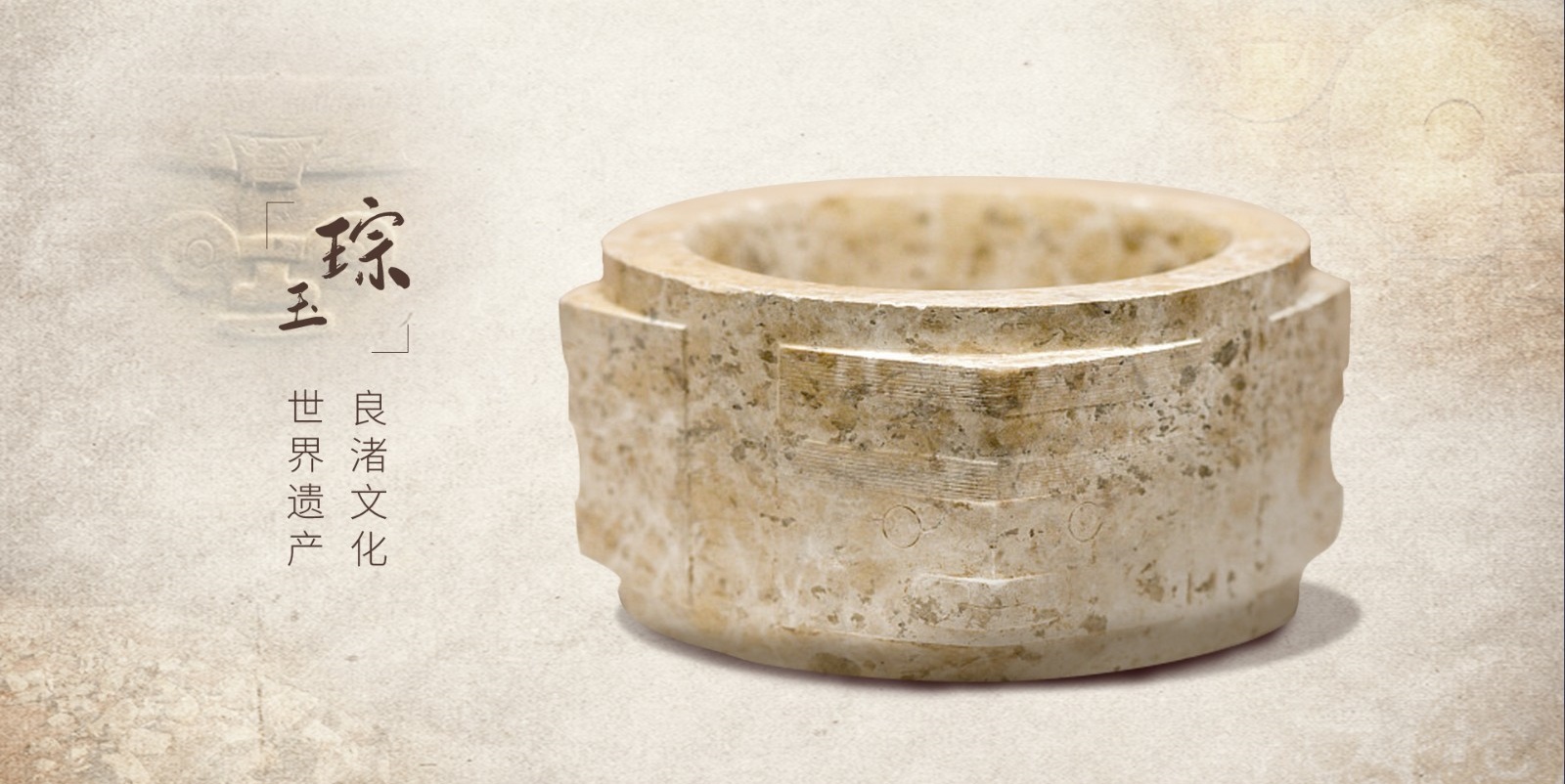
The jade assemblage includes a complete ritual system represented by Cong, Bi, and Yue – cylindrical tubes (Cong), flat disks (Bi), and ceremonial axes (Yue).Many jade pieces feature the “Divine Emblem” – the iconic “divine man and beast face” pattern – which is the basic decorative motif on Liangzhu jade Cong.Rulers and elites of the Liangzhu state used this system of emblematic jade ritual implements, along with the underlying ceremonial system, to assert control over divine power, thereby monopolizing royal authority, military power, and economic wealth.
The Fanshan Cemetery offers a striking glimpse into Liangzhu‘s hierarchical society. Excavations here yielded over 1,200 precious artifacts, including jade, stoneware, pottery, ivory, and lacquerware inlaid with jade, with jade alone accounting for over 90 percent of the total.Among the most representative artifacts is the “King of Jade Cong” , a piece of such exceptional quality that its engraved patterns only become fully visible under magnification.
值得注意的是,在金属工具极度匮乏的新石器时代,良渚工匠凭借原始的工具雕琢出如此精美绝伦的玉器,其工艺成就令人惊叹,也充分展现了良渚社会复杂精密的组织结构。
The jade burial system, combined with factors such as tomb location, construction scale, burial arrangements, and the quantity and combinations of grave goods, together demonstrates the distinct and rigid class structure that existed across the Liangzhu society.
🪦 Social Hierarchy and Class Structure
The city site and its surrounding areas contain several cemeteries of different ranks. Five well‑preserved and representative cemeteries have been identified: Yaoshan, located approximately 5 km northeast of the city site, and Fanshan, Jiangjiashan, Wenjiashan, and Bianjiashan within the city site itself.
Yaoshan is a particularly significant discovery. The Yaoshan altar, dating to about 5,300 years ago – even earlier than the city site itself – is a ceremonial platform with 13 tombs on top. This is the first “altar‑and‑tomb‑in‑one” complex discovered in the Liangzhu culture. The Yaoshan discoveries reflect the unified belief system of a “divine‑kingdom” and highlight a society where spiritual authority was paramount.
These cemeteries, combined with the wealth of jade artifacts discovered, reveal a society with clear class divisions, an organized hierarchy, and the emergence of a ruling elite, all of which are key characteristics of an early state.
国际权威考古学家、剑桥大学教授科林·伦福儒(Colin Renfrew)在参观完良渚博物院和古城遗址后曾表示:“中国新石器时代是被远远低估的时代。”他认为良渚遗址出土的玉琮、玉璧带有明显的象征意义,反映了当时社会的复杂程度和阶级制度,已经达到了‘国家‘的标准,是中国文明的起源。
🌾 An Economy Supported by Rice Agriculture
The Liangzhu civilization thrived on an advanced rice‑cultivating agriculture that sustained its population and enabled the rise of a complex society.The water conservancy system not only provided flood control but also supported large-scale irrigation for rice farming, creating a stable economic foundation.This agricultural surplus would have allowed for the specialization of labor, including the development of skilled jade artisans and the mobilization of large workforces for monumental construction projects.
🌏 Global Recognition as a World Heritage Site
The inscription of Liangzhu Ancient City on the UNESCO World Heritage List in 2019 marked a watershed moment in the global recognition of Chinese civilization. As Liu Yuzhu, head of China’s National Cultural Heritage Administration, stated at the UNESCO session: “The Archaeological Ruins of Liangzhu City are both a major archaeological discovery of China in the 20th century and a key cultural site that bears testimony to the over 5,000-year-long Chinese civilization.”
Shen Yang, China’s ambassador and permanent delegate to UNESCO, said: “We are proud that after 25 years of preparation, our efforts have finally led to the successful inscription of this exceptionally important property, which is the most concrete testimony of 5,000 years of Chinese civilization.”
The World Heritage Committee concluded that Liangzhu Ancient City:
-
Represents an early urban civilization with complex functions and structures
-
Testifies to the existence of a regional state with a unified belief system supported by rice‑cultivating agriculture in late Neolithic China
-
Fills a gap in the UNESCO World Heritage List concerning Neolithic city archaeological sites in East Asia
良渚古城遗址申遗成功,标志着中华五千多年文明史得到了国际社会的一致认可,丰富了世界文明起源的内涵和标准。良渚古城遗址也因此被誉为“实证中华五千年文明史的圣地”。
🏛️ Liangzhu National Archaeological Site Park
Today, visitors can explore the Liangzhu National Archaeological Site Park, located in the core zone of the Liangzhu Site Protection Area. The park was named one of the first National Archaeological Site Parks in China (one of 12 nationwide) by the National Cultural Heritage Administration in 2010.
The park is a vivid and tangible representation of the profound history and culture of the Liangzhu Ancient City, offering an experience that is both educational and immersive. It provides a space where visitors can appreciate the ingenuity and achievements of a civilization that flourished five millennia ago, while the Archaeological Ruins of Liangzhu City continues to be recognized as a world-class cultural heritage site of universal significance to humanity.
The Liangzhu Ruins Protection Zone includes both the Liangzhu site and the Liyushan–Tiger Mountain Dam site (the water conservancy system).Today, the entire site is protected by a sophisticated system. Over 500 surveillance cameras and 241 monitoring devices are integrated into the “Liangzhu Site 5000+ Digital Intelligence Platform,” providing 24/7 monitoring.
📌 Visiting Information
The Liangzhu National Archaeological Site Park is located in Yuhang District, Hangzhou, approximately 30 minutes by car from Hangzhou city center. The park is well-connected by public transportation, including metro lines and bus routes. The Liangzhu Museum, located near the park, houses an extensive collection of Liangzhu jade artifacts and provides comprehensive background information on the site.
For the most up‑to‑date opening hours and admission policies, visitors are advised to check the official website of the Liangzhu National Archaeological Site Park (lzsite.cn) before planning their visit.
💎 Summary
The Archaeological Ruins of Liangzhu City stand as one of the most remarkable archaeological discoveries of the 20th century, providing irrefutable evidence of China’s 5,000-year civilization. Its monumental urban planning, sophisticated water management system, exquisite jade craftsmanship, and clearly defined social hierarchy collectively demonstrate an advanced early state that flourished in the Yangtze River Delta over five millennia ago.
Inscribed as a UNESCO World Heritage Site in 2019, Liangzhu not only rewrites our understanding of early Chinese history but also enriches the global narrative of human civilization. As an outstanding example of early urban civilization, Liangzhu continues to inspire and inform our appreciation of humanity‘s shared cultural heritage.